
1-805-484-2992
Quotes - Engineering - SalesTwo-Pass U-Tube Heat Exchangers
Even Passes, and Why It Matters
A U-tube bundle is a two-pass exchanger by geometry, not by choice. Fluid enters one leg and leaves the other. Everything else about pass arrangement follows from that, including the one limitation the design cannot escape.
Because each tube doubles back, the tube-side fluid always makes at least two passes. Four, six and eight pass arrangements are built by adding partition plates to the channel so the fluid crosses the bundle multiple times before leaving. What never happens is an odd number of passes.
Why add passes at all? To raise tube-side velocity. Higher velocity means a better heat transfer coefficient and less fouling deposition, and it is the standard remedy when the tube-side flow is too low to be turbulent in a single pass. The cost is pressure drop, which climbs steeply with pass count.
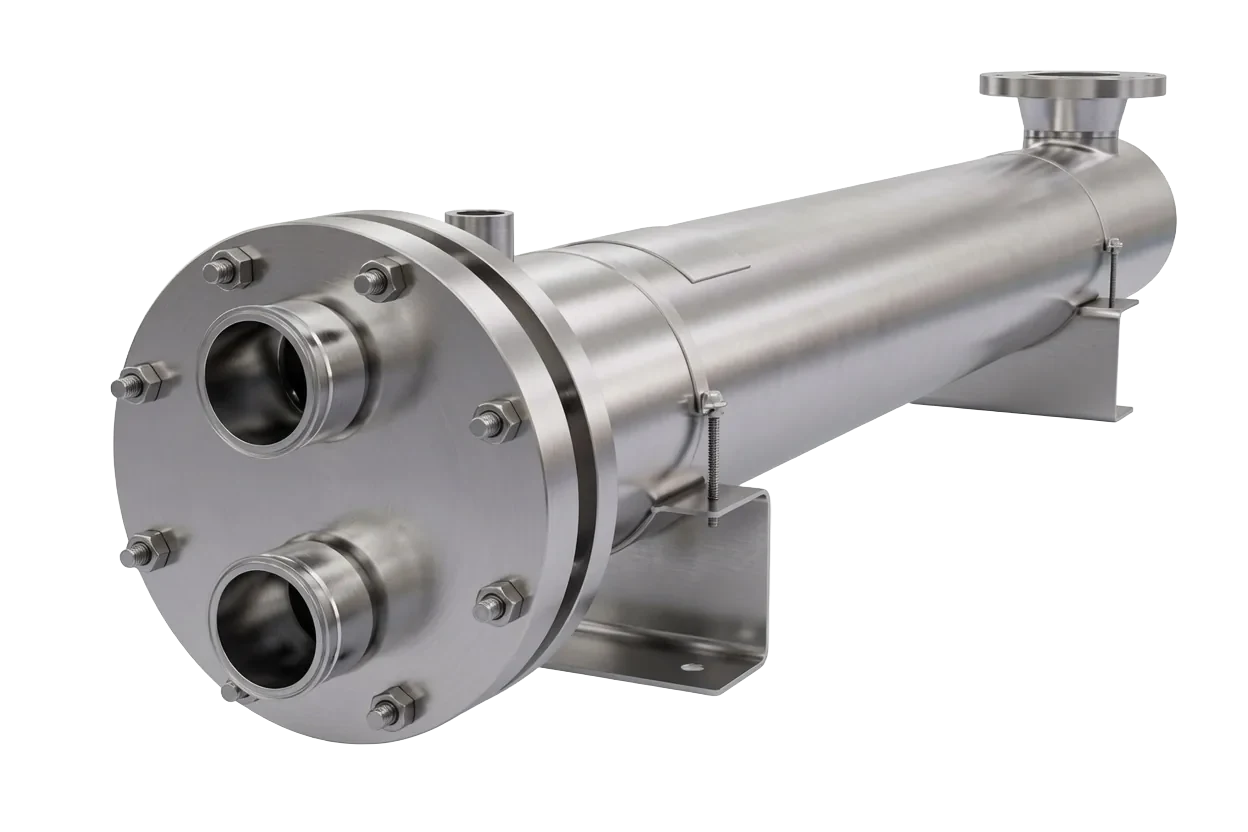
| PRODUCT | STYLE | TEMA TYPE | BUNDLE |
| U-Tube Heat Exchanger | U-Tube, single tubesheet | BEU / AEU / BKU | Removable |
Typical Construction
- Minimum passes: Two, set by the U-bend geometry
- Typical arrangements: Two, four, six or eight passes
- Odd passes: Not possible in U-tube construction
- Pass partitions: Plates in the channel or bonnet
- Velocity target: Selected for turbulence, fouling and erosion limits
- Pressure drop: Rises steeply with pass count
- Temperature cross: Requires F-shell, shells in series, or a different rear head
- Correction factor: LMTD F factor checked at rating; low F flags a poor configuration
- Gasket detail: Pass partition gasket rib required in the channel
- Nozzle arrangement: Inlet and outlet on the same head
Two-Pass U-Tube Heat Exchangers
The temperature cross problem. A two-pass tube side cannot achieve true countercurrent flow, because half the tube length runs one way and half the other. When the required duty produces a temperature cross — the cold stream leaving hotter than the hot stream leaves — a single two-pass exchanger cannot do it regardless of surface area.
The remedies. An F-shell with a longitudinal baffle creates two shell passes and restores counterflow. Two shells in series does the same thing with more hardware. Or the rear head changes to a fixed tubesheet or floating head design that permits a single tube pass. We would rather raise this at rating than let a correction factor quietly ruin the design.
Reading the LMTD Correction Factor
Every multi-pass exchanger rating carries a correction factor applied to the log mean temperature difference. It accounts for the fact that flow is not purely countercurrent. When that factor drops much below about 0.8, the configuration is fighting the duty, and small changes in operating temperature produce large changes in performance.
A low correction factor is not something to solve by adding surface area. It is a signal that the configuration is wrong for the temperature profile, and the right response is an F-shell, shells in series, or a different design entirely.
Both Nozzles on One End
A practical consequence of U-tube construction that is easy to overlook during layout: the tube-side inlet and outlet are both on the same head, because the fluid comes back to where it started. That simplifies some pipe runs and complicates others.
It also means the tube-side connections sit at the end you need clear to withdraw the bundle. Plan the piping so those connections can be broken without dismantling half the skid, or the maintenance advantage of a removable bundle becomes theoretical.
Passes and Temperature Profiles
Compare the outlet temperatures: if the cold stream leaves warmer than the hot stream leaves, a two-pass U-tube cannot do the duty no matter how much surface it carries. The sign is on the rating sheet, where the LMTD correction factor falls below 0.8 and the required surface climbs steeply as the cross deepens. In the plant it shows as a unit that meets its outlet temperture at low flow and loses it as flow rises, which is often misread as fouling. Send all four terminal temperatures and the configuration is chosen before a shell is ever drawn.
No; extra passes raise tube-side velocity and the coefficient, but pressure drop rises roughly with the cube of the pass count at fixed flow, so going from two to four passes multiplies the loss about eight times. Whether that is worth it depends on where the resistance lies: if the shell-side film or a fouling layer controls, a faster tube side buys almost nothing and the pump that was sized for the two-pass unit is the casualty. Ask which side controls before adding a pass; the rating sheet lists the individual resistances and makes the answer obvious.
Sometimes, because the pass count lives in the bonnet partition plates and the tubesheet gasket ribs rather than in the tubes, so a new bonnet and gasket can convert a unit without touching the bundle. The tube layout must have been drilled with a lane for the extra partition, and on a stock unit it usually was not, so the conversion is more often made with a replacement bundle. A four-pass bonnet can also move the inlet and outlet side by side, and the piping must follow.
Related
U-TUBE • CONSTRUCTION
Stock Steam-to-Liquid
Two-pass 304L and 316L units, code stamped.
+ Learn More
U-TUBE • CONSTRUCTION
Custom U-Tube Exchangers
Rated to your conditions, inspected as specified.
+ Learn More