
1-805-484-2992
Quotes - Engineering - SalesHot Water & Glycol U-Tube Heat Exchangers
Closed Loop Heating and Freeze Protection
Liquid to liquid, closed loop, modest temperature difference. The thermal problem is undemanding until glycol enters it, at which point viscosity changes the arithmetic on both heat transfer and pumping power.
Hot water and glycol loops do three jobs: they isolate a process from a primary heat source, they carry freeze protection into equipment exposed to ambient, and they distribute heat around a plant from one central source rather than piping steam everywhere.
Glycol is not water with antifreeze in it. It is more viscous, less thermally conductive, and has a lower specific heat. All three work against you at once: the film coefficient falls, the pressure drop rises, and you need more mass flow to move the same heat. A loop converted from water to glycol without resizing the exchanger will not make its duty, and the shortfall is usually larger than people expect.
Size for the cold condition, not the operating point. Glycol viscosity climbs steeply as temperature falls. A loop that is comfortably turbulent at operating temperature can be laminar at startup on a cold morning, and once flow goes laminar the coefficient collapses and warm-up takes far longer than the calculation predicted. Check the design at the coldest realistic starting condition.
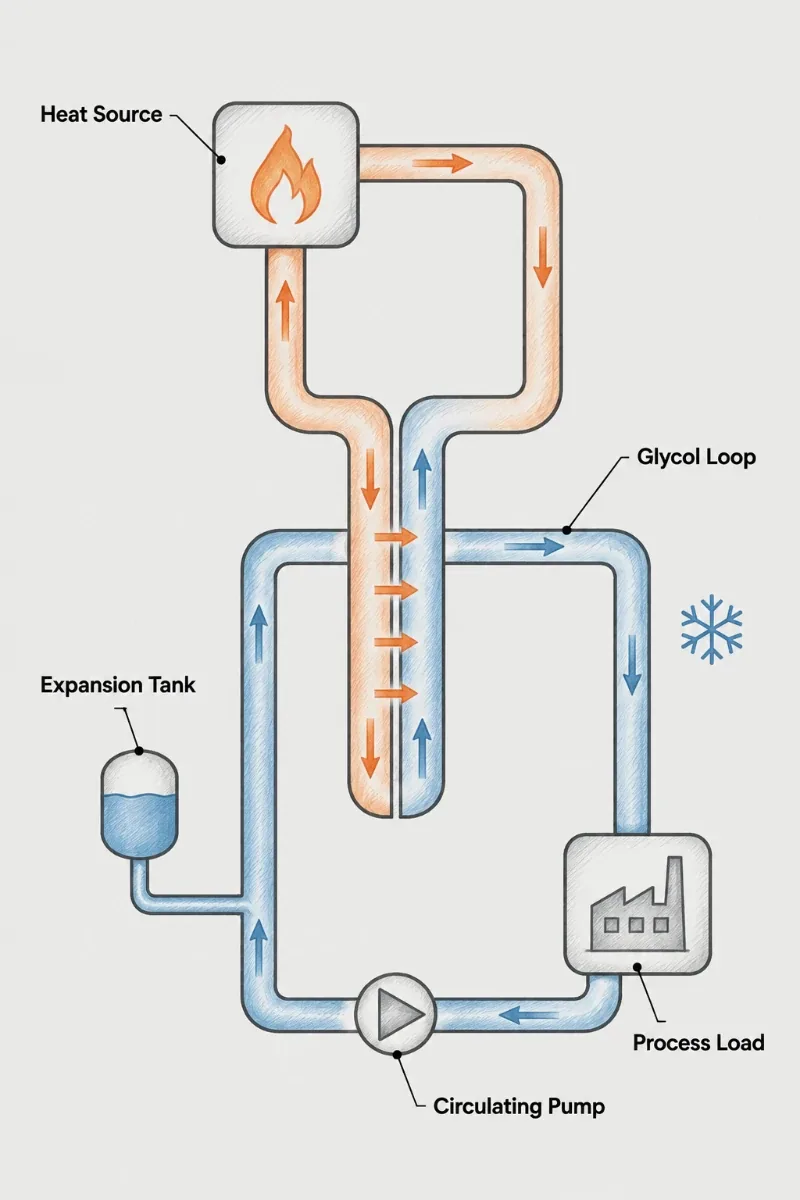
A closed loop isolates the process from the primary heat source and carries freeze protection. Concentration should be the minimum the protection temperature requires.
Request a QuoteHot Water & Glycol Heating




Design Notes
Concentration costs performance. Every percentage point of glycol above what the freeze protection genuinely requires costs heat transfer and pumping power for no benefit. Loops are routinely over-concentrated on the theory that more must be safer. Decide the protection temperature you actually need, set concentration to match it, and monitor it — concentration drifts as make-up water is added.
Propylene or ethylene. Propylene glycol wherever any possibility of food or potable contact exists, because it is far less toxic. Ethylene otherwise, since it performs better thermally and is less viscous at equal concentration. Many plants standardize on propylene simply to remove the question from the risk assessment.
Water quality decides exchanger life. A properly treated, genuinely closed loop should stay clean for years. Persistent fouling in a closed system is almost always oxygen ingress and an exhausted inhibitor package rather than an exchanger problem, and corrosion products from that ingress are what foul the surface.
Related pages: process cooling, thermal fluid heating, tube passes and velocity and 304L and 316L construction.
Glycol Loop Answers
More than the specific heat alone suggests. Using 500 x GPM x dT for water, a 1,000,000 BTU/hr load at a 20 F range needs 100 GPM. A glycol mix has a lower specific heat that its higher density only partly offsets, so the 500 constant drops and the flow rises to carry the same heat, and the pump sees a thicker fluid on top of that. Size the pump and the exchanger together against the supplier's property table for your concentration at the coldest start, not at the operating point.
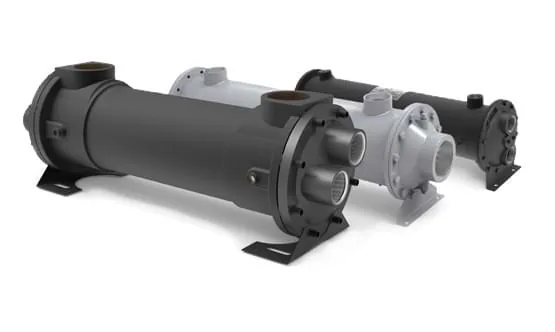
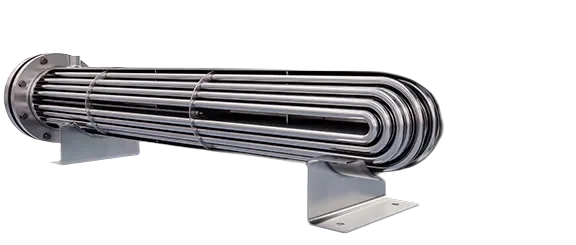
Usually, provided the duty is rated with glycol properties rather than water. The stock two-pass U-tube units are rated on water, so a glycol loop at the same GPM and temperature range comes out needing either a larger size or a wider approach. Send concentration, glycol type, flow and both loop temperatures and the stock unit is rated against them; one size up from stock usually closes the gap. Where the primary side is steam, the same stock units apply with steam in the tubes and glycol on the shell.
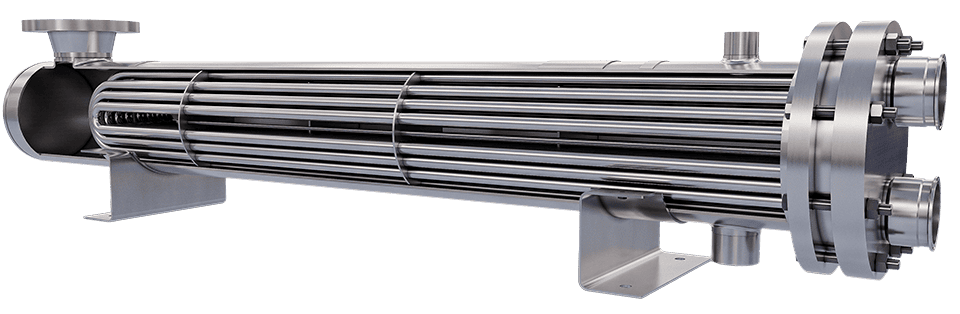
Yes, when both fluids are liquid, because tube-side velocity is set directly by pass count and the glycol stays turbulent. A viscous fluid on the shell side slips into laminar flow behind the baffles and the coefficient collapses. The exception is a steam primary, where the steam condenses in the tubes and the glycol takes the shell. Both sides of a closed loop are clean, so cleanability does not decide it. Pressure drop usually does: going from two passes to four raises the pumping penalty far faster than it raises the coefficient.
Not while the inhibitor package is maintained. Uninhibited or degraded glycol oxidizes into organic acids that attack carbon steel, copper and brazed joints, and the breakdown accelerates at high surface temperature. Keep film temperature down by avoiding high-pressure steam on the primary side, and check pH and reserve alkalinity on a schedule. Stainless tubes resist the acids, but the real fix is fluid maintenence; a stainless bundle in a sour loop still fouls with corrosion products from the carbon steel piping around it.
Decide whether the loop needs freeze protection or only burst protection. Freeze protection keeps the fluid pumpable at the design low; burst protection accepts slush but prevents pipe rupture, and it needs a much lower concentration. Most plant loops need only burst protection on the exposed sections, which lets the concentration drop and the exchanger recover performance. Check with a refractometer after every make-up addition.