
1-805-484-2992
Quotes - Engineering - SalesSanitary Process Applications
Velocities high enough to sweep every surface, complete drainage in the installed orientation, no crevices or dead legs, an alloy that tolerates the cleaning chemistry at temperature, and enough access to verify it all. Thermal duty is the easy part.
3-A for dairy and much food contact equipment; ASME BPE for pharmaceutical and bioprocess work. They are not interchangeable and specifying both means satisfying both. Your quality group rather than your engineering group should make that call.
Yes, routinely. The questions that come up are the bend interior, which cannot be electropolished or inspected, and drainability, which depends on shell slope and nozzle placement. Both are resolved at design stage by deciding which side the product runs on.
It is the fatigue case on most sanitary units. Steam-in-place at elevated temperature, repeated for years, would fatigue an expansion joint. A U-bundle expands freely and has none, which is a large part of why the geometry dominates hygienic service.
Specifying a surface finish that cannot be achieved on every surface it is applied to, most often an electropolished requirement on the inside of U-bends. It gets discovered during qualification, which is the most expensive possible moment.
Sanitary duty asks the exchanger to do two jobs at once: hit the thermal target, and be demonstrably cleanable afterward. The second one is where most of the engineering time goes.
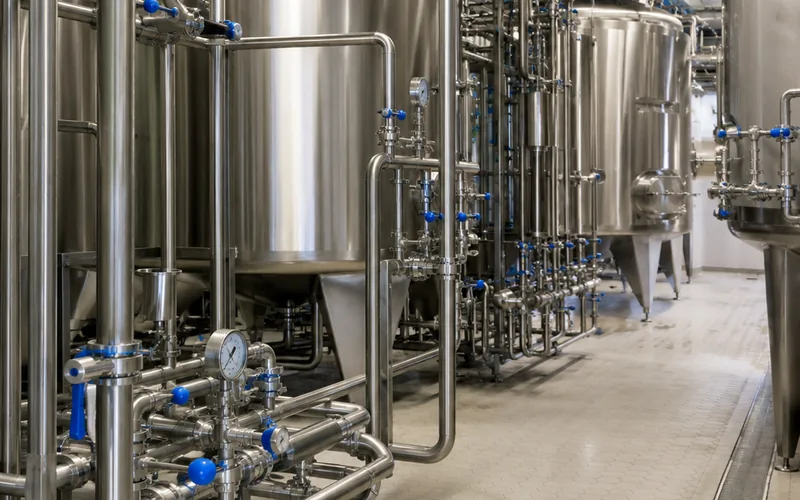
These pages describe the job rather than the hardware. CIP circuits heating caustic and acid to setpoint, pasteurizers holding a temperature that regulation defines, clean steam systems where condensate purity is part of the specification, and product cooling where drainability between runs matters as much as approach temperature.


What Decides the Design
The cleaning regime first, because it sets velocities, slope, drain locations and the alloy that has to survive the chemistry. Then the thermal duty and its turndown. Then the documentation: 3-A, ASME BPE or neither, decided by who audits the plant rather than by the physics of the duty.
Why U-Tube Suits Sanitary Duty
The bundle withdraws in one piece for inspection and manual cleaning, which turns a cleaning claim into something verifiable. The single tubesheet makes a double tubesheet straightforward where cross-contamination cannot be tolerated. And the free thermal expansion handles repeated SIP cycles without an expansion joint to fatigue.
Related
SANITARY PROCESS • APPLICATION
CIP Heating
CIP heat exchangers for clean-in-place circuits. Heating caustic, acid and rinse water to setpoint, ramp rate, chemical compatibility and CIP-able construction.
+ Learn More
SANITARY PROCESS • APPLICATION
Pasteurization & HTST
Pasteurization and HTST U-tube heat exchangers. Regeneration, hold tube relationship, pressure differential rules and where tubular beats plate on particulates.
+ Learn More
SANITARY PROCESS • APPLICATION
Culinary & Clean Steam
Culinary and clean steam U-tube heat exchangers. Generating and condensing clean steam, filtration grade, condensate quality and the U-bundle as the vaporizing element.
+ Learn More