
1-805-484-2992
Quotes - Engineering - SalesU-Tube Heat Exchangers For
Carbon Steel Construction
U-Tube Duty
Carbon steel is the cost benchmark against which every alloy decision is measured. It does not resist corrosion, it tolerates it, and the design accounts for that with a stated allowance.
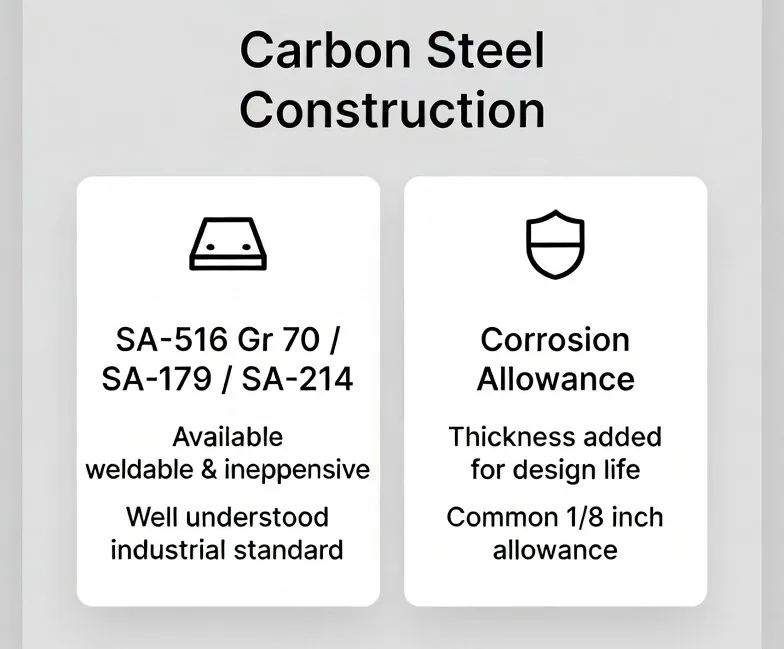
SA-516 Grade 70 plate for shells and tubesheets, with SA-179 or SA-214 tube, covers an enormous amount of industrial heat exchanger work. The material is available, weldable, well understood and inexpensive.
Corrosion allowance. Rather than resisting attack, carbon steel construction adds thickness that is expected to be consumed over the design life. An eighth of an inch is a common allowance; more where the service warrants it.
Mixed Construction Economics. Putting a stainless or high-alloy bundle inside a carbon steel shell is routine, and it puts the expensive material where the aggressive fluid is rather than throughout the exchanger.
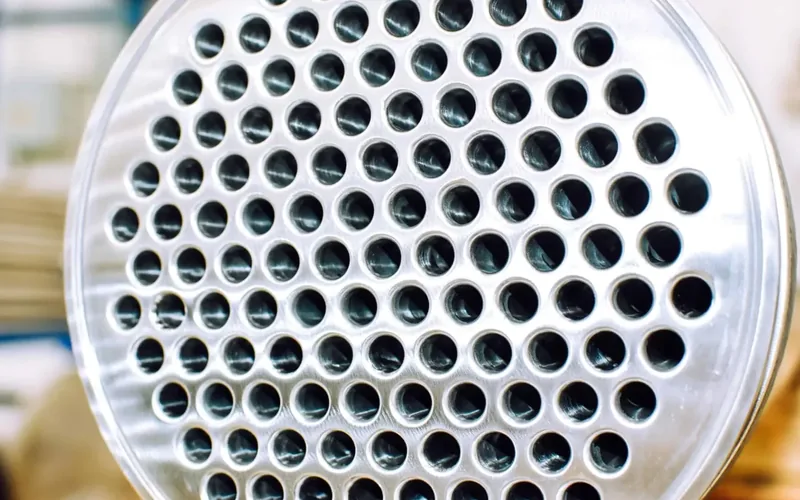
Watch two details. Galvanic pairing where dissimilar metals meet in a wetted joint, and differential thermal expansion between shell and bundle. A U-tube bundle handles the second by design, which is one more reason the geometry suits mixed construction.
Where it does not. Untreated water with oxygen, acids, chlorides, and anything where product contamination by iron matters. Coatings extend the range on the shell side; they are not a substitute for choosing the right material.
Request a Quote



Carbon Steel as the Cost Benchmark
SA-516 Grade 70 plate with SA-179 or SA-214 tube covers an enormous amount of industrial exchanger work. The material does not resist corrosion; it tolerates it, and the design accounts for that with a stated allowance that is expected to be consumed over the design life. A stainless or high-alloy bundle inside a carbon steel shell puts the expensive material only where the aggressive fluid is.
Materials
Corrosion Allowance
Where It Does Not Belong
Related
MATERIALS & FINISHES • DESIGN
304L & 316L Stainless
Where each fits, and the chloride cracking limit.
+ Learn More
MATERIALS & FINISHES • DESIGN
Duplex & High Alloys
2205, Alloy 20, Hastelloy and how each bends.
+ Learn More
MATERIALS & FINISHES • DESIGN
Titanium & Copper-Nickel
Alloys for seawater and brine service.
+ Learn More