
1-805-484-2992
Quotes - Engineering - SalesSanitary U-Tube Heat Exchangers
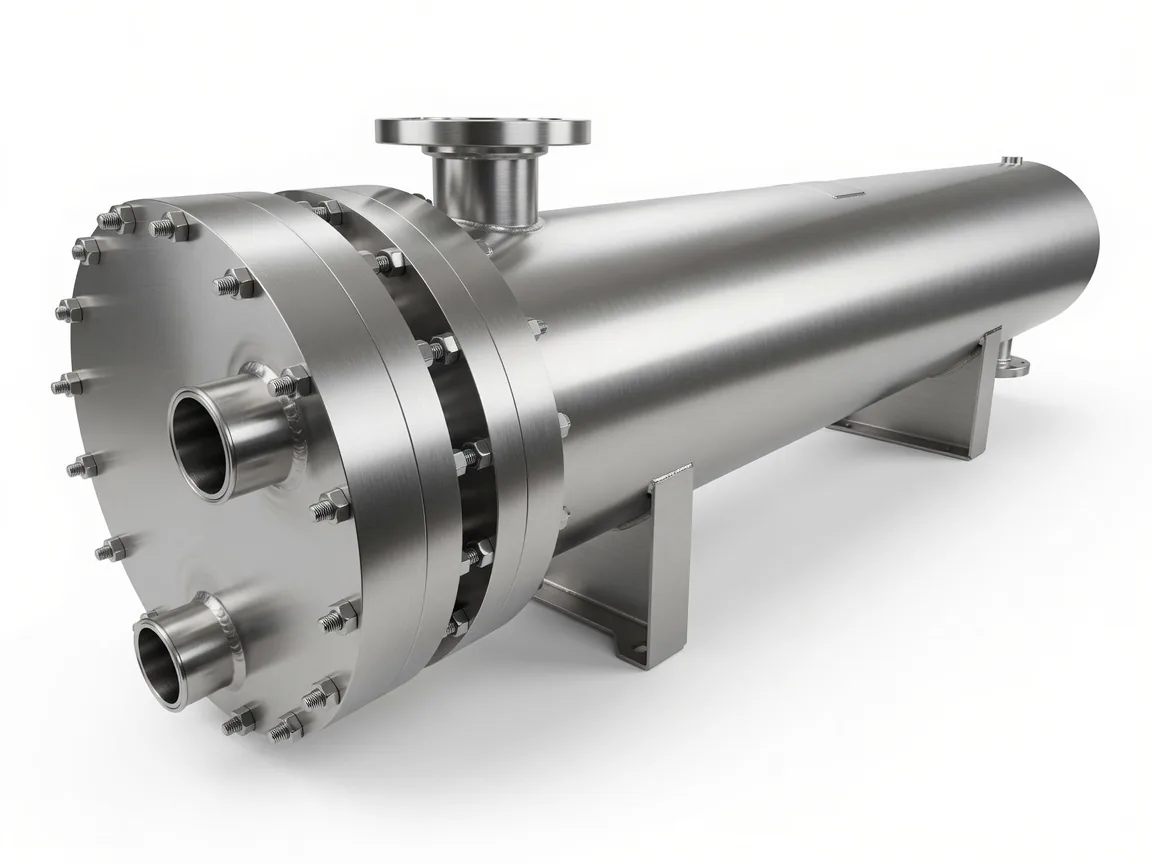
Sanitary duty asks two things of an exchanger at once: hit the thermal number, and survive an audit. A U-tube bundle answers both, because the same removable geometry that absorbs thermal expansion is also the geometry you can pull, inspect and swab.
A sanitary exchanger is not simply an industrial exchanger built in stainless. It is a unit where every product-contact surface is smooth enough to clean, sloped enough to drain, and free of the crevices and dead legs where warm residue sits between production runs. The U-tube bundle helps here more than people expect, because it comes out of the shell in one piece and the shell has no rear head joint to hide a pocket behind.
- 316L wetted parts. Dual-certified plate and tube, mechanically polished to a specified maximum Ra and passivated. Roughness governs both cleanability and how readily a biofilm anchors.
- Sanitary connections. Tri-clamp fittings or extended tube weld ends on the product side rather than threaded or standard flanged joints, with gasket material matched to temperature and cleaning chemistry.
- Drainable by design. Sloped shells, low-point drains and a bundle arrangement that lets condensate and CIP solution leave completely under gravity rather than pooling in a horizontal tube run.
- Removable bundle. The whole assembly withdraws for inspection, riboflavin testing or manual cleaning, which is what turns a cleaning procedure into something you can actually verify.
- Double tubesheet option. A vented interspace between two tubesheets turns a silent cross-contamination failure into a visible drip, on any duty where utility fluid must never reach product.
- Seal-welded tube joints. Full-penetration tube-to-tubesheet welds with no crevice, because a rolled-only joint leaves an annular gap that no cleaning cycle reaches.
- 3-A symbol authorized
- 316L, polished to spec
- Fully drainable design
- Vented interspace
- Visible leak detection
- WFI and product duty
- Electropolish to 15 Ra
- Passivated and certified
- High-purity service
Specifying a Sanitary U-Tube Exchanger
Which Side Should the Product Be On?
This is the first decision and it drives everything after it. Running product through the tubes gives you a smooth, positively drained passage that CIP solution follows exactly, and it keeps the product volume small. The catch is the U-bend: you cannot mechanically clean through it, and on a viscous or particulate-bearing product that matters.
Running product on the shell side gives you a larger flow area, gentler velocities for shear-sensitive fluids, and a surface you can physically reach once the bundle is out. The cost is that shell-side drainage has to be engineered rather than assumed, because a horizontal shell will hold a puddle unless it is sloped to a low-point drain.
For clean utility duty — culinary steam heating a product stream, or chilled water cooling one — the usual answer is utility in the tubes and product in the shell, which also puts the fouling side where you can get at it.



Surface Finish Is a Cleaning Specification, Not a Cosmetic One
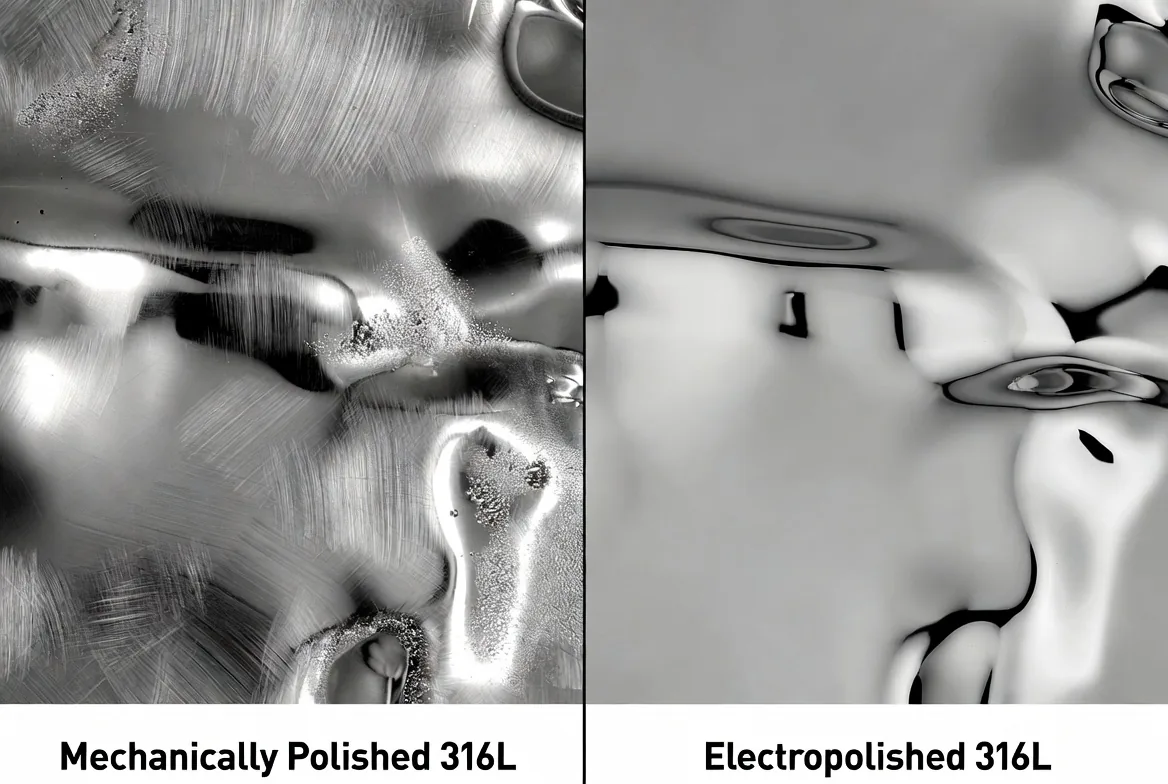
Ra is shorthand for how easily a surface releases soil. A typical sanitary specification runs around 32 Ra on product contact and 40 Ra on exterior surfaces, with electropolishing available where a lower number is required. Below roughly 32 Ra the practical gains come more from consistency than from the number itself.
The important detail is where the finish can actually be achieved. The inside of a tight U-bend cannot be reliably mechanically polished or electropolished, which is a real argument for putting product on the shell side when a low Ra on every product-contact surface is a hard requirement. We would rather raise that at quotation than have it surface during qualification.
Cleaning Regime Drives the Design
Tell us how the unit will be cleaned and the rest of the specification follows. CIP recirculation sets minimum velocities and therefore nozzle and pass arrangement. SIP with clean steam sets the slope, the vent and drain locations and the thermal cycling the bundle will see. Manual strip-down sets the clearance you need around the shell to pull the bundle.
Cleaning chemistry also drives alloy. Hot caustic is straightforward in 316L. Chlorinated sanitizers, brine-bearing streams and some acid cycles are not, and chloride stress-corrosion cracking is the failure mode that catches stainless in food plants. Where the chloride load is real, duplex or a higher alloy is the honest answer.
Sanitary U-Tube Duty
FOOD & DAIRY • 3-A
Pasteurizing & HTST
Regeneration, heating and cooling sections where pressure differential rules keep product above utility at all times.
+ Learn More
CLEANING • CIP
CIP Solution Heating
Bringing caustic, acid and rinse water to setpoint fast, in an exchanger that is itself fully CIP-able.
+ Learn More
UTILITY • CLEAN STEAM
Culinary Steam Duty
Clean and culinary steam generation and condensing, where condensate purity is part of the product specification.
+ Learn MoreSanitary Build Answers
Turbulent flow throughout, which in practice means the velocity your cleaning validation specifies, commonly cited at around 5 feet per second in tubing. The velocity has to hold in every tube, so the pass arrangement and nozzle size are set from the CIP flow as well as the product flow. A two-pass bundle halves the flow area against a single-pass straight tube, which raises velocity for the same pump. Where product flow is low and CIP flow is high, the CIP case sizes the connections.
Yes, and it has to be whenever product runs on the shell side. The shell interior is polished to the specified Ra, the baffles are crevice-free at the shell wall and tube holes, nozzles sit flush with no projection, and the shell slopes to a low-point drain. The tubesheet gasket face on the shell side becomes a product-contact joint. Utility on the shell side needs none of that, so declaring which side the product runs on is what sets the price difference between the two builds.
Usually, but less and simpler than an industrial bundle. Each baffle is a place where product can sit against a crevice at the shell wall and the tube hole, so sanitary shells use the minimum baffle count the velocity needs, with tube holes and shell clearances held tight and baffle edges polished. Where product runs on the shell side, rod-type supports in place of plate baffles cut the crevice length. Utility on the shell side allows ordinary segmental baffles.
It will if the bundle sits horizontal with the bends below the tubesheet and nothing drives the condensate out. The fix is orientation: vertical mounting with the tubesheet down and the bends at the top drains every tube to the head, and a horizontal unit is pitched toward the tubesheet so the bends sit high. Condensate left in a bend cools, becomes a wet spot, and is the first thing a swab finds. Ask for the orientation to be shown on the drawing.
A coverage test: the product-contact surfaces are coated with a riboflavin solution that fluoresces under ultraviolet light, the CIP cycle or spray device is run, and any surface still glowing afterward was not reached. It is done at the factory acceptance test with the bundle withdrawn, and repeated on site after installation where the cleaning validation requires it. On a U-tube unit the bundle comes out so both the shell interior and the bundle exterior can be inspected directly under the lamp.
For mild duty, yes; for anything with chlorides, 316L. 304L polishes and welds like 316L and costs less, and plenty of dairy and beverage exchangers run on it. The molybdenum in 316L is what buys resistance to chloride pitting, and a chlorinated sanitizer in the CIP set puts chlorides on the surface at temperature every day. Specify 316L on product contact unless the full chemistry list has been reviewed and found free of chlorides.