1-805-484-2992
Quotes - Engineering - SalesK-Shell Kettle U-Tube Exchangers
Sizing the Vapor Space
A kettle is an ordinary shell that has been enlarged above the bundle. That extra space is not wasted volume, it is the separation stage that keeps liquid out of your vapor line.
The bundle sits submerged in the lower section. Boiling liquid generates vapor that rises into the enlarged upper section, where the cross-sectional area is large enough that vapor velocity drops and entrained droplets fall back.
Disengagement is the design problem. Vapor loading per unit of liquid surface area, and the height available above the liquid, together decide how much liquid carries over. Undersize either and the downstream column or vessel receives liquid it was not designed for.
Typical Construction
- Shell type: K - kettle
- Bundle: U-tube, submerged, removable
- Liquid level: Set by internal weir
- Vapor space: Sized on vapor loading and allowable entrainment
- Heating medium: Steam, hot oil or hot process fluid, tube side
- Heat flux: Limited to avoid film boiling
- Blowdown: Bottom connection for concentrating duty
- Typical duty: Reboilers, vaporizers, steam generators
- Front head: Bonnet or channel
- Codes: ASME Section VIII, TEMA R, B or C
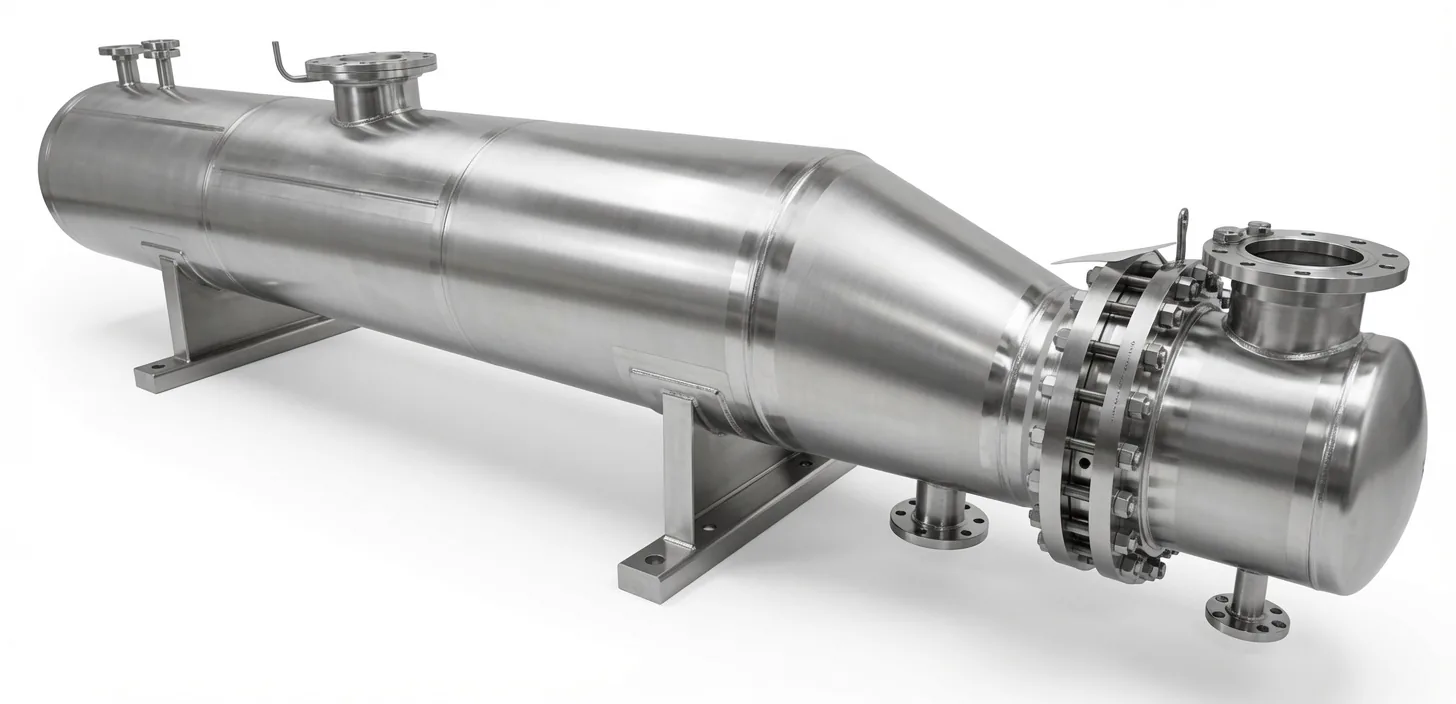
The enlarged section of a kettle shell above the submerged bundle. Its cross-section is large enough that vapor velocity falls and entrained droplets drop back, which is what keeps liquid out of the vapor line.
K-Shell Kettle U-Tube Exchangers
The weir. An internal weir near the outlet sets the liquid level over the bundle. Too low and tubes are exposed and overheat; too high and the vapor space shrinks. It is a fixed dimension, so it has to be right at design.
Concentration and blowdown. Anything dissolved in the feed stays behind as vapor leaves. Without a blowdown route the boiling side scales, heat flux falls, and eventually tubes overheat. Design the connection in and write the procedure.
Why Heat Flux Is Limited
Boiling heat transfer improves as the temperature difference rises, but only up to the critical heat flux. Beyond it the surface blankets in vapor, the coefficient collapses and tube temperature climbs sharply.
Designing near that limit produces an exchanger that meets its rating and misbehaves in service, particularly during startup when the temperature difference is at its largest. Conservative flux is not timidity here; it is what keeps the unit stable.
Kettle Shell Specifics
Because the bundle is sized like an ordinary U-bundle and only the shell is enlarged above it. The tubesheet and the shell flange match the bundle diameter, then a conical or eccentric transition opens the shell out to the kettle diameter. That is why a kettle holds a conventional removable U-bundle with the same bonnet or channel head, and why the bundle-pull clearance is tube length plus a margin exactly as on an E shell. Quote the bundle diameter and the kettle diameter separately; they are different numbers and both matter.
One on a short kettle, two or more on a long one. Vapor leaving the liquid surface along the whole bundle has to travel to a nozzle, and a single nozzle on a long shell pulls everything toward one end. Surface velocity near that nozzle climbs, lifts droplets, and carryover appears even though the average vapor loading looked fine. Spacing nozzles along the top keeps surface velocity even across the length. Each nozzle is sized on vapor velocity, not on the pipe that happens to be nearby.
Below the liquid level, and on a long bundle at more than one point along the length. A single feed at the front end means the far end of the bundle boils liquid that has already been concentrated on its way past the tubes. Dissolved solids build toward the weir end, which is where scale starts and tubes overheat first. Distributing the feed keeps composition and heat flux even along the bundle. Feeding above the surface is the common mistake: it splashes, adds entrainment and sends part of the cold feed straight toward the vapor outlet.
Yes, but the vapor space has to be sized for it. Foam raises the effective liquid level, so a disengagement height that was adequate for a clean boiling surface becomes marginal, and carryover arrives at a lower vapor rate than the rating predicted. The responses are more height above the liquid, which means a larger kettle diameter, or lower surface velocity, which means a longer shell for the same duty. Curing carryover with antifoam alone and leaving the shell undersized works untill the dosing lapses. Say the fluid foams when you Request a Quote so HeatX sizes the vapor space for it.
Related
CONFIGURATION • TEMA
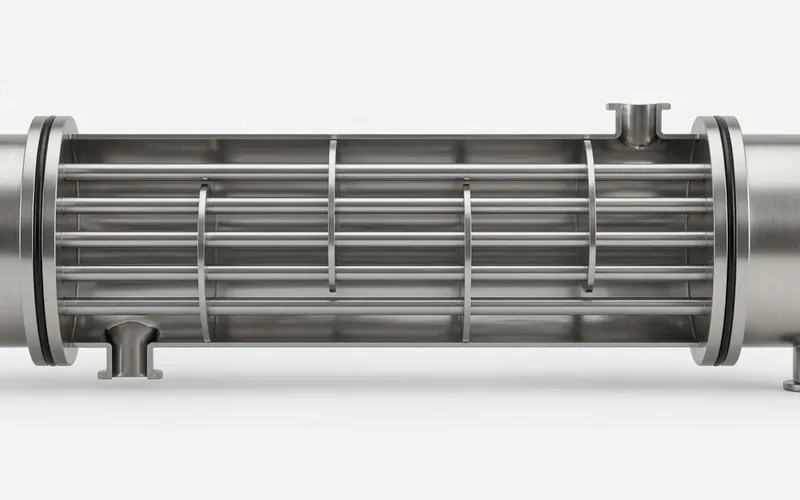
E-Shell Single Pass
The single-pass default shell, and its limits.
+ Learn More