1-805-484-2992
Quotes - Engineering - SalesBKU Kettle Type U-Tube Exchangers
Boiling Duty and Vapor Disengagement
A kettle is a shell that has been enlarged above the bundle so vapor has somewhere to go. Almost every kettle built uses a U-tube bundle, and the reason is thermal shock as much as cost.
In a K shell the bundle sits in the lower portion of an enlarged shell, submerged in boiling liquid. Vapor rises into the free space above, where velocity drops far enough that entrained droplets fall back rather than leaving with the vapor. A weir at the far end maintains the liquid level over the bundle.
Why U-tubes. The heating medium is usually steam or hot oil at a temperature well above the boiling liquid, so the differential is large and the startup transient is abrupt. A U-bundle absorbs both. It also lifts out, which matters because the boiling side fouls as dissolved solids concentrate.
Typical Construction
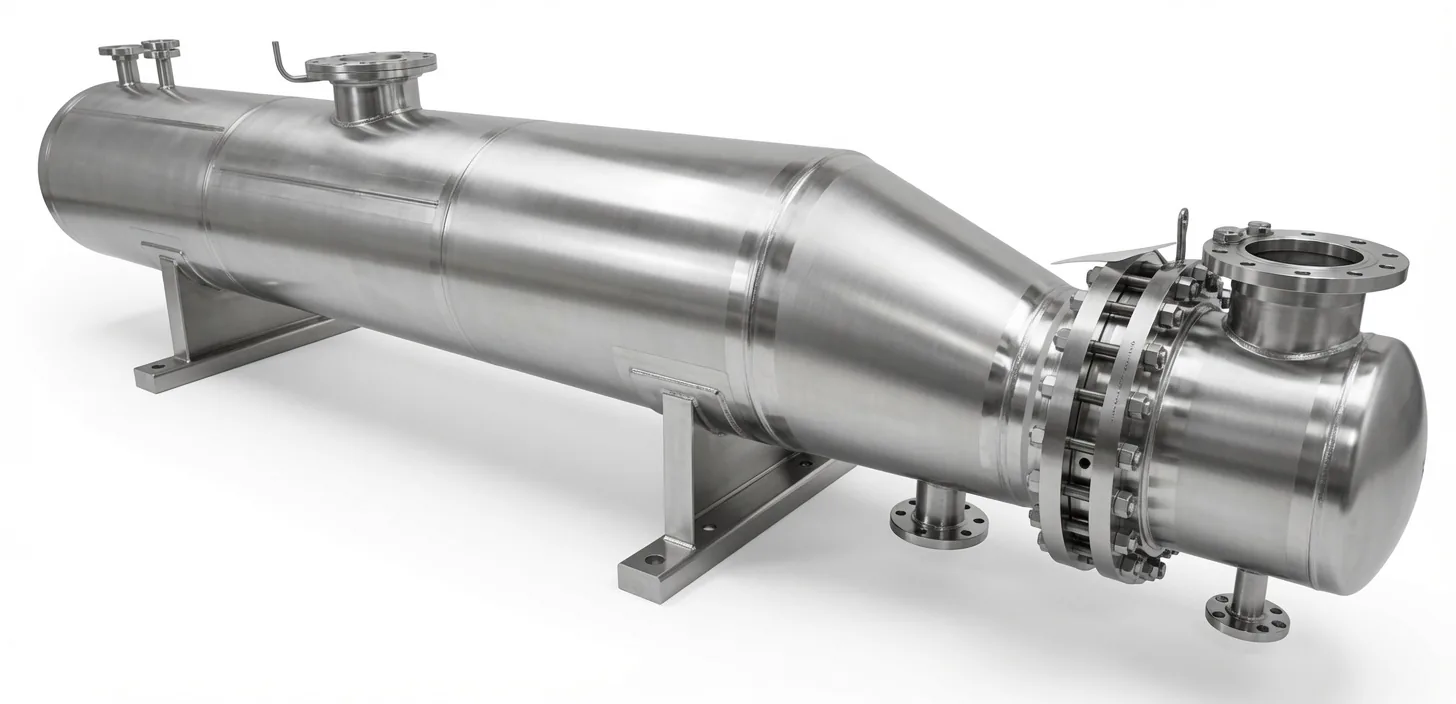
- Shell: K - kettle, enlarged for vapor disengagement
- Front head: B - bonnet (A channel also used)
- Rear head: U - U-tube bundle
- Typical duty: Reboiler, vaporizer, steam generator
- Liquid level: Maintained by an internal weir over the bundle
- Vapor space: Set by the vapor load and the entrainment allowed
- Heating medium: Steam, hot oil or hot process fluid in the tubes
- Blowdown: Bottom connection required for concentrating service
- Bundle: Removable for boiling-side cleaning
- Codes: ASME Section VIII, TEMA R, B or C
Bonnet front head, kettle K shell, U-tube rear. The bundle sits submerged in boiling liquid and the enlarged shell above it lets vapor slow down and shed its droplets before it leaves.
BKU Kettle Type U-Tube Exchangers
Sizing the vapor space. This is where kettles are most often got wrong. Too little disengagement height and liquid carries over into the column or the downstream equipment. The vapor space is sized on vapor loading, not on convenience.
Blowdown. Whatever does not vaporize concentrates. A kettle needs a blowdown connection at the bottom and a policy for using it, or the boiling side scales and the heat flux collapses.
Reboiler Versus Vaporizer
The hardware is the same; the service is not. A reboiler returns vapor to a distillation column and its duty is set by the column's heat balance, so it has to be stable across turndown and controllable. A vaporizer converts a liquid feed to a vapor product and is usually a simpler, steadier duty.
The design consequence is mostly in the control arrangement and the turndown range rather than the exchanger geometry, but it changes how the unit is rated.
Where the Heat Flux Limit Bites
Boiling heat transfer improves with temperature difference up to a point, beyond which the surface goes in to film boiling and the coefficient collapses. Designing close to that limit produces an exchanger that works on the test sheet and misbehaves in service.
This is why kettle reboilers are rated conservatively on flux, and why a large temperature difference is not automatically a good thing on boiling duty.
Reboiler and Vaporizer Notes
About 1,030 lb per hour of low-pressure steam for every 1,000,000 BTU per hour of boiling duty, using 970 BTU per lb latent heat. Boiling duty is the vapor rate times the latent heat of the process fluid, plus the sensible heat to bring feed up to its boiling point. Condensate collects in the lower tube pass and drains to the bottom nozzle on the front head, so the trap sits there and is sized for that flow with a margin for startup. An undersized trap floods the lower pass, the flooded tubes stop boiling, and kettle output falls off exactly when demand rises.
Wide, because the pool stays at its boiling point whatever the duty; the limit is on the heating side. At low load a steam-heated kettle has its control valve throttle steam pressure down, saturation temperature falls with it, and the temperature difference shrinks until boiling becomes uneven across the bundle. Hot oil turns down more gracefully because flow can be cut without losing temperature. Tell HeatX the lowest sustained load when you Request a Quote.
Because disengagement needs a wide liquid surface with a vapor space above it along the full bundle length, and only a horizontal shell provides both. Stand the same shell on end and the liquid surface shrinks to the shell cross-section, surface velocity jumps and carryover follows. A horizontal kettle also lets the weir hold a level over the entire bundle rather than over its bottom tubes only. Vertical thermosiphon reboilers exist, but they are a different exchanger with separation done in the column. For a U-tube kettle, plan a horizontal footprint with the front head clear for the bundle pull.
Square or rotated-square pitch, at or above the TEMA minimum of 1.25 times tube OD, with the open lanes left for vapor to escape upward. Triangular pitch packs more tubes in to the shell but closes the vertical lanes, so vapor generated on lower rows blankets the rows above and the upper tubes run at a worse coefficient than the rating assumed. Square pitch also leaves cleaning lanes for the scale that concentrating service builds on the outside of the tubes. On a kettle, tube count per shell diameter is the wrong figure to optimize; stable boiling on every row is the one that matters.
Only when downstream equipment cannot tolerate the entrainment a correctly sized vapor space still leaves, or when the shell cannot be made large enough. A mesh pad under the vapor outlet knocks out the fine droplets gravity will not, and it is cheap to add at build. It is not a substitute for disengagement height: a pad over a flooded or foaming surface loads up and its pressure drop climbs. Pads must also be removable for cleaning, which means a flanged access or a removable nozzle section designed in from the start.
Related
CONFIGURATION • TEMA
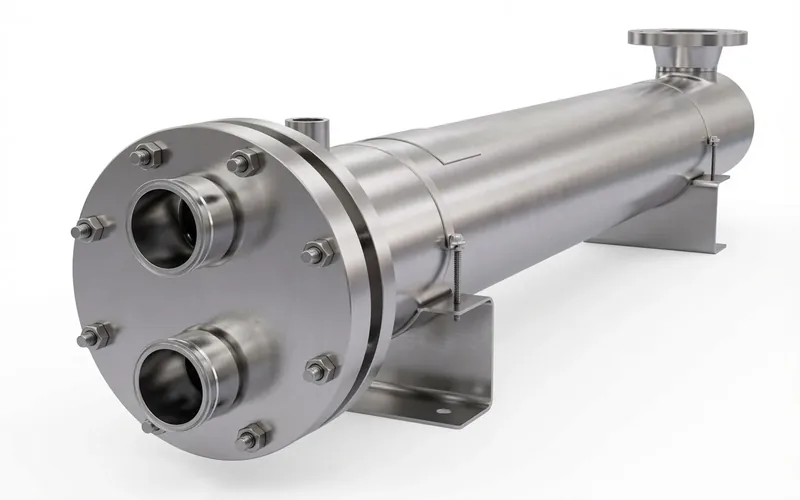
BEU Heat Exchangers
The least expensive removable-bundle exchanger.
+ Learn More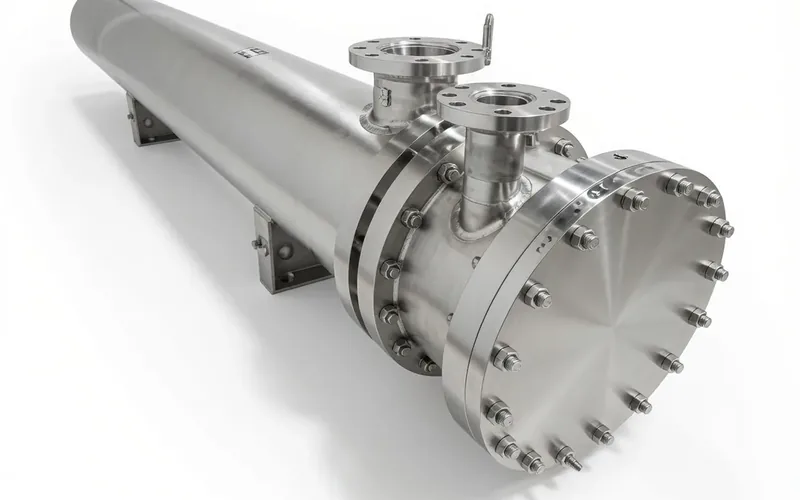
CONFIGURATION • TEMA
AEU Heat Exchangers
A removable cover, so the tube side opens in place.
+ Learn More