
1-805-484-2992
Quotes - Engineering - SalesGas Cooling U-Tube Heat Exchangers
Low Coefficients Against a Fixed Pressure Drop Budget
Gas has a poor heat transfer coefficient and almost no pressure drop to spare. Those two facts pull directly against each other, and resolving that conflict is essentially what gas cooler design consists of.
Gas-side film coefficients sit roughly an order of magnitude below liquid, so the gas side controls the overall coefficient almost regardless of what runs on the other side. The consequence is a lot of surface area for a modest duty, and a design where every decision is made on the gas side first.
The obvious fix and the obvious problem. Raising gas velocity improves the coefficient, and pressure drop rises with roughly the square of velocity. On compressed gas that drop is compression work you have already paid for, so the pressure drop budget usually sets the design before surface area does. On low-pressure gas the budget is small in absolute terms and just as binding.
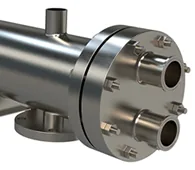
Which side the gas runs on. High-pressure gas is cheaper to contain in tubes than in a shell, and that frequently decides it. Where gas is at low pressure and drop is critical, the shell side offers a much larger flow area and opens up the option of finned tube, which puts extra surface exactly where the resistance is.
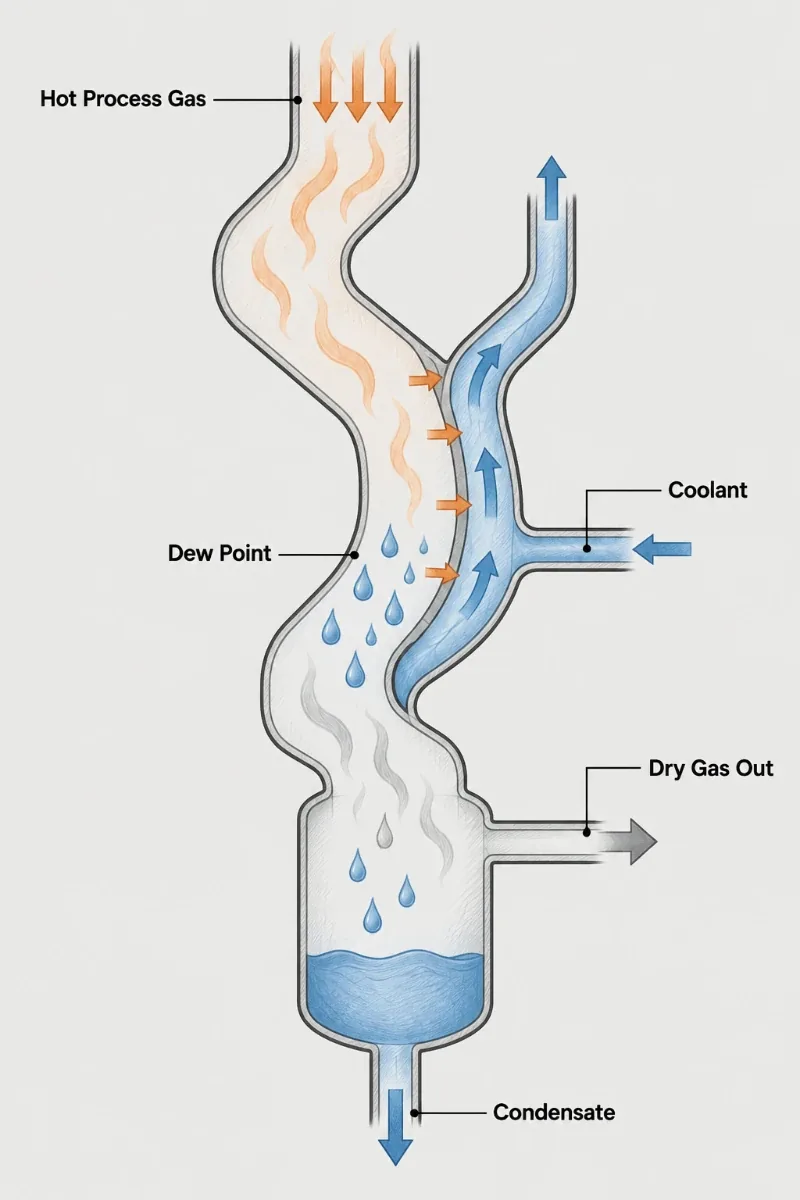
Gas-side coefficients are an order of magnitude below liquid, so the gas side controls. Past the dew point, partial condensation changes the duty profile and introduces liquid to remove.
Request a QuoteGas Cooling


Design Notes
Design for the condensate, not the gas. As gas cools past its dew point, the first liquid to form concentrates whatever acid or chloride the gas carries into a very small volume against the tube wall. That film is what corrodes, and it can be far more aggressive than the dry gas analysis suggests. Selecting material against the gas composition and then finding the cold end corroded through is a common and expensive sequence.
Partial condensation changes the duty profile. Latent heat is released as condensation begins, so the heat load is not distributed the way a sensible-cooling calculation predicts. The rating needs a condensing curve rather than a dew point, and the design needs somewhere for the liquid to go — usually a knockout separator sized for the expected condensate rate.
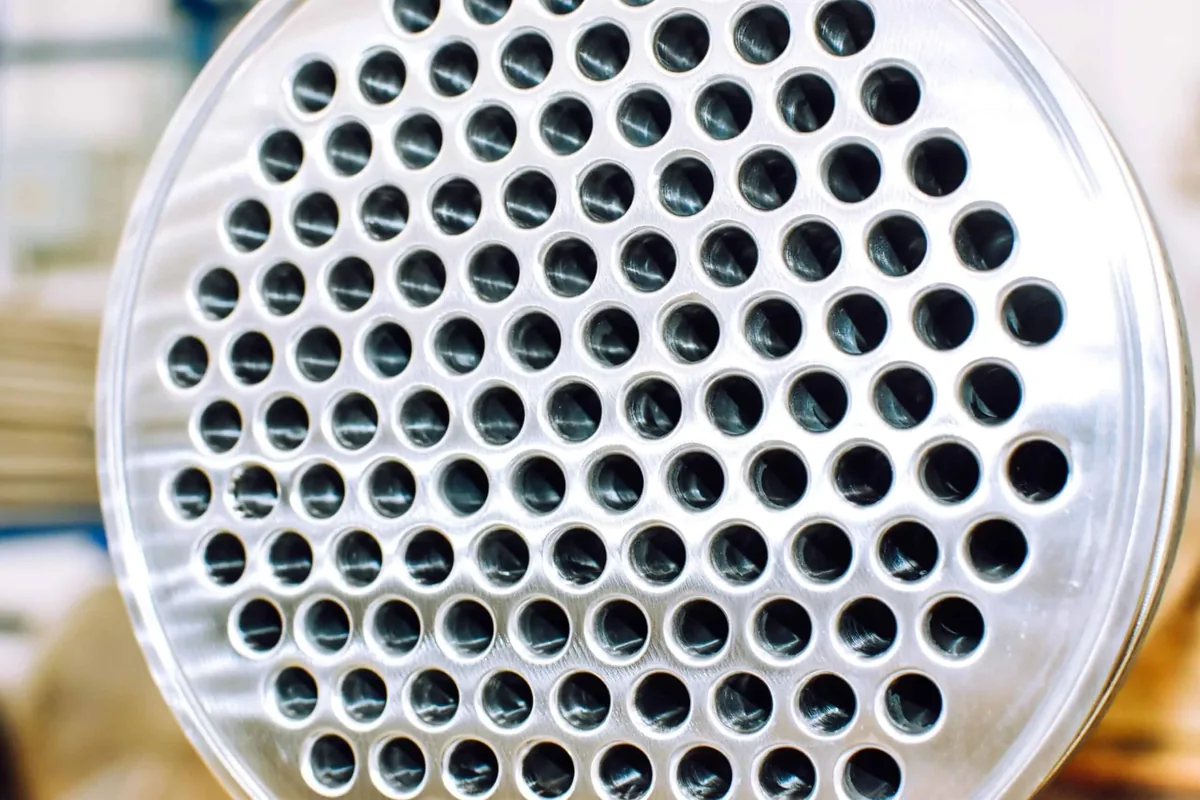
Fouling on dirty gas. Gas carrying compressor oil, dust or polymer-forming components will foul, and it will foul preferentially at the cold end where the deposit does the most damage to the approach. A removable bundle earns its keep here, and generous tube pitch makes the shell side genuinely lanceable.
Related pages: process cooling, vapor condensing, duplex and high alloys and shell selection.
Gas Duty Answers
Enough to stay turbulent at the lowest operating flow, and no more than the pressure drop budget allows at the highest. For tube-side gas that means a tube count and pass count chosen so the lowest flow stays well above the laminar transition; two passes is the U-tube default and four passes doubles velocity at roughly eight times the pressure drop. Check the drop at the warmest inlet temperature, where density is lowest. A cooler rated at a cold average that then runs through a hot afternoon shows up as an undersized compressor, not an undersized exchanger.
Interstage coolers sit between compression stages at intermediate pressure, where the allowable pressure drop is tighter, because every psi lost is a psi the next stage must restore. Aftercoolers see the highest temperature and pressure and condense the most water. Both are usually tube-side gas in a U-tube bundle with cooling water on the shell, and both need a knockout pot immediately downstream. State which stage the cooler serves and the discharge temperature at that stage, not the final discharge.
Yes, low-fin tube bends into a U and runs on the shell side, where the gas flow area is largest. Fins multiply the outside surface several times, so a finned bundle in the same shell can carry a gas-side coefficient that would otherwise demand a much larger exchanger. Fins foul on dirty gas and cannot be lanced as easily as plain tube at the same pitch, so they belong on clean gas only. On gas carrying compressor oil, plain tube on a wider pitch is the better long-term choice even at a larger shell diameter.
The condensate rate at the coldest operating point, the gas rate at the highest, and a drain from the cooler that cannot back liquid up into the bundle. A horizontal shell with gas in the tubes drains from the bottom head; specify the outlet nozzle at the low point so liquid leaves with the gas instead of pooling in the lower tubes. The separator is sized for carry-over droplets, not only the bulk condensate. When the two are bought seperately the cooler outlet and the separator inlet often do not match, so give us the separator inlet size.