1-805-484-2992
Quotes - Engineering - SalesE-Shell U-Tube Heat Exchangers
The Single-Pass Standard
The E shell does one thing: it takes the shell-side fluid in at one end and out at the other. It is the cheapest shell, the easiest to fabricate, and the right answer far more often than not.
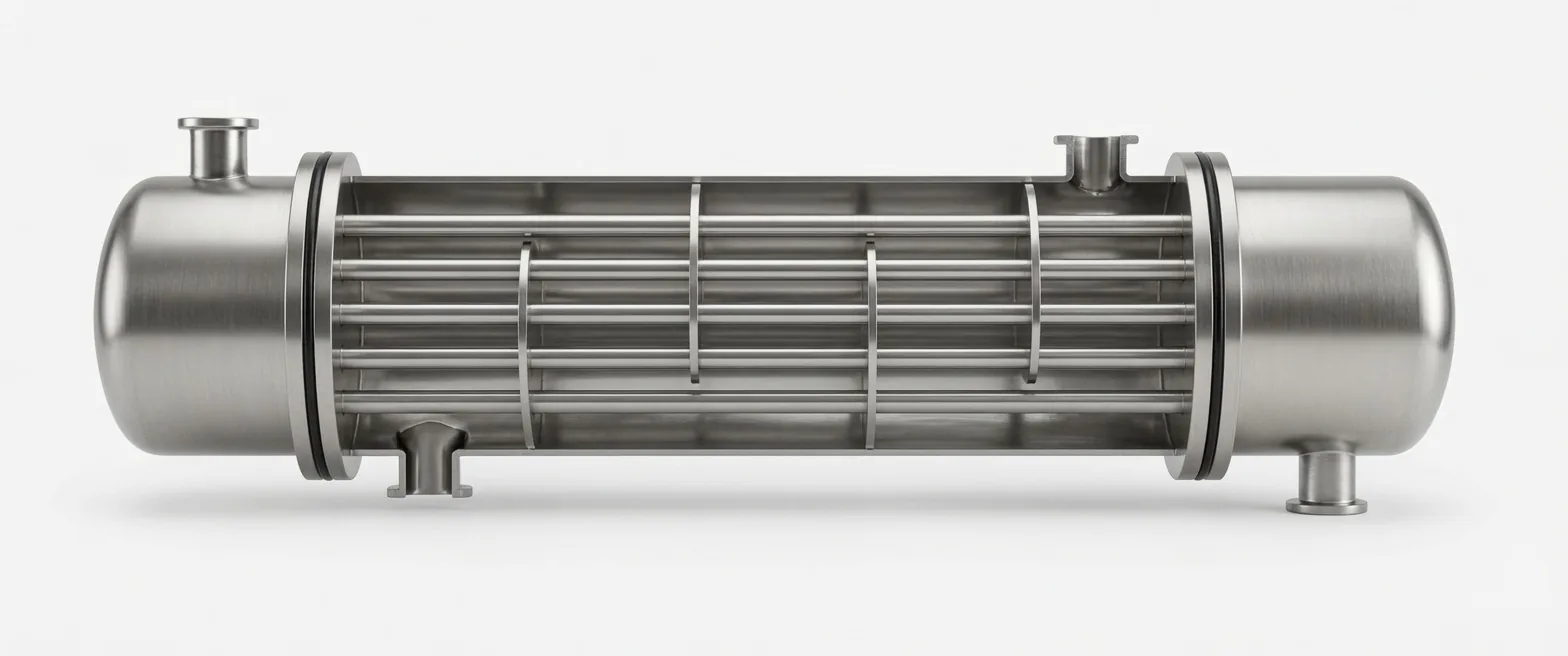
Shell-side fluid enters through a nozzle at one end and leaves at the other, crossing the bundle repeatedly as segmental baffles direct it back and forth. That cross-flow is where most of the shell-side heat transfer happens.
Baffle cut and spacing. Cut is the fraction of shell diameter the baffle leaves open; spacing is the distance between baffles. Together they set velocity, coefficient and pressure drop. Around a quarter of shell diameter is a common starting cut, adjusted from there.
Typical Construction
- Shell type: E - single pass
- Shell-side flow: Cross-flow over segmental baffles
- Typical baffle cut: Approximately 20 to 25 percent of shell diameter
- Baffle spacing: Set by velocity, pressure drop and unsupported span limits
- Pressure drop: Higher than J or X shells for the same flow
- Temperature profile: Cannot achieve a true cross with a two-pass tube side
- Cost: Lowest of the shell types
- Bundle: Removable U-tube
- Vibration check: Required, especially in the bend region
- Codes: ASME Section VIII, TEMA R, B or C
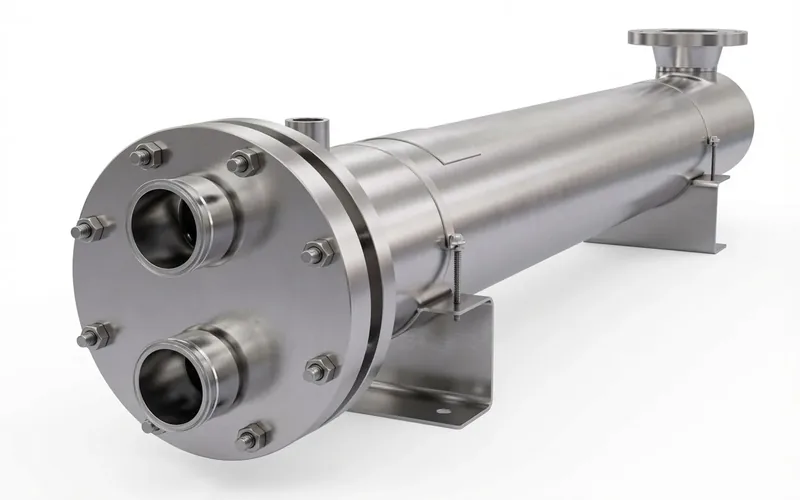
The TEMA single-pass shell. The shell-side fluid enters at one end and leaves at the other, crossing the bundle as segmental baffles turn it back and forth. The cheapest shell, and the right one more often than not.
E-Shell U-Tube Heat Exchangers
Where the E shell runs out. Paired with a two-pass tube side it cannot produce a counterflow profile, so a temperature cross defeats it regardless of surface area. The LMTD correction factor is the warning sign, and below roughly 0.8 the configuration needs rethinking.
Vibration. Unsupported span between baffles is the variable that decides whether tubes vibrate. On a U-bundle the bend region needs particular attention, since those tubes are the longest and least restrained in the assembly.
Reading a Low Correction Factor
When a rating comes back with an LMTD correction factor below about 0.8, the exchanger is being asked to do something it's configuration does not suit. Adding surface area barely helps, and performance becomes sensitive to small changes in operating temperature.
The fixes are an F shell, two shells in series, or a rear head that permits a single tube pass. Recognizing the signal early avoids buying an exchanger that only works on paper.
Shell Inlet and Correction Factor
At the tubesheet end, over the straight tubes, never over the U-bends. The bend region is the least supported part of the bundle, so a high-velocity inlet jet there is the classic cause of tube vibration and bend wear. Putting the inlet near the tubesheet also lands the hottest or coldest shell fluid against the thickest metal, where the tube joints can take it, and the outlet then sits at the bend end. The correction factor for a 1-2 arrangement is the same whichever way the shell flows, so there is no thermal penalty for choosing the mechanically safer end.
TEMA calls for impingement protection when the inlet nozzle rho-V-squared exceeds 1,500 lb per foot per second squared for noncorrosive, nonabrasive single-phase liquids, 500 for other liquids, and in every case for gases, vapors and two-phase streams. Rho is density in lb per cubic foot and V is nozzle velocity in feet per second. Water at 62.4 lb per cubic foot reaches 1,500 at just under 5 feet per second, so most liquid inlets at ordinary nozzle sizes need a plate. The plate blanks a few tubes under the nozzle; a rating that ignores it slightly overstates surface and understates shell-side pressure drop.
Surface scales with one over the correction factor, so F of 0.8 means 25 percent more tubes then pure counterflow would need, and F of 0.7 means 43 percent more. Below 0.8 the curve turns nearly vertical: a small shift in one terminal temperature can push the design onto a part of the curve where no added surface recovers it. A rating at F of 0.75 that looks affordable on paper is a poor buy, because the unit will be sensitive to every excursion in service.
E-Shell U-Tube Heat Exchangers