
1-805-484-2992
Quotes - Engineering - SalesCorrosion-Resistant U-Tube Heat Exchangers
Selecting Alloy by Attacking Species
Alloy selection should follow the film, not the bulk stream. The first liquid to condense, or the last to evaporate, concentrates whatever is aggressive into a small volume against the tube wall, and that is what actually does the damage.
Naming a bulk fluid rarely settles a material question. What matters is what concentrates at the surface, at what temperature, and whether the surface is wetted continuously or intermittently. A stream that is benign in the pipe can be aggressive in the exchanger.
Chlorides. The classic limitation on 300-series stainless is chloride stress-corrosion cracking, and it depends on chloride concentration, temperature and tensile stress together. Duplex grades resist it markedly better. Titanium is effectively immune in most chloride service and is the standard answer for seawater and hypochlorite.
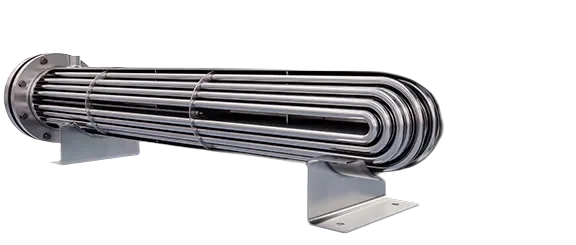
| PRODUCT | STYLE | TEMA TYPE | BUNDLE |
| U-Tube Heat Exchanger | U-Tube, single tubesheet | BEU / AEU / BKU | Removable |
Typical Construction
- 304L / 316L stainless: General service; limited by chloride stress-corrosion cracking
- Duplex 2205: Higher chloride tolerance and strength; work hardens in the bend
- Super duplex: Severe chloride and strength duty
- Alloy 20: Sulfuric acid and mixed acid service
- Hastelloy C-276: Broad oxidizing and reducing chemical resistance
- AL-6XN: High chloride and seawater duty, between duplex and nickel alloys
- Monel: Hydrofluoric acid and some reducing conditions
- Titanium Grade 2: Seawater, brine, hypochlorite; effectively immune to chlorides
- Copper-nickel 90/10 and 70/30: Seawater with velocity limits observed
- Sour service: NACE MR0175 hardness control and post-bend stress relief
Corrosion-Resistant U-Tube Heat Exchangers
Acids. Sulfuric, phosphoric and organic acids each have their own map. Alloy 20 was developed for sulfuric service; Hastelloy C-276 handles a broad range of oxidizing and reducing conditions; AL-6XN sits between the duplex grades and the nickel alloys on both performance and price.
Sour service. The U-bend is a residual stress concentration because cold bending work-hardens the outside of the bend. NACE MR0175 limits hardness there, which in practice means post-bend stress relief of the bend zone, a documented procedure and hardness testing. It is routine work, and it adds cost and lead time, so it needs to be on the table at inquiry.
Bending Changes What the Alloy Can Do
This is the part of alloy selection that is specific to U-tube construction. Cold bending work-hardens the outside of the bend and leaves residual tensile stress there. Duplex grades work-harden noticeably. High-strength alloys can approach their formability limit at tight radii.
The consequences are practical: a larger minimum bend radius on some alloys, a heavier tube gauge to compensate for wall thinning, and stress relief where the service or the code demands it. All of that is manageable, but it means the tube alloy and the bend radius have to be decided together rather than in sequence.
Mixed Construction Is Often the Right Answer
It is common and entirely correct to build the shell in one material and the bundle in another. Carbon steel shells with stainless or high-alloy bundles are routine where the shell-side fluid is benign and the tube side is not.
The detail to watch is galvanic pairing at the tubesheet and any wetted joint, and differential thermal expansion between dissimilar materials. Both are straightforward to design around once they are acknowledged.
Alloy Decisions in Practice
Yes, provided the galvanic pairing is managed at the tubesheet and the shell-side fluid is one carbon steel tolerates. The noble bundle is the large cathode and the carbon steel beside it the anode, the unfavorable ratio: a small anode feeding a large cathode corrodes fast, so the carbon steel touching the bundle is at risk. The part to engineer is the tubesheet, which is wetted by both fluids and touches both metals. A clad or solid-alloy tubesheet on a carbon steel shell flange is the usual answer, with the shell gasket face kept dry. Where the shell side is seawater or brine the logic reverses, and the shell either moves to an alloy or is lined.
Not by the subcritical heat treatment used on carbon steel, because the temperature range it uses forms embrittling phases in duplex grades. Where sour service calls for hardness control on a duplex bend, the bend zone is solution annealed and quenched instead, which restores the ferrite-austenite balance and removes the cold work together. That is a hotter, faster and more tightly controlled operation than stress relief, and it is followed by hardness testing on the outside of the bend. Ask for the annealing procedure and the hardness map with the quotation.
Tube side, in almost every case, because that confines the alloy to the tubes, the tubesheet face and the channel and leaves the shell in carbon steel. Tube-side flow is also easier to hold at a controlled velocity, which matters for the copper-nickel grades: 90/10 loses its protective film if seawater runs too fast and pits under deposits if it runs too slow, so the velocity window is part of the material decision. Shell-side placement is the exception when the corrosive stream fouls heavily and the bundle must be pulled for cleaning, or when the fluid attacks the bend interior, which cannot be inspected. Then the shell gets the alloy and the bundle is sized around it.
The location and shape of the damage usualy tells you before a lab does. Pits clustered under deposits or at the U-bends point to chloride attack. Branching cracks on the outside of the bend are stress-corrosion cracking. Tubes thinned at the inlet rows directly under the shell nozzle are impingement, which an impingement plate fixes rather than an alloy change. Wear bands at each baffle location are vibration, and a heavier gauge or closer baffle spacing is the remedy. Send photographs of the failed bundle with the inquiry, because a replacement bundle in a better alloy will fail again in the same place if the original cause was mechanical.
Related
U-TUBE • CONSTRUCTION
High-Pressure U-Tube
D-type heads, heavy tubesheets, fewer joints.
+ Learn More
U-TUBE • CONSTRUCTION
High-Temperature U-Tube
Hot oil and thermal fluid, with no expansion joint.
+ Learn More