
1-805-484-2992
Quotes - Engineering - SalesThermal Fluid & Hot Oil U-Tube Exchangers
High Temperature at Low System Pressure
Hot oil systems reach temperatures that would demand an enormous pressure system in steam, and they do it near atmospheric. In exchange, the design has to respect one number that never appears on the process datasheet: film temperature.
Thermal fluids carry heat at high temperature and low pressure. That combination is why they exist: reaching the same process temperature with steam would require a pressure system heavy enough to change the economics of the whole plant.
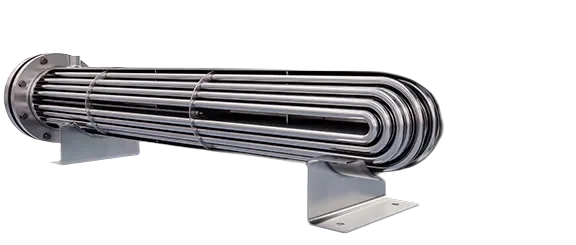
This is the duty the U-tube was made for. Large differential temperature between the hot oil and the process, abrupt startup transients, and constant cycling would all require an expansion joint in a fixed tubesheet exchanger. In a U-tube bundle they require nothing at all, because each tube is anchored at one end and free at the bend. Tubes can even sit at different temperatures from one another without consequence.
Film temperature is the governing limit. Degradation happens at the tube wall, where the fluid is hottest and moving slowest, not in the bulk. A system can run entirely within its bulk temperature rating and still crack the oil if tube-side velocity is too low or heat flux too high. What follows is coke: a hard carbonaceous deposit bonded to the tube wall that insulates, raises wall temperature further, and accelerates the process that created it.
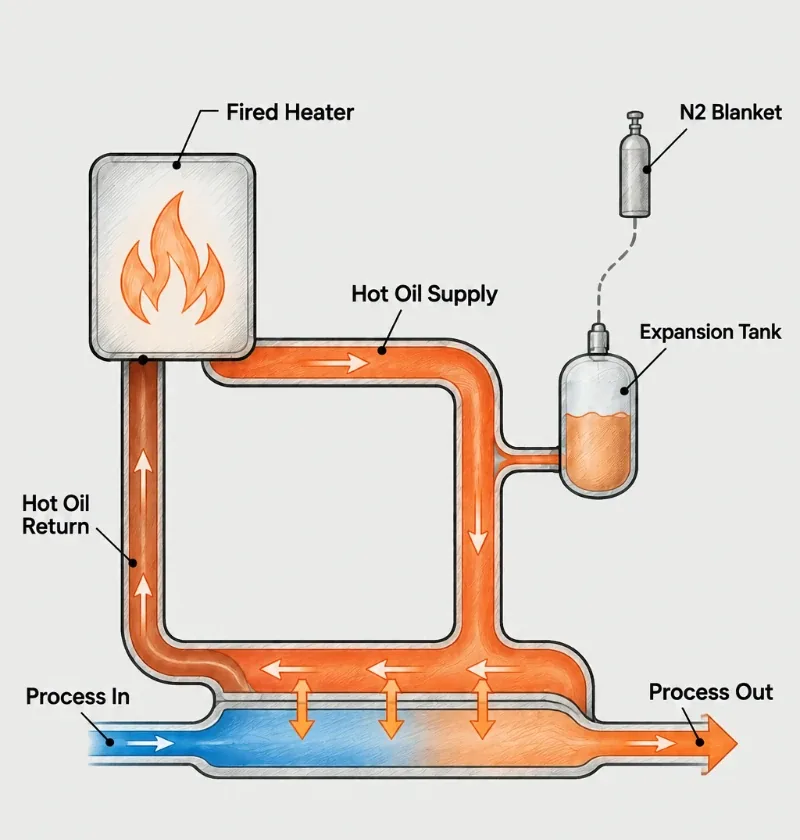
Degradation happens at the tube wall rather than in the bulk. Velocity and heat flux are selected together to keep film temperature inside the fluid supplier's limit.
Request a QuoteThermal Fluid & Hot Oil Heating


Design Notes
Coke cannot be cleaned off a U-bundle. Chemical cleaning barely touches it, and mechanical cleaning cannot pass a 180 degree bend. This makes film temperature control a design requirement rather than an operating preference, and it is why we ask for the fluid supplier's data sheet rather than just the operating temperature.
Oxidation and the expansion tank. Thermal oil oxidizes rapidly wherever hot oil meets air, and the expansion tank is precisely where that contact happens. A nitrogen blanket is standard practice and inexpensive insurance. Oxidized fluid turns acidic and forms sludge, which fouls surfaces and attacks the system, and routine fluid analysis catches it long before the exchanger does.
Support design at temperature. A hot shell grows measurably. One saddle fixed and one sliding, with slots sized for the calculated growth, keeps that movement out of the nozzles and the connected piping. We state the expected growth and the required support arrangement on the drawing rather than leaving it to be inferred on site.
Related pages: high-temperature U-tube exchangers, tank and suction heating, horizontal mounting and supports and carbon steel construction.
Hot Oil Answers
High enough to keep the oil turbulent at every point, including the cold end where the oil is thickest. The fluid supplier states a maximum film temperature; the rating backs out the velocity and heat flux that keep the wall under it with margin. Two tube passes is the starting point, and where the pump has head to spare a four-pass bundle is the usual next step. The error is rating at the hot-end viscosity only; a bundle that is turbulent at running temperature can be laminar on a cold start and coke before it warms through.
In the tubes, whether the exchanger is heating a process stream with hot oil or is the oil heater itself. Film temperature control depends on velocity, and tube-side velocity is set precisely by tube count and pass count. The shell side has low-velocity zones behind the baffles where oil stagnates and cokes, which is the strongest argument against shell-side oil. Both sides are clean in a well-run system, so cleaning does not decide it. Where the process stream is the viscous one, call for rating; the compromise is case by case.
The oil in the tubes stops moving and it's temperature climbs toward the shell-side medium, so the film limit is exceeded within minutes and coke forms. Every hot oil system needs a low-flow trip that cuts the heat source before this happens, and the exchanger rating should state the trip point. On a U-tube bundle the stagnant oil at the bend cokes first, and sooner still when the heating medium enters the shell at the bend end. Specify the trip on the inquiry so the drawing carries it.
Yes, carbon steel is the standard material for thermal fluid service, because the oil is non-corrosive and the temperatures sit within carbon steel's allowable stress range. What matters more is the tube-to-tubesheet joint, which is seal welded as well as rolled on hot oil duty to stop the thin oil seeping past a rolled joint alone. Stainless is chosen when the process side demands it, not for the oil. Call for rating when the operating temperature approaches the upper limit of the carbon steel allowables.
The fluid trade name and the supplier's data sheet, with the maximum film temperature and the properties across the operating range. Density, viscosity and specific heat all change substantially between a cold start and running temperature, and the rating uses them at both ends. Also state the expansion tank pressure, because system pressure at the exchanger sets the design pressure; most hot oil systems are low pressure but not atmospheric. Without the data sheet the rating has to assume properties, and the margin added to cover that costs surface.