
1-805-484-2992
Quotes - Engineering - SalesSteam-to-Water U-Tube Heat Exchangers
The Most Common Duty, and the Easiest to Install Badly
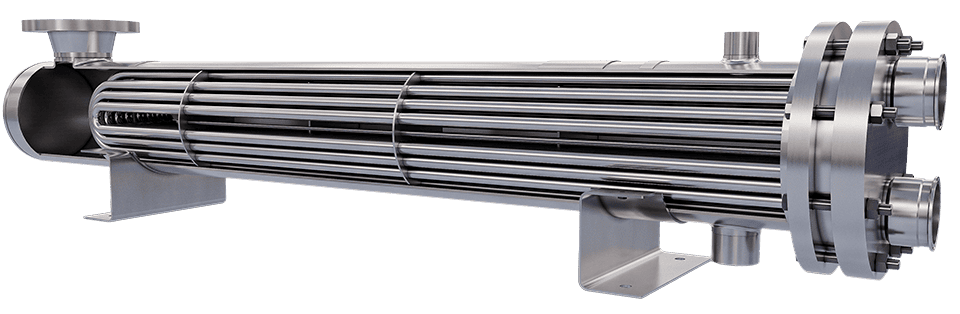
Steam in the tubes, water in the shell, two tube passes and a bundle that lifts out. It is the highest-volume heat exchanger duty in industry, and the one most often installed in a way that guarantees trouble.
Steam condenses inside the tubes and releases latent heat to water flowing through the shell. Because the condensing coefficient is very high, the water side almost always controls the design, which means the exchanger is sized on water-side velocity and pressure drop rather than on anything happening in the steam.
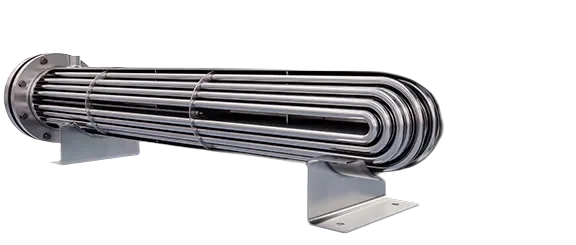
Why the steam belongs in the tubes. Steam is the clean fluid, and a U-tube bundle cannot be mechanically cleaned through the bend, so the clean stream goes tube side by default. Containing steam pressure inside tubes is also cheaper than containing it in a shell. That leaves the water on the shell side, where the bundle can be withdrawn and the surface hydroblasted when plant water eventually lays a deposit down.
Two tube passes is normally right. A U-tube bundle is two-pass by geometry. Adding passes raises steam-side pressure drop, and pressure drop on the steam side lowers saturation temperature, which works directly against the duty. If a rating comes back wanting four or six passes on a steam heater, something else in the design needs looking at first.
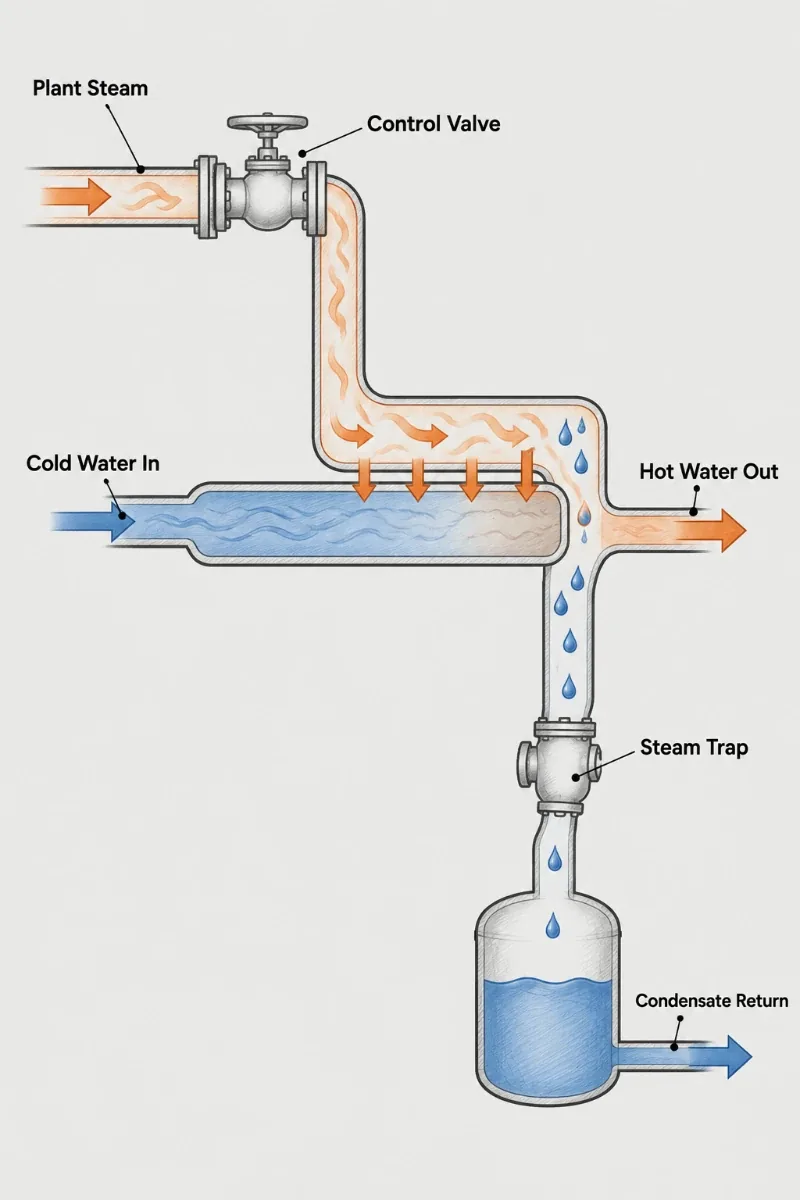
Steam condenses in the tubes at essentially constant temperature. The water side normally controls the design, and condensate drainage decides whether the installation is stable.
Request a QuoteSteam-to-Water Heating

Design Notes
Condensate has to leave as fast as it forms. This is the failure we are called about most. When condensate cannot drain it backs up from the bottom of the shell and progressively covers surface. Performance falls, the approach temperature widens, and every symptom points at a fouled exchanger. Before anyone pulls a bundle on a steam heater, check the trap, the back pressure and the drain leg.
Stall. When a modulating control valve throttles steam pressure down at low load, pressure inside the exchanger can fall below the pressure in the condensate return line. Condensate then physically cannot drain, the unit floods, and control becomes erratic. The remedies are well known — a pumping trap, a vented condensate arrangement, or a control scheme that keeps the unit out of the stall region — but they have to be designed in, because in service stall looks exactly like an undersized exchanger.
Steam hammer and startup. Admitting steam quickly into a cold exchanger holding condensate produces violent collapse and shock loading that damages tubes, joints and connected pipework. Drain first, warm through slowly, and size the trap for the startup condensate load, which is far larger than the running load.
Related pages: stock steam-to-liquid units, two-pass arrangements, CIP solution heating and gaskets and sealing.
Steam Heater Answers
Divide the water-side heat load by the latent heat of the steam, about 970 BTU/lb at low pressure. For 50 GPM of water heated from 60 F to 140 F, the load is 500 x 50 x 80, or 2,000,000 BTU/hr, which condenses about 2,060 lb/hr of steam. Size the trap and condensate line for that figure at running load and for several times it at startup. The number most often left off an inquiry is the steam pressure at the exchanger inlet after the control valve, which sets the saturation temperature the rating uses.
The highest pressure the supply can deliver with the control valve wide open, which is the safety case, and the lowest pressure the valve throttles to at minimum load, which is the duty case. The two are often confused. A stock steam-to-liquid unit carries its design pressure on the nameplate; call for rating when the supply exceeds it. The thermal rating is done at the throttled pressure, because that is the saturation temperature the water actually sees. A heater rated at supply pressure and run throttled comes up short.
Yes, on the water side whenever it can be isolated while steam is still on, because trapped water expanding against closed valves reaches shell design pressure quickly. A relief valve on the shell set at shell design pressure is the standard provision, and ASME Section VIII requires overpressure protection on the vessel. On the steam side, the supply header relief covers the exchanger provided nothing between them can isolate the path. A bundle with bulged tubesheets is almost always a heater that was isolated full of water with steam still admitted. State on the inquiry whether the water side has isolation valves, and the relief connection goes on the shell drawing rather than being left for the installer.
Close to the saturation temperature of the steam at the pressure inside the tubes, with the approach set by surface area. Raising steam pressure raises that ceiling, but it also raises the wall temperature and the scale rate on hard water. For domestic hot water the usual practice is low-pressure steam with enough surface to hold a modest approach, which keeps the wall cool and the scale down. Specify the outlet temperature you need and the allowable water-side pressure drop; the rating picks steam pressure and surface together.
316L or 304L stainless tubes for potable water, with a stainless or lined shell where the water is aggressive; copper tubes where the water chemistry is known and soft. Stainless resists the chlorinated municipal supplies that pit copper, and it is what the stock two-pass units are built in. 90/10 copper-nickel earns its place on seawater or brackish make-up. The mistake on domestic service is carbon steel on the water side: it works for a year and then rusts the hot water. Send the water analysis if you have one; chloride and hardness decide it.
Not well; each loop needs its own heater or a two-shell unit. Two loops on one shell share the same water-side control, so the one with the smaller load overshoots whenever the other calls for heat. A single steam supply can feed two U-tube heaters in parallel, each with its own control valve and trap, and that arrangement keeps one loop running while the other is serviced. On a small secondary loop, a stock unit one size down with the same connections is often cheaper than tying both loops to one large shell.