1-805-484-2992
Quotes - Engineering - SalesBioprocess U-Tube Heat Exchangers
Supporting a Fermentation Suite
Bioprocess duty is thermally undemanding and mechanically fussy. The loads are modest, the fluids are shear sensitive and often expensive, and the exchanger has to fit into a system that gets sanitized between every campaign.
Very little bioprocess heat transfer is difficult in the thermal sense. What makes it exacting is everything around the duty: hold-up volume that becomes product loss, shear that damages cells, cleaning between campaigns, and a documentation burden inherited from the pharmaceutical side of the plant.
Media preparation and sterilization. Heating media to sterilization temperature and cooling it back down without cooking the components that matter. The cooling step usually sets the exchanger size because the approach temperature is tight.
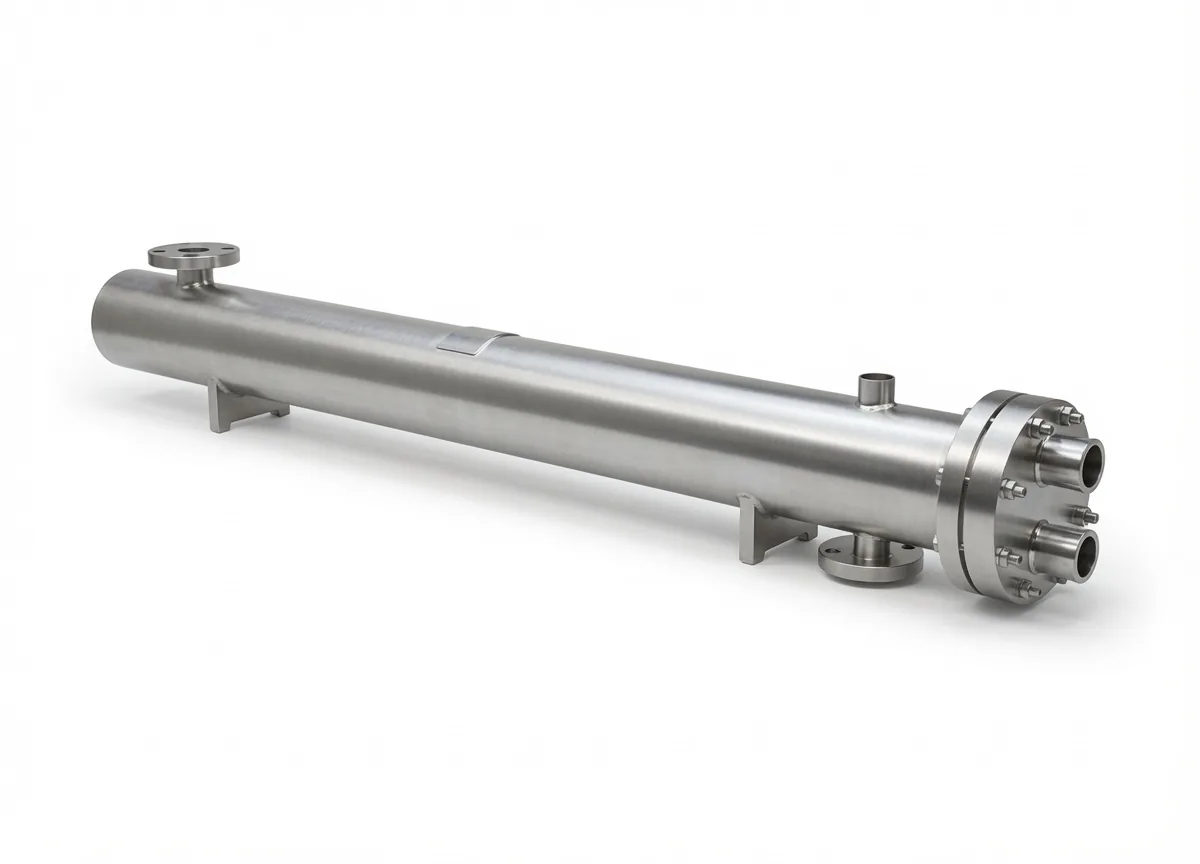
| PRODUCT | STYLE | TEMA TYPE | BUNDLE |
| U-Tube Heat Exchanger | U-Tube, single tubesheet | BEU / AEU / BKU | Removable |
Typical Construction
- Typical duty: Media prep, fermenter cooling, harvest cooling, buffer heating
- Wetted material: 316L, dual certified
- Surface finish: Mechanically polished or electropolished to specification
- Hold-up volume: Minimized; reported at quotation
- Velocity: Selected for shear-sensitive streams
- Tubesheet: Single or double with vented interspace
- Cleaning: CIP and SIP capable, drainable in installed orientation
- Turndown: Sized across the full growth curve, not one design point
- Connections: Sanitary clamp, sized to the process line
- Codes: ASME Section VIII, ASME BPE where specified
Bioprocess U-Tube Heat Exchangers
Fermenter temperature control. Removing metabolic heat through a jacket or external loop, where the control requirement is stability rather than capacity, and turndown across the growth curve is wide.
Harvest and buffer duty. Cooling harvest streams quickly to preserve product, and bringing buffers to temperature. Gentle velocities matter here; so does hold-up, because whatever stays in the exchanger is product that did not reach the next step.
Hold-Up and Turndown Matter More Than Peak Duty
Sizing a bioprocess exchanger on the peak load alone produces a unit that is oversized for most of its operating life and holds more product than it should. Both are real costs, and the second is the one people notice.
Tell us the range rather than the maximum. Knowing that a fermenter cooling loop spends most of a campaign at a fraction of peak metabolic heat changes the pass arrangement and often the exchanger size.
Cleaning Between Campaigns
Changeover is where bioprocess equipment is really tested. The exchanger has to clean reliably, drain completely, and demonstrate both. That points toward vertical orientation with the process fluid on the tube side where drainage is gravity-assisted, or a properly sloped horizontal shell where it is not.
Where the same equipment serves multiple products, carryover is a regulatory question as much as a technical one. Design for the cleaning validation you will have to perform, not the one you hope to.
Fermentation Suite Questions
A few degrees is achievable, but each degree past that costs disproportionate surface, so the coolant temperature decides the exchanger size more than the duty does. The driving force at the cold end is the difference between the media outlet and the coolant inlet. Cooling media to a set point a few degrees above chilled water is routine; asking the same of tower water in summer is not, and the unit either grows very large or misses the set point on the warmest days. If the target sits close to the coolant temperature, say so at inquiry, so the design uses counterflow and chilled water rather than more passes, which raise velocity and shear without closing the approach.
Not measurably, compared with what the pump and the control valve do to the same broth. Shear in a tube is set by velocity and tube diameter, and a bend of several tube diameters radius adds little beyond the straight run. The pump impeller and any throttling valve impose far higher shear rates over a shorter time. So the exchanger design lever is velocity: enough to keep the tube wall swept, low enough to keep pressure drop and wall shear modest, which usually means more tubes in parallel and fewer passes. If the broth is truly fragile, a two-pass unit at low velocity in a larger shell is the right shape, not a four-pass unit chosen for thermal efficiency.
It must be drained and isolated before steam enters the product side, or the SIP cycle never reaches temperature. A shell full of chilled water or glycol condenses the steam as fast as it arrives, and the probe at the product outlet never sees the hold temperature. Drain the utility side, leave its vent open so it can breathe as it heats, and let the U-tube bundle take the expansion, which it does without a joint. After the hold, do not reintroduce cold utility until the product side has cooled on a controlled ramp; quenching a hot tubesheet with cold water stresses the tube joints even though the bundle itself tolerates the cycle.
Use the jacket for the broth and put the exchanger on the jacket water loop, not on the broth. A tempered water loop circulating through the jacket, with a U-tube exchanger cooling that loop against chilled water or glycol, keeps the broth inside the vessel, keeps the exchanger out of product contact, and lets the control valve work on clean water. That arrangement does not need BPE on the exchanger and still gives tight temperature control, because the loop acts as a thermal buffer. An external broth exchanger is justified only when the jacket area cannot remove peak metabolic heat, and then hold-up, shear and cleaning validation all come with it. Check the jacket's capacity before specifying the broth loop.
Because the control valve ends up working near its seat, where a small movement changes flow a lot and the loop cycles between too much and too little cooling. Early in a campaign metabolic heat is a small fraction of peak, so a unit sized for peak sees a tiny demand. Two remedies work. Size the exchanger for the realistic range rather than the maximum and pair it with a valve whose rangeability covers the low end. Or control temperature on a circulating tempered loop, where the exchanger runs at a steady load and the valve blends chilled water into the loop. The second is the usual fix on larger vessels.
Related
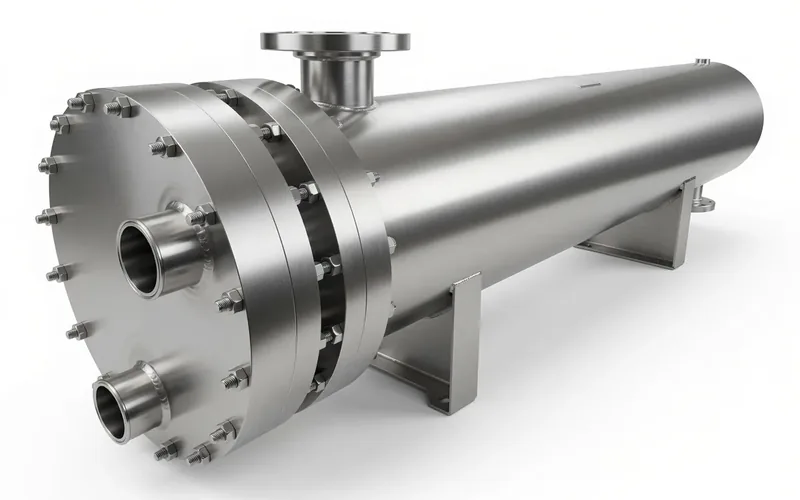
U-TUBE • CONSTRUCTION
ASME BPE U-Tube
Surface designations and a qualification package.
+ Learn More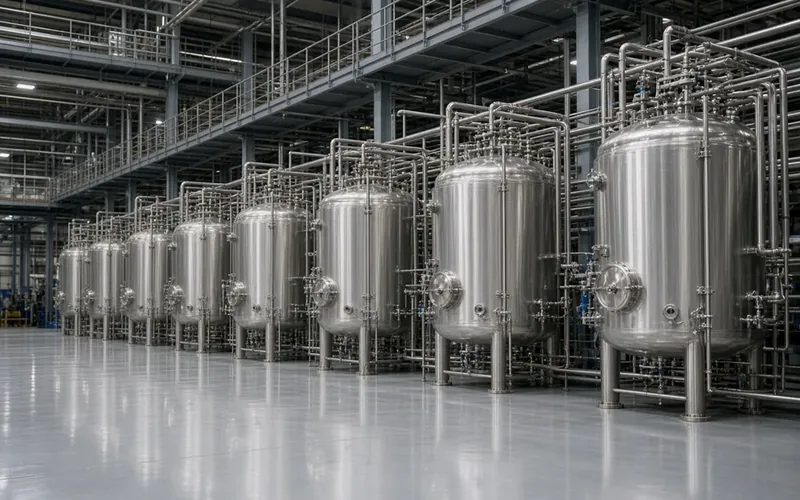
U-TUBE • CONSTRUCTION
WFI & Pure Steam U-Tube
Double tubesheets and electropolished 316L.
+ Learn More