
1-805-484-2992
Quotes - Engineering - SalesProcess Cooling U-Tube Heat Exchangers
Tower, Chilled and Glycol Water Duty
General plant cooling is the least glamorous duty in the plant and among the most consequential, because when it stops performing every process upstream of it slows down with it.
Cooling water arrives from a tower, a chiller or a glycol loop, and each brings a different supply temperature, a different cleanliness and a very different cost per unit of heat removed. That choice, more than anything in the exchanger, sets what the duty will cost to run.
Tower water is the workhorse and the dirtiest. Its supply temperature follows wet bulb, so the hot humid day is the design case and winter is the control problem. It also carries whatever the tower scrubs out of the air, concentrates dissolved solids as it evaporates, and supports biological growth. Everything about a tower-water cooler is a fouling decision.
Which stream goes in the tubes. On a U-tube exchanger the tube interiors cannot be mechanically cleaned, so the cleaner stream belongs there. Where tower water is the dirtier of the two, it goes on the shell side despite the widespread instinct to put cooling water in the tubes. Getting this backwards produces an exchanger that cannot be maintained.
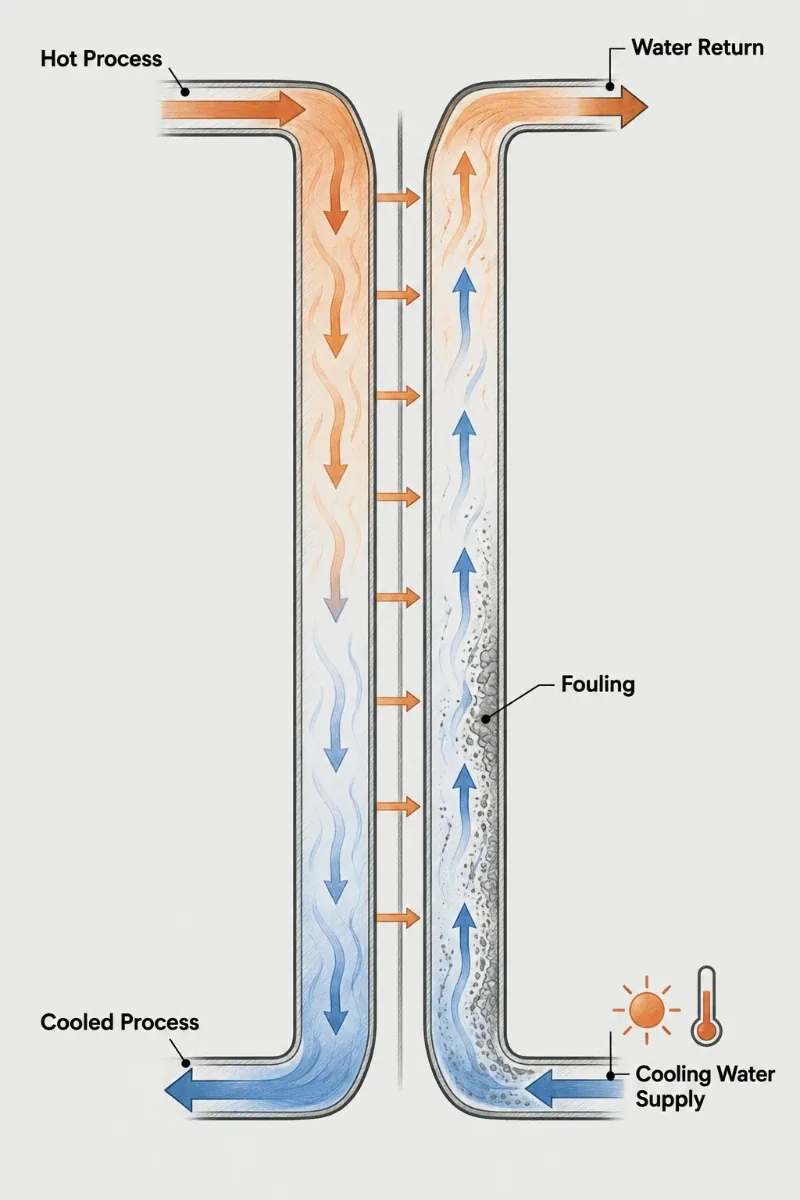
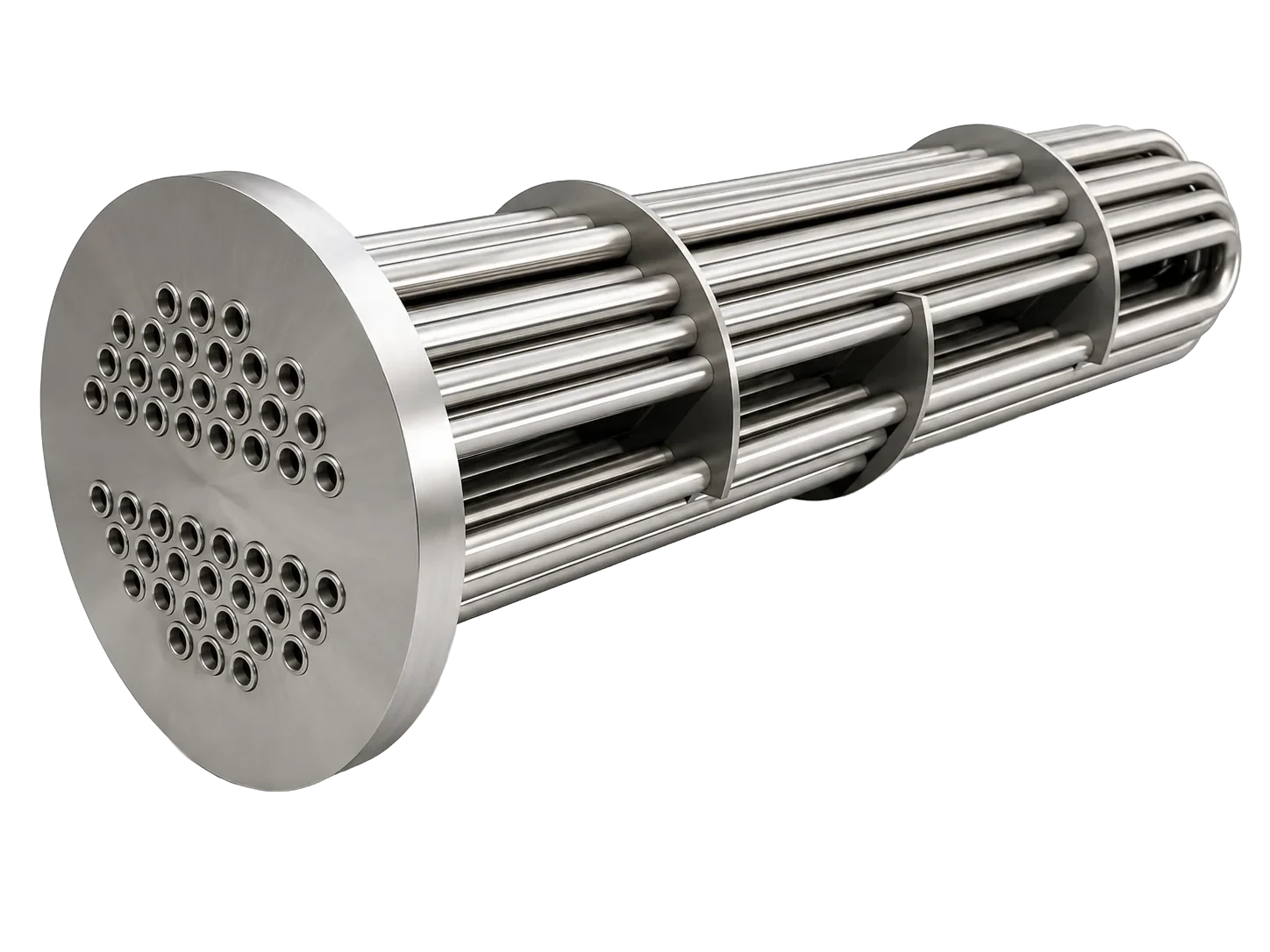
Put the fouling stream on the shell side. Tube interiors cannot be rodded through a U-bend, so the shell is the side that stays mechanically cleanable.
Request a QuoteProcess Cooling


Design Notes
Fouling factor is a design decision, not a default. An over-generous allowance produces excess surface, and excess surface means lower velocity when the unit is clean. Low velocity encourages the very deposition the allowance was meant to cover, so the exchanger fouls its way toward the condition it was designed for. An inadequate allowance produces a unit that meets duty when clean and fails within months. Your own water quality and cleaning history beats any published table.
Seasonal swing is larger than most designs acknowledge. A tower supplying 85 degrees in August may supply far cooler water in February. The exchanger has to be sized for the summer case and controlled through the winter one, and where the range is very wide a control valve on the coolant side or a bypass arrangement is usually needed for stable operation.
Clean on condition, not on the calendar. Trend the approach temperature or the overall heat transfer coefficient over time. When it degrades past a threshold you have set, clean. Plants that adopt this almost always find they clean less often and have better availability than plants cleaning to a fixed schedule.
Related pages: gas cooling, hot water and glycol loops, titanium and copper-nickel and replacement bundles.
Cooling Water Answers
High enough to keep solids suspended and biological growth off the wall, and low enough to avoid erosion on the chosen alloy. On the shell side, where tower water normally runs on a U-tube unit, baffle spacing sets the velocity and is adjusted in the rating. If the water must be tube-side because the process stream is dirtier, remember that copper alloys erode at velocities stainless tolerates, so alloy and velocity are chosen together. Low velocity is the more common error: an oversized cooler at low flow fouls within months.
When the required process outlet sits below what tower water can reach in summer. Chilled water carries a compressor's energy cost per BTU removed, so it is used for the last few degrees only, often with tower water taking the bulk load in a first exchanger. Chilled water is also the cleaner stream, which on a U-tube bundle lets it run in the tubes with the process on the shell. Specify the chiller supply temperature and the return temperature the chiller plant allows, because a cooler designed for a wide chilled-water range may violate the chiller's limit.
On the coolant outlet when the coolant is tower water, so the exchanger stays full and pressurized. Throttling the inlet drops pressure inside the unit, which encourages air release and lets solids settle in the low-velocity zone behind the baffles. Where the seasonal swing is wide, a bypass that blends warm return water into the supply holds the inlet temperature steady. Process-side control gives cleaner temperature response but leaves the water side at full flow, which is good for fouling and poor for pumping cost.
A fouled cooler loses approach gradually and the process outlet creeps up; a leaking tube shows up as cross-contamination, which on a tower-water cooler means process fluid in the tower basin or water in the process. Check conductivity or a tracer on the lower-pressure side before pulling anything. On a U-tube bundle a leak is almost always at the tube-to-tubesheet joint or the outer bend, where erosion and chloride cracking both start. A new drop-in bundle in a better alloy usually costs less than the production lost to repeated plugging.
The difference between the process outlet temperature and the cooling water inlet temperature. A smaller approach needs more surface, and the cost climbs steeply over the last few degrees because the driving force at the cold end shrinks toward zero. Specify the approach you need rather than an outlet temperature alone, since the outlet is only achievable when the water supply cooperates. Trending approach over time is the cleanest fouling indicator available, because it corrects for seasonal water temperature on its own.
Give the tower water supply temperature on the hottest wet-bulb day the site actually records, not the nameplate design value. A tower said to deliver 85 F in August may miss that figure when it is fouled or short of fans, and the cooler sized to it falls short on exactly the days production matters most. Add the process outlet you can tolerate for a few hours a year beside the one you need everyday. That gives two rating points, and the cooler is sized on the one that costs you production.