
1-805-484-2992
Quotes - Engineering - SalesCulinary & Clean Steam U-Tube Exchangers
Generating and Condensing Clean Steam
Plant steam carries treatment chemicals that have no business in a product stream. Clean and culinary steam exist to solve that, and a U-tube bundle is usually the element that generates it.
Three terms get used interchangeably and should not be. Culinary steam is plant steam that has been filtered to a specified grade so it is acceptable for direct contact with food. Clean steam is generated separately from treated feedwater and carries no boiler treatment chemicals at all. Pure steam is clean steam whose condensate meets water-for-injection quality, and it is what a validated sterilization step is supplied with.
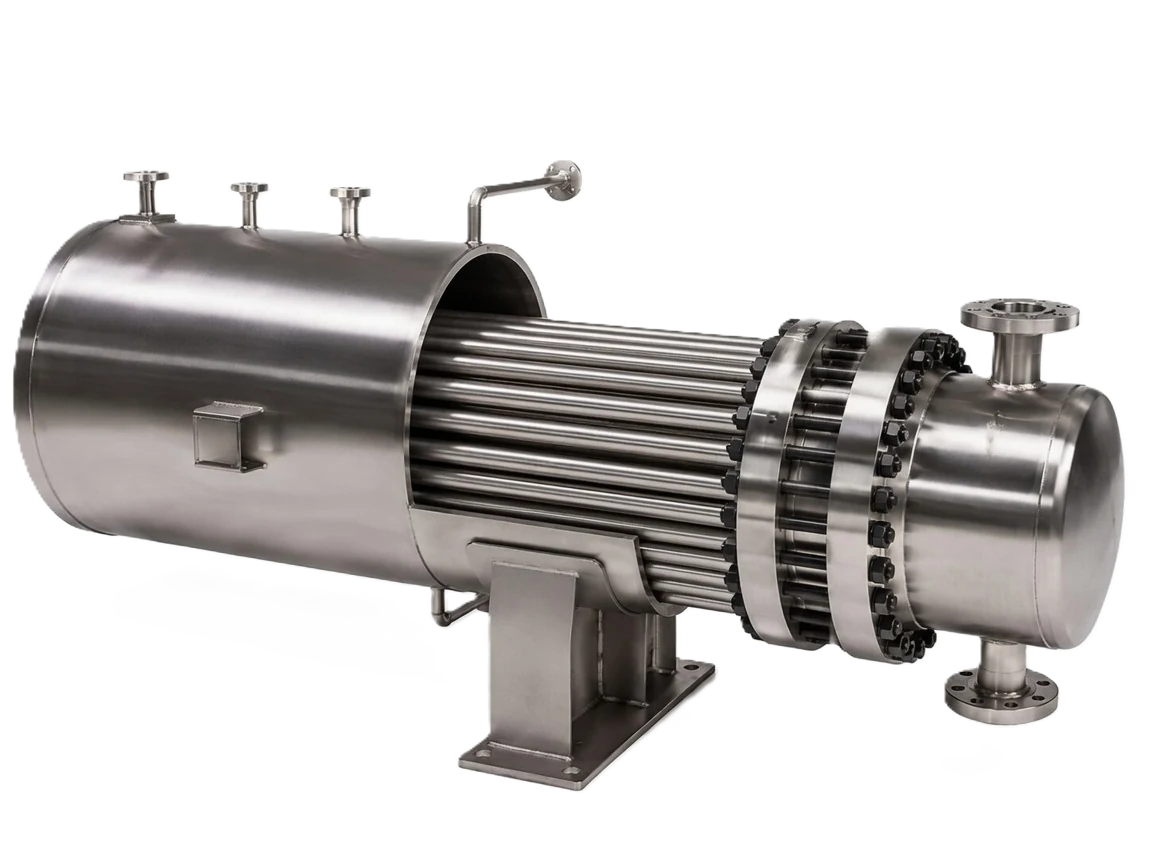
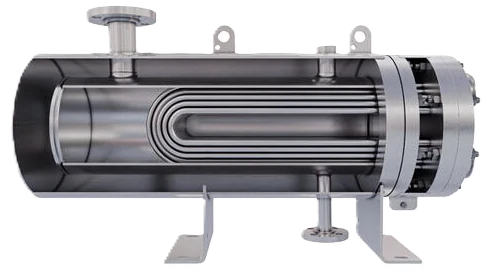
A clean steam generator is a small boiler. Plant steam heats treated feedwater through a U-tube bundle submerged in it. The bundle is the vaporizing element, and it is the barrier that keeps plant steam and its treatment chemicals away from the steam that reaches product. On pure steam duty that barrier is normally doubled, with a vented interspace between two tubesheets so a tube leak becomes visible rather than silent.
Why a U-tube here. Three conditions coincide. The temperature difference between plant steam and boiling feedwater is large. The unit cycles with demand, sometimes many times a day. And the boiling side concentrates solids and needs cleaning. Free thermal expansion answers the first two, and a removable bundle answers the third.
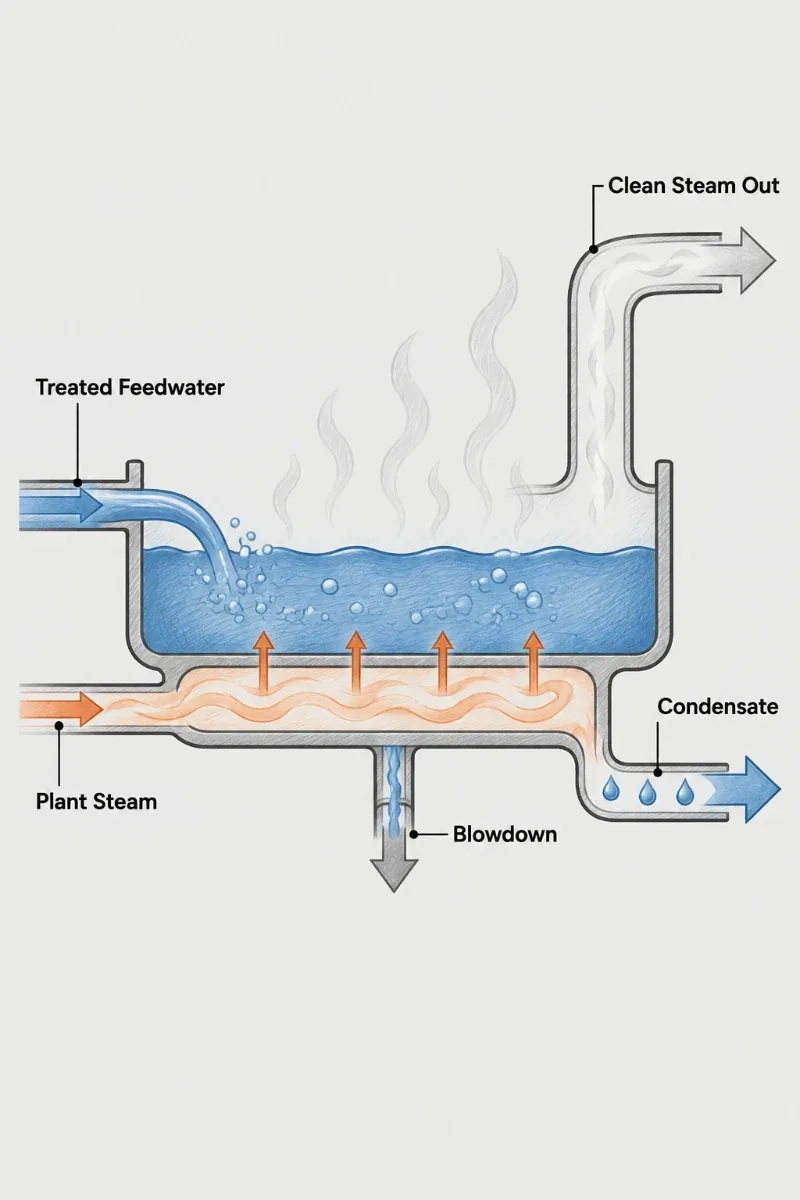
A clean steam generator is a small boiler in which a U-tube bundle is the vaporizing element. Feedwater solids concentrate on the boiling side, so blowdown is not optional.
Request a QuoteCulinary & Clean Steam



Design Notes
Blowdown is not optional. Everything dissolved in the feedwater stays behind as steam leaves. Without adequate treatment and a blowdown routine, concentration climbs until the boiling side scales, heat flux falls, and the bundle overheats. Clean steam generators are frequently installed and then given less water treatment attention than a boiler of equivalent duty would receive, and the failure mode that follows is entirely predictable.
Condensate quality is part of the specification. On pure steam service the condensate has to meet WFI standards, which drives material, surface finish and the tubesheet arrangement together. 316L with controlled sulfur welds predictably and produces a surface that electropolishes well; heat tint and weld ferrite are controlled because both create sites where the passive layer is weaker.
Condensing clean steam. The same principles run in reverse when clean steam is being condensed rather than generated — drainability, noncondensable venting and a surface that can be cleaned and verified. Vertical mounting with the steam on the tube side is the usual arrangement, because condensate runs out under gravity and nothing is left standing between cycles.
Related pages: WFI and pure steam exchangers, double tubesheet construction, BKU kettle reboilers and CIP solution heating.
Clean Steam Generation Details
About 1.1 to 1.2 pounds of plant steam per pound of clean steam produced, with the margin set by blowdown, feedwater temperature and shell losses. Latent heat is nearly equal on both sides at low pressure, about 970 BTU/lb, so the pound-for-pound figure is close to one. Cold feedwater has to be raised to boiling first, and that sensible heat is the main addition: water at 1 BTU/lb-F heated through 150 F costs about 150 BTU per pound, roughly 15 percent on top of the latent duty. Feedwater preheating recovers much of that. Plant steam pressure has to sit high enough above the clean steam pressure to drive the bundle; call for rating on a given pairing.
Any pressure who's saturation temperature sits far enough below that of the plant steam to drive boiling across the bundle, which in practice means plant steam at a materially higher pressure than the clean steam header. The temperature difference between plant steam condensing in the tubes and feedwater boiling in the shell is the driving force, and shrinking it makes the bundle grow quickly. The shell rating sets the ceiling on the clean side. Send the plant steam pressure available and the clean steam pressure the sterilizer or process needs, and the bundle is rated against that pair. Call for rating rather than assuming a catalog figure covers it.
Just ahead of the point of use, with an entrainment separator in front of it, following 3-A Accepted Practice 609 for culinary steam. The filter removes particulate and rust carried from the plant main; it does nothing about dissolved treatment chemicals, which is the whole distinction between culinary and clean steam. A clean steam generator is what you buy when the chemicals themselves are the problem. On a culinary system the exchanger that raised the steam is ordinary plant equipment, and the sanitary section begins at the separator and filter.
By conductivity monitoring of the clean steam condensate, since plant steam treatment chemicals raise conductivity sharply the moment they cross the barrier. A conductivity cell on a cooled condensate sample, with an alarm and a dump valve, is the usual arrangement where a double tubesheet has not been specified. It is detection after the fact rather than prevention, which is why pure steam duty moves to the vented interspace instead. On culinary and general clean steam service the monitor is often accepted on its own, with the generator bundle withdrawn for inspection on a fixed schedule.
In the tubes, so the shell holds the boiling feedwater and the vapor space above it. Condensate drains out of the U-tubes under gravity, the clean side gets the larger volume for disengagement, and the removable bundle is the surface that scales and needs inspection. With steam in the tubes the shell is the clean pressure boundary, so its finish, welds and drainability follow the clean steam specification while the tube interior stays ordinary utility surface.