1-805-484-2992
Quotes - Engineering - SalesF-Shell Two-Pass U-Tube Exchangers
Restoring Counterflow
Put a longitudinal baffle down the middle of the shell and the fluid travels down one side and back the other. Two shell passes against two tube passes gives you counterflow, and with it the temperature cross an E shell cannot reach.
The F shell exists to solve one problem. A U-tube bundle is inherently two-pass on the tube side, which means half the tube length runs against the shell flow and half runs with it. When the required duty needs a temperature cross, that arrangement cannot deliver it.
How the baffle helps. Dividing the shell lengthwise means the shell-side fluid also makes two passes. Two shell passes against two tube passes approximates true counterflow, and the LMTD correction factor recovers to something workable.
Typical Construction
- Shell type: F - two pass with longitudinal baffle
- Purpose: Counterflow profile; permits a temperature cross
- Tube passes: Two, matched to the shell passes
- Correction factor: Substantially higher than an equivalent E shell
- Baffle sealing: Sealing strips or welded baffle; leakage degrades performance
- Pressure drop: Higher than E shell for the same flow
- Bundle removal: Longitudinal baffle arrangement must permit withdrawal
- Alternative: Two E shells in series
- Typical duty: Close approach and crossing temperature profiles
- Codes: ASME Section VIII, TEMA R, B or C
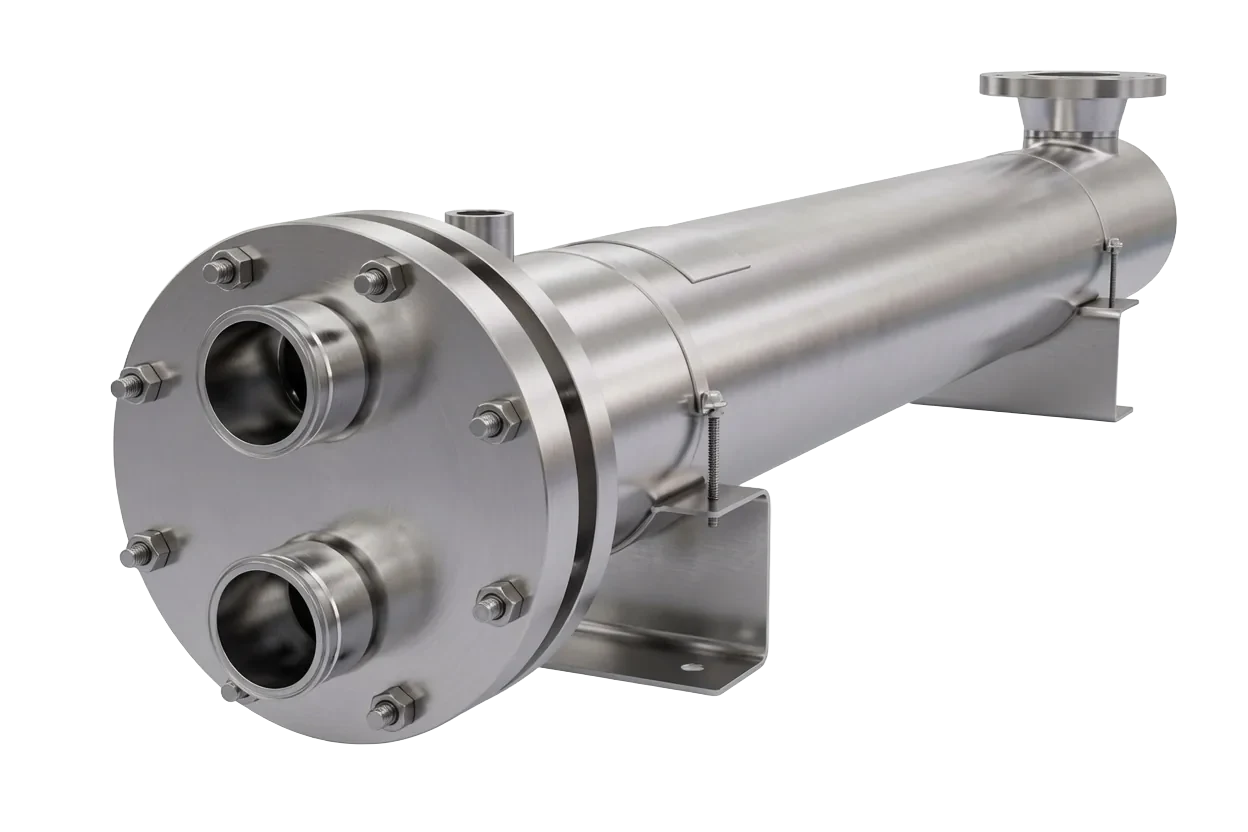
A plate running down the middle of an F shell that splits it into two shell passes, so the fluid travels down one side and back the other and true counterflow is restored against a two-pass U-bundle.
F-Shell Two-Pass U-Tube Exchangers
The leakage problem. The longitudinal baffle has to seal against the shell wall along its whole length. Any bypass short-circuits fluid from one pass to the other and erodes the benefit. Sealing strips help; thermal distortion and age work against them.
The alternative. Two E-shell exchangers in series achieve the same counterflow with no sealing problem, at the cost of an extra shell, extra nozzles and more plot space. On a severe cross that robustness is often worth buying.
When to Choose Series Shells Instead
If the cross is mild, an F shell is efficient and compact. If the cross is severe, or the fluids are such that a leaking baffle would be difficult to detect, two shells in series is the more dependable engineering.
Series shells also give you a maintenance advantage: each unit is smaller and lighter, and one can be isolated. Against that, you pay for two shells, two sets of nozzles and the interconnecting pipework.
Longitudinal Baffle Details
BFU with a bonnet front head, or AFU with a channel; only the middle letter changes. One piping consequence surprises people. Because the shell fluid goes down one side of the longitudinal baffle and returns on the other, both shell nozzles sit at the tubesheet end, and both tube nozzles are already there on any U-tube. All four connections land at the front head end. Plan the pipe rack for that and leave the bundle-pull length clear at the same end. The U-bend end carries no connections at all and can sit close to a wall.
Not on a removable bundle. A baffle welded to the shell would trap the bundle, so on a U-tube F shell the baffle is attached to the bundle and travels with it, sealing to the shell wall with flexible metal strips or packing. Those strips are the wearing part, which is why a leakage allowance belongs in the rating from day one. A welded baffle is only an option when the owner accepts that the bundle is never coming out.
Because counterflow needs each shell pass to face exactly one tube pass running the opposite way, and two shell passes against two tube passes is what delivers it. Put four tube passes in the same shell and each shell pass now sees two tube passes, one with the flow and one against it, which is the partly co-current pattern the F shell was bought to escape. The correction factor drops back toward an E shell value and the temperature cross is lost. If tube-side velocity seems to need four passes, the answer is a smaller tube count or a second shell, not more passes.
Yes. The baffle is a thin plate with the hot first pass on one face and the cooled return pass on the other, so heat conducts straight across it. The loss is small on a modest shell-side temperature range and grows with it; a wide range across a thin carbon steel baffle takes a noticeable bite out of the counterflow advantage. Ratings that treat the baffle as adiabatic overstate performance on those duties. Ask whether conduction was included, or specify a thicker or insulated baffle when the range is large.
The pressure difference across the longitudinal baffle is the shell-side pressure drop, and it pushes the plate toward the low-pressure return pass. Flexible sealing strips tolerate a modest deflection; a large one lifts them off the shell wall and opens a bypass right where the two passes meet, so the fluid that should have made the full circuit short-cuts to the outlet. An F shell already runs a higher drop than an E shell for the same flow, and a tight baffle spacing chosen for coefficient works against the seal. Keep shell-side pressure drop moderate. When the rating needs a high drop to reach the coefficient, treat that as the signal for two E shells in series.
Related
CONFIGURATION • TEMA
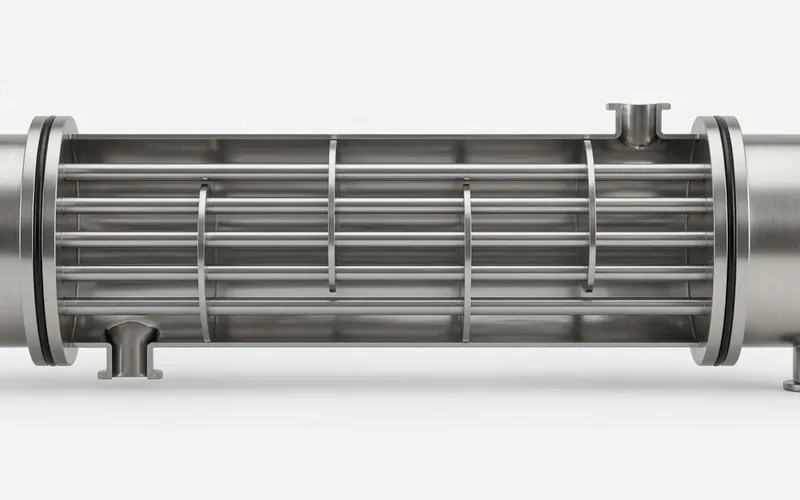
E-Shell Single Pass
The single-pass default shell, and its limits.
+ Learn More