
1-805-484-2992
Quotes - Engineering - SalesStock Steam-to-Liquid U-Tube Exchangers
The Shelf Range and What It Covers
Steam on one side, water or product on the other, two tube passes, a removable bundle and a code stamp. It is the most common heat exchanger duty in industry, which is exactly why it makes sense to hold them on a shelf.
Stock steam-to-liquid exchangers exist for one reason: the gap between a unit failing and a replacement arriving is measured in production, not in dollars. A standard unit that ships tomorrow is worth considerably more than a perfect unit that ships in twelve weeks.
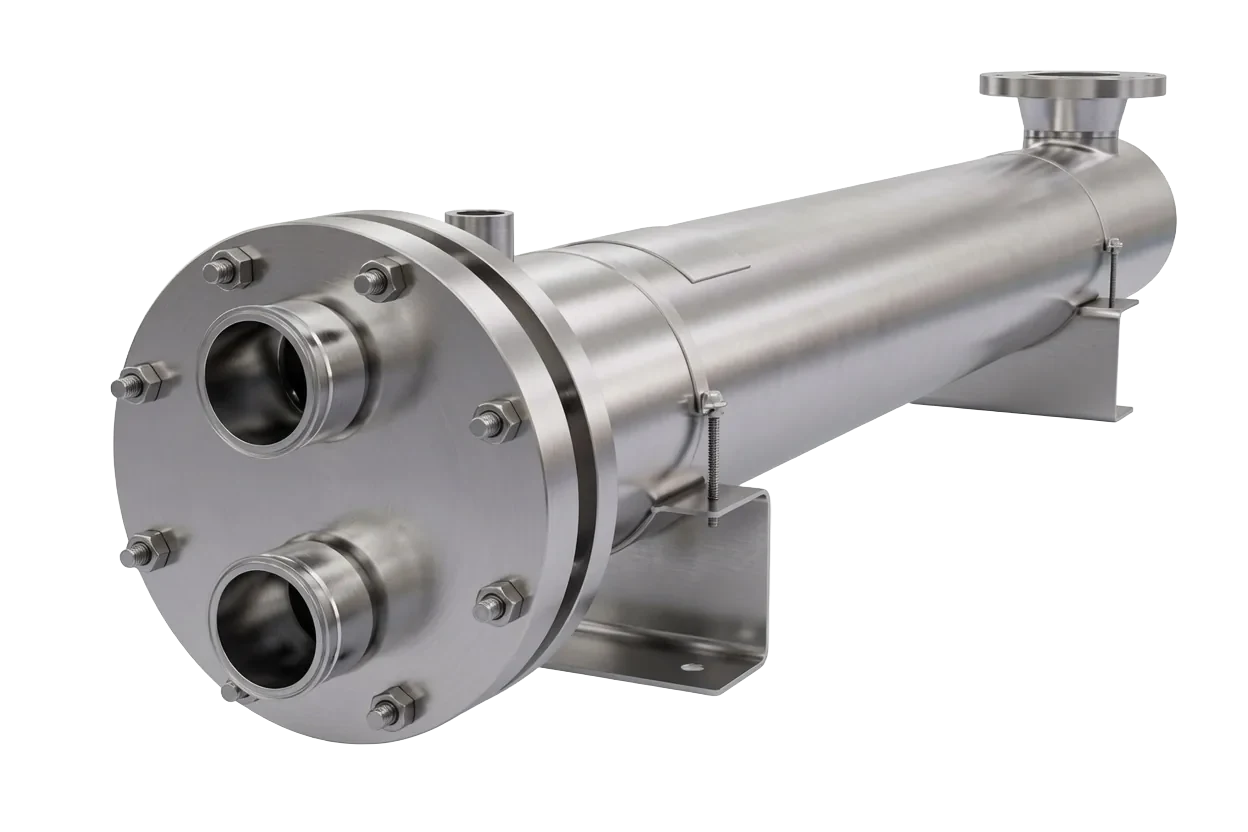
Standard construction. Two-pass U-tube bundle, 304L or 316L wetted parts, sanitary tri-clamp connections on the process side, built to TEMA C, ASME hydro-tested and code stamped. Removable bundle with O-ring or PTFE gasket sealing.
| PRODUCT | STYLE | TEMA TYPE | BUNDLE |
| U-Tube Heat Exchanger | U-Tube, single tubesheet | BEU / AEU / BKU | Removable |
Typical Construction
- Configuration: Two-pass U-tube, removable bundle
- Shell sizes: Small to mid-range diameters and lengths; ask for current list
- Wetted material: 304L or 316L stainless steel
- Process connections: Sanitary tri-clamp
- Utility connections: NPT or flanged
- Standard: TEMA C construction
- Code: ASME hydro-tested and code stamped
- Bundle sealing: O-ring or PTFE gasket
- Surface finish: Polished product contact; specify if a particular Ra is required
- Availability: Held in inventory; frequently ships next business day
Stock Steam-to-Liquid U-Tube Exchangers
Where they fit. Hot water generation, CIP solution heating, tank heating, product warming, general plant utility duty and any sanitary steam heating application within the standard size and pressure range.
Where they do not. Anything needing an alloy above 316L, design pressures beyond the standard rating, a double tubesheet, electropolishing, a tight approach temperature, or a documentation package beyond the standard. Those are custom builds and the honest answer is to say so early.
Rating a Stock Unit Against a Real Duty
Catalog surface area is not a duty. The same exchanger will deliver very different results depending on steam pressure, the liquid flow rate, the inlet temperature and how much pressure drop the process can spare.
We run stock units through the same thermal model as a custom build before quoting them. If the standard unit makes the duty with margin, that is the fastest and cheapest answer available. If it does not, we would rather tell you than let you discover it at startup.
Steam-Side Details That Decide Performance
Two things spoil steam-to-liquid exchangers more than anything else. The first is condensate that cannot leave, because a flooded exchanger loses surface progressively and looks exactly like fouling from the control room. Trap sizing and the drainage arrangement matter as much as the exchanger.
The second is control valve turndown. A modulating steam valve operating far below its designed range produces unstable temperature and, in the worst case, stall, where condensate cannot drain against the back pressure. Both are system problems rather than exchanger problems, and both are cheaper to address before installation.
Buying From the Shelf
Connections, supports, insulation jackets and accessories can be changed on a shelf unit; alloy, tubesheet style, surface finish and tube count cannot, because they are set at fabrication. A changed utility connection, say a flange in place of an NPT, is a short shop operation. A request for a second tubesheet is a different exchanger. The mistake we see is ordering first and asking after, which turns a next-day shipment into a return. Ask with the order and the answer is immediate.
Yes, every stock unit is hydrostatically tested and stamped before it goes on the shelf, and ships with the U-1 data report and test record. That matters when a plant is replacing a failed unit on a weekend, because the inspector who later reviews the installation sees a registered vessel rather than a question. It also fixes the ratings: a stamped unit cannot be re-rated upward in the field, so a stock heater is bought for the stamped pressure and temperature, not for what a custom build could have reached. If your steam header sits above the stamped rating, say so and a custom unit is the answer.
Surface margin is harmless in itself; the trouble comes from the steam control valve, which spends its life nearly closed on an oversized heater and hunts. Work the number: if the duty is half the unit's capacity at full steam pressure, the valve passes half the flow and sits low on its curve, where a small stem movement makes a large temperature swing. Remedies are a smaller valve, a pressure reduction so the heater runs at lower steam temperature, or a smaller exchanger. Tell us the turndown and the valve is sized with the heater.
Call for the rating on the specific unit; stock units carry a stamped shell-side design pressure that is listed with the inventory, and we will not print a figure here that could sit above a unit's nameplate. The useful check is simple: the header pressure upstream of your control valve, with the valve failed open, must be at or below the stamped shell rating. If it is not, a pressure reducing station or a custom shell is required. The tube-side rating is separate and often lower, set by the sanitary clamp connections, so give both pressures with the inquiry.
Related
U-TUBE • CONSTRUCTION
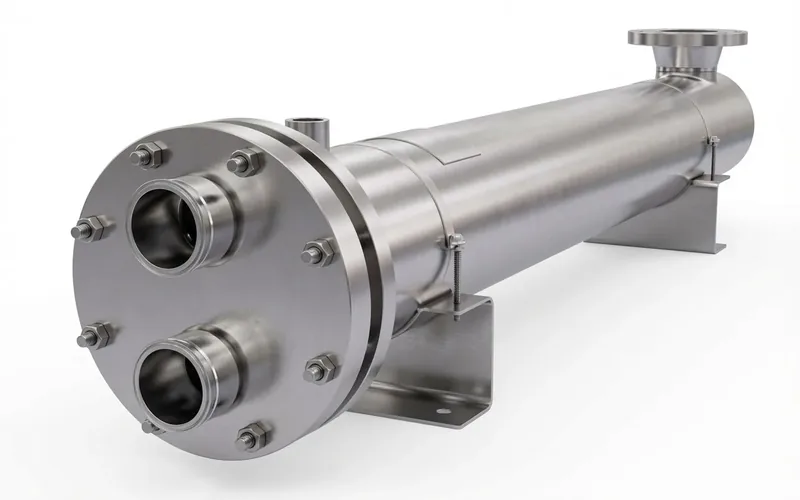
Two-Pass U-Tube Exchangers
Why a U-bundle is even-pass, and the temperature cross.
+ Learn More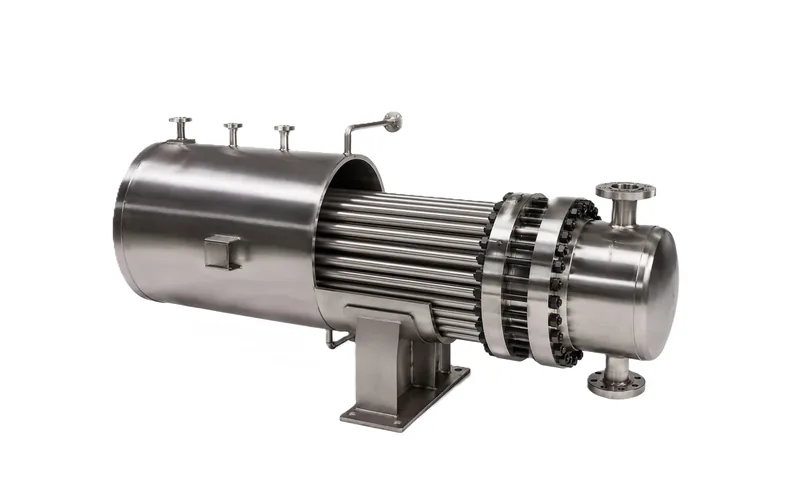
U-TUBE • CONSTRUCTION
Custom U-Tube Exchangers
Rated to your conditions, inspected as specified.
+ Learn More