
1-805-484-2992
Quotes - Engineering - SalesVertical U-Tube Heat Exchangers
Gravity Does the Work
Turn the exchanger on end and two problems solve themselves. Gas leaves at the top, liquid leaves at the bottom, and the footprint shrinks to almost nothing. The cost is headroom.
Vertical mounting suits condensing duty, sanitary service and crowded plots. Condensate runs down and out rather than pooling. Noncondensable gas collects at the top where a vent can take it. Drainage between batches is complete without needing a deliberate slope.
Sanitary advantage. Where drainability is a requirement rather than a preference, vertical orientation with the product on the tube side is the cleanest arrangement available. The path the product takes is the path the CIP solution takes, and nothing is left behind.
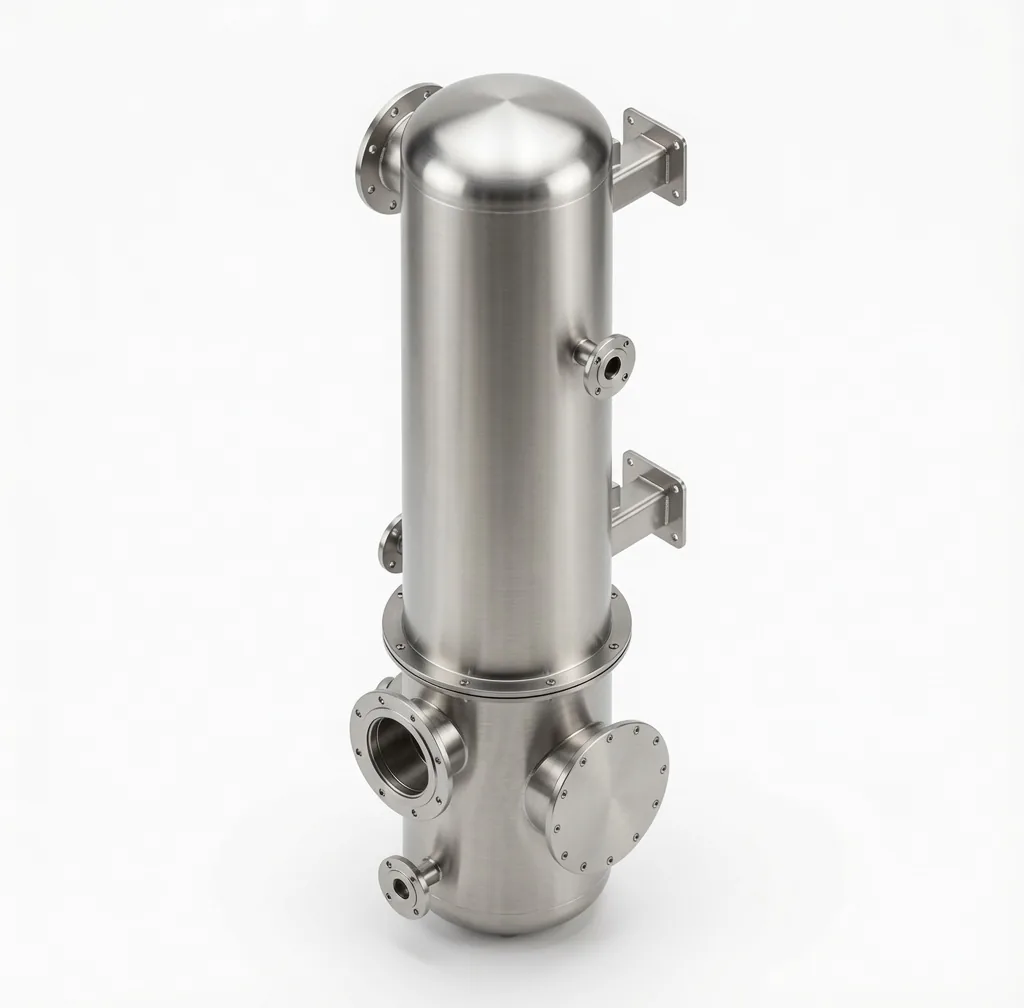
Typical Construction
- Orientation: Vertical, bundle withdrawn upward
- Supports: Lugs or support skirt
- Condensate drainage: By gravity to the bottom connection
- Venting: Self-venting at the top connection
- Footprint: Substantially smaller than horizontal
- Overhead clearance: Bundle length plus rigging above the unit
- Sanitary suitability: Preferred where full drainability is required
- Wind and seismic: Applied on tall installations
- Thermal growth: Accommodated at the support arrangement
- Codes: ASME Section VIII, TEMA R, B or C
An exchanger stood on end so gas leaves at the top, liquid leaves at the bottom and the footprint shrinks to almost nothing. The price is the headroom needed to lift the bundle out.
Vertical U-Tube Heat Exchangers
Support design. Lugs or a support skirt carry the weight, and the arrangement has to allow vertical thermal growth without loading the nozzles. On tall units, wind and seismic cases enter the mechanical design in a way they do not for horizontal units.
The clearance trade. The bundle comes out upward, so you need overhead lift height at least equal to the bundle length plus rigging, and a clear route for it. That is often the constraint that sends a design back to horizontal.
Where Vertical Wins Outright
Condensing service, because condensate drains rather then flooding tubes. Sanitary and pharmaceutical duty, because drainability is verifiable rather than argued. Reflux and knock-back service, where condensate has to run back down against rising vapor. And any plot where floor space costs more than headroom.
It also simplifies venting on any duty that carries noncondensable gas, since the high point is unambiguous.
Headroom and Gravity
Normally the tubesheet and front head are at the top so the bundle lifts out through the head opening, and the U-bends hang downward into the shell. That puts both tube-side nozzles at the top. With condensing in the tubes, vapor enters at the top and condensate runs down one leg, around the bend and up the other, so the design has to make sure the return leg does not hold a liquid seal. Tubesheet-down mounting is used where the shell side must drain through the head end, but then the bundle comes out downward, which is rarely practical.
Shell-side drainage of a vertical unit is complete only if the bottom nozzle sits at the low point of the shell and nothing in the bundle traps liquid above it. On a U-tube bundle the bends sit at the bottom, so the shell drain must be below the bend tips and the lowest baffle needs drain notches. Without them a ring of liquid stays around the bends after every batch. With product in the tubes this problem does not arise, which is one more reason the product side is the tube side on sanitary units.
The bundle length plus the lifting gear, meaning the spreader or sling, the hook and whatever clearance the hoist needs at the top of its travel. Plan on several feet beyond the bundle rather than inches. The overlooked case is a unit under a mezzanine where the clear height exists but a beam crosses the lift line. If headroom is short, a removable roof panel, a lifting beam installed at build time, or a shorter and larger-diameter bundle are the usual answers. Give the clear height to the lowest obstruction with the inquiry.
On tall vertical units, yes: the support skirt or lugs, the anchor bolts and sometimes the shell thickness near the base are governed by overturning moment rather than by pressure. The pressure parts are unchanged in principle, but the mechanical design has to carry the lateral load into the foundation. This is a site-specific calculation, so the Request a Quote should state the site seismic category and wind exposure, and whether the unit stands alone or is braced to adjacent structure. Horizontal units on saddles almost never raise this issue.
With the shell fixed at one support elevation and free to grow upward or downward from it, so the growth is not pushed into the piping. On a skirt-supported unit the base is fixed and the whole shell grows upward, taking the top nozzles with it, so the top piping needs flexibility. With lug support the lugs sit partway up and the shell grows both ways from them. The mistake is to hard-pipe both ends; the nozzles then crack. Tell us where the rigid piping is and the support can be placed to suit.
Related
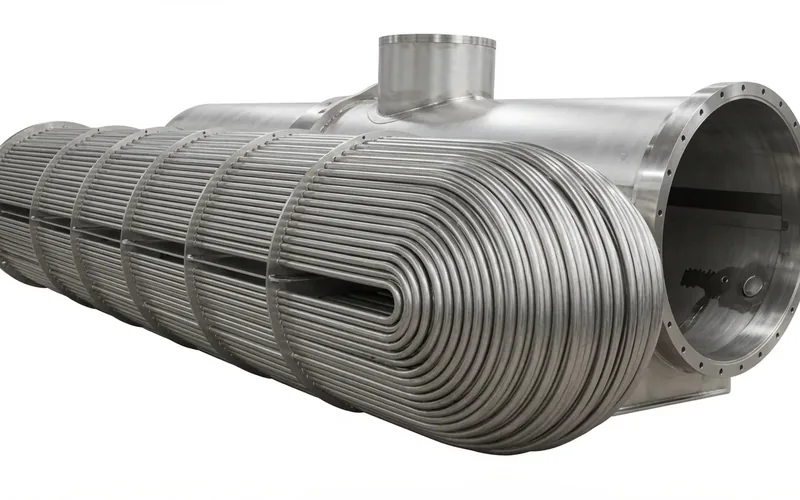
CONFIGURATION • TEMA
Horizontal U-Tube
Saddles, thermal growth and bundle pull clearance.
+ Learn More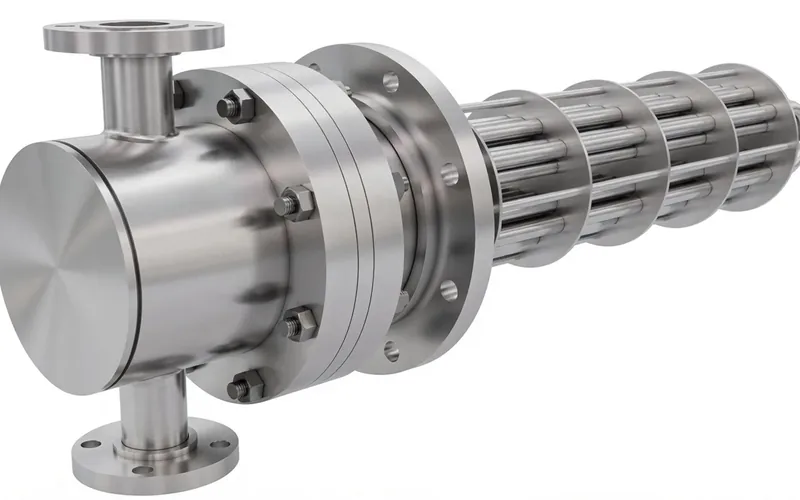
CONFIGURATION • TEMA
Tank-Mounted & Immersion
Bundles that enter the tank through a manway flange.
+ Learn More
CONFIGURATION • TEMA
TEMA U-Tube Types
BEU, AEU, BKU and DEU, and what the front head decides.
+ Learn More