
1-805-484-2992
Quotes - Engineering - SalesCondensate & Feedwater U-Tube Heat Exchangers
Boiler House Heat Recovery
The boiler house is where recovered heat has the shortest payback anywhere in the plant, because every degree you put back into feedwater is fuel you do not burn.
Condensate returning from process users carries substantial heat and is already treated, which makes recovering both the water and its energy the single best economic move available in most steam plants. You avoid the make-up water cost, the treatment chemical cost and the fuel to reheat it, all at once.
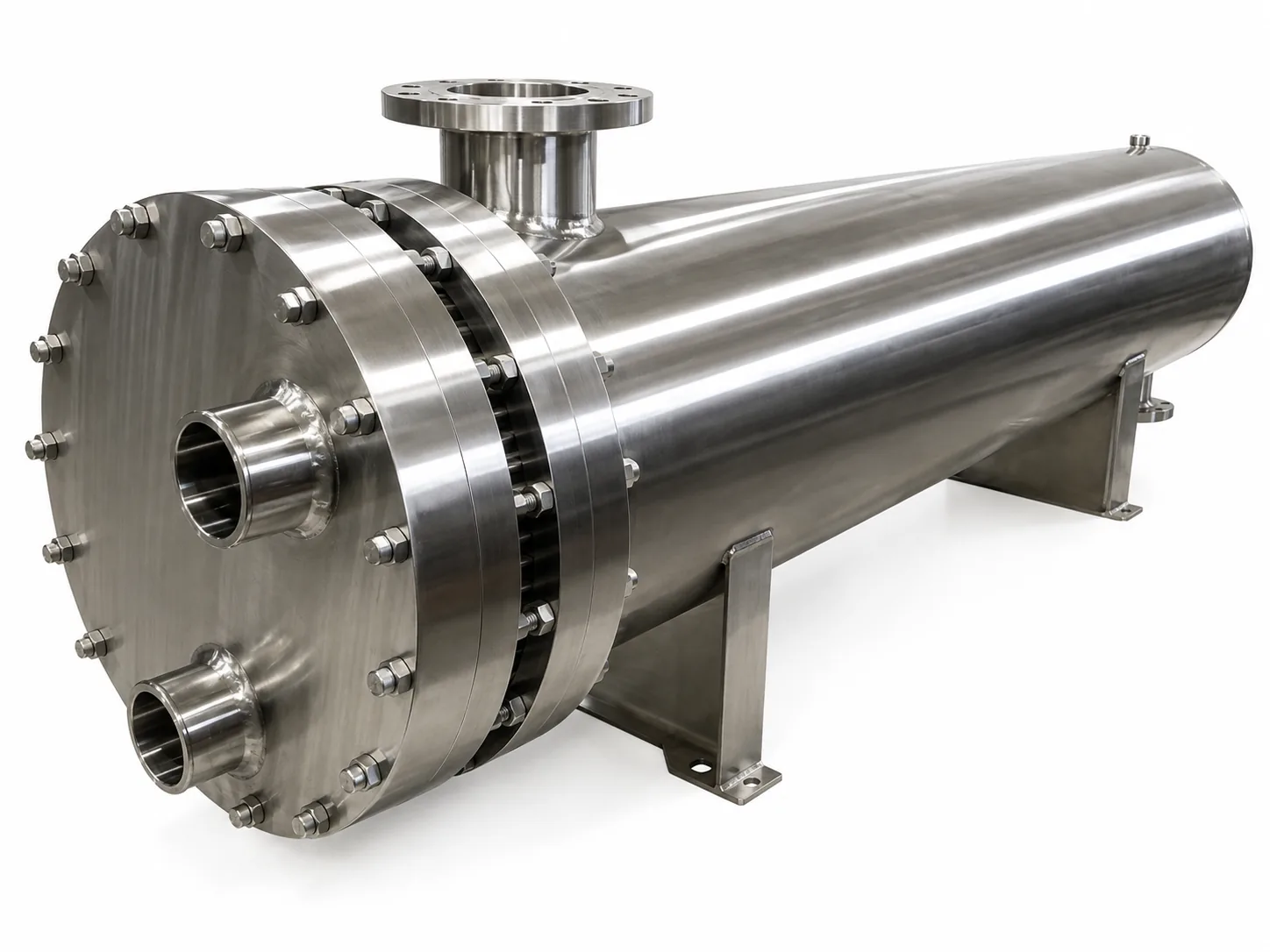
Feedwater preheating raises boiler efficiency directly. Every degree added before the boiler is a degree the boiler does not have to add. High-pressure feedwater heaters in power generation are among the most demanding U-tube applications built, and they are classic DEU territory: a D-type front head closure for tube-side pressure beyond what a bolted bonnet holds economically, behind a bundle with no rear pressure joint at all.
Blowdown recovery is the item most often omitted. Continuous blowdown carries heat away by design, and it does so continuously. A small exchanger recovering that heat into make-up water typically pays back in months. The reason it gets left out is not economics; it is that nobody put it on the drawing.
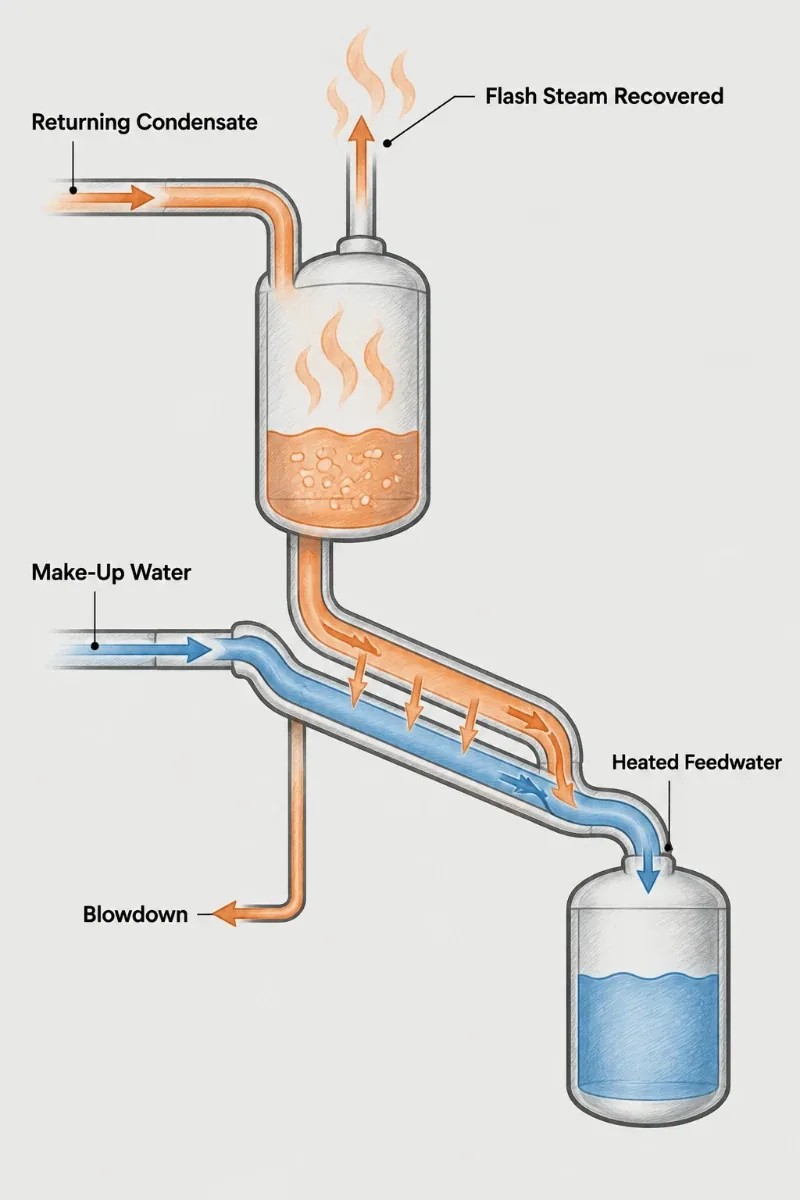
Hot condensate and blowdown flash when released to lower pressure. Recover the low-pressure steam first, then size the exchanger for the liquid that actually reaches it.
Request a QuoteCondensate & Feedwater

Design Notes
Flash steam is part of the design, not an afterthought. Hot condensate and blowdown released to a lower pressure flash into steam. Ignoring that produces an exchanger sized for a liquid stream that is partly vapor in practice. The usual arrangement is a flash vessel recovering low-pressure steam first, with the remaining liquid passing through the heat exchanger, and sizing the exchanger for the liquid that actually reaches it is what makes the numbers work.
Oxygen control matters as much as heat recovery. Recovered condensate that picks up air on its way back becomes a corrosion problem in the boiler rather than an asset. Closed recovery systems, properly vented deaeration and attention to where the return line can draw air are all part of doing this properly.
Thermal cycling is constant. Boiler house exchangers follow plant steam demand, which means they cycle for their whole service life. A U-tube bundle absorbs that without an expansion joint, which is a large part of why the geometry dominates the application.
Related pages: steam-to-water heating, DEU high-pressure exchangers, high-pressure U-tube construction and clean steam generation.
Boiler House Questions
Roughly one pound of steam for every 24 pounds of feedwater raised 40 F, because 40 BTU/lb of sensible heat divides into about 970 BTU/lb of latent heat. Take 10,000 lb/hr of feedwater raised 40 F: that is 400,000 BTU/hr, which condenses roughly 412 lb/hr of steam. That steam is not lost, because its condensate joins the feedwater, so the only waste is the small fraction that flashes at the trap. The common error is rating the heater on the full make-up flow when most of the return is already hot; rate it on the mixed temperature leaving the receiver, or the unit ends up oversized and throttled all year.
Yes, because blowdown carries the boiler's concentrated solids and scales whatever surface it touches. Run the blowdown on the shell side and the make-up water through the tubes in two passes; the tube bores on a U-bundle cannot be rodded through the bend, so the dirty stream has to be outside the tubes where the bundle pulls for cleaning. Expect the exchanger to be small. If continuous blowdown is 5 percent of a 20,000 lb/hr steaming rate, that is only 1,000 lb/hr of hot water to cool. Carbon steel is adequate on treated feedwater; stainless where the make-up is untreated or chloride-bearing.
Not well; keep them separate. Condensate return is clean, intermittent and near saturation, while blowdown is dirty, continuous and at boiler pressure before it flashes. Mixing them puts solids into the clean stream and subjects a single bundle to two different temperature cycles. The usual arrangement is a flash vessel ahead of each, with a small blowdown cooler in its own U-tube shell and the condensate handled by the deaerator or a dedicated heater. Where floor space is tight, two shells stacked on one saddle set is a better compromise than one shell with two duties.
The tube side must carry full feed pump discharge pressure, which is well above drum pressure, while the shell side sees only the heating steam. That asymmetry is why a high-pressure feedwater heater is specified with a D-type front head, and why a low-pressure industrial unit gets by with a bolted bonnet. Specify the pump shutoff head, not the running pressure, as the tube-side design condition; relying on a relief valve set at running pressure is a common oversight. Call for rating on anything above the standard catalog figures.