
1-805-484-2992
Quotes - Engineering - SalesSanitary Product Cooling U-Tube Exchangers
Bringing Product to Fill or Storage Temperature
Cooling product to fill or storage temperature is the last thermal step before it becomes inventory. Get it wrong and you affect shelf life, texture and everything the process upstream worked to achieve.
Post-process cooling takes product from a hot process step down to fill or storage temperature, usually against chilled water or glycol. It looks like the simplest duty in the plant and it contains two traps that catch people regularly.
The cold end works hardest for the least return. Two things happen there simultaneously. The temperature difference is at its smallest, and the product is at its most viscous, so both the driving force and the film coefficient are at their lowest. The last few degrees therefore cost disproportionate surface area. If the required outlet temperature can be relaxed even slightly, the exchanger often gets substantially smaller and cheaper.
Freezing is a real risk, not a theoretical one. Where the coolant runs well below the product's freezing point and flow is low or momentarily stopped, product freezes onto the tube wall. It insulates, so the surrounding surface works harder, and later it sloughs off in pieces. That is a quality problem as much as a thermal one. Coolant temperature control and minimum flow interlocks are the standard protections and they belong in the design rather than in the operating procedure.
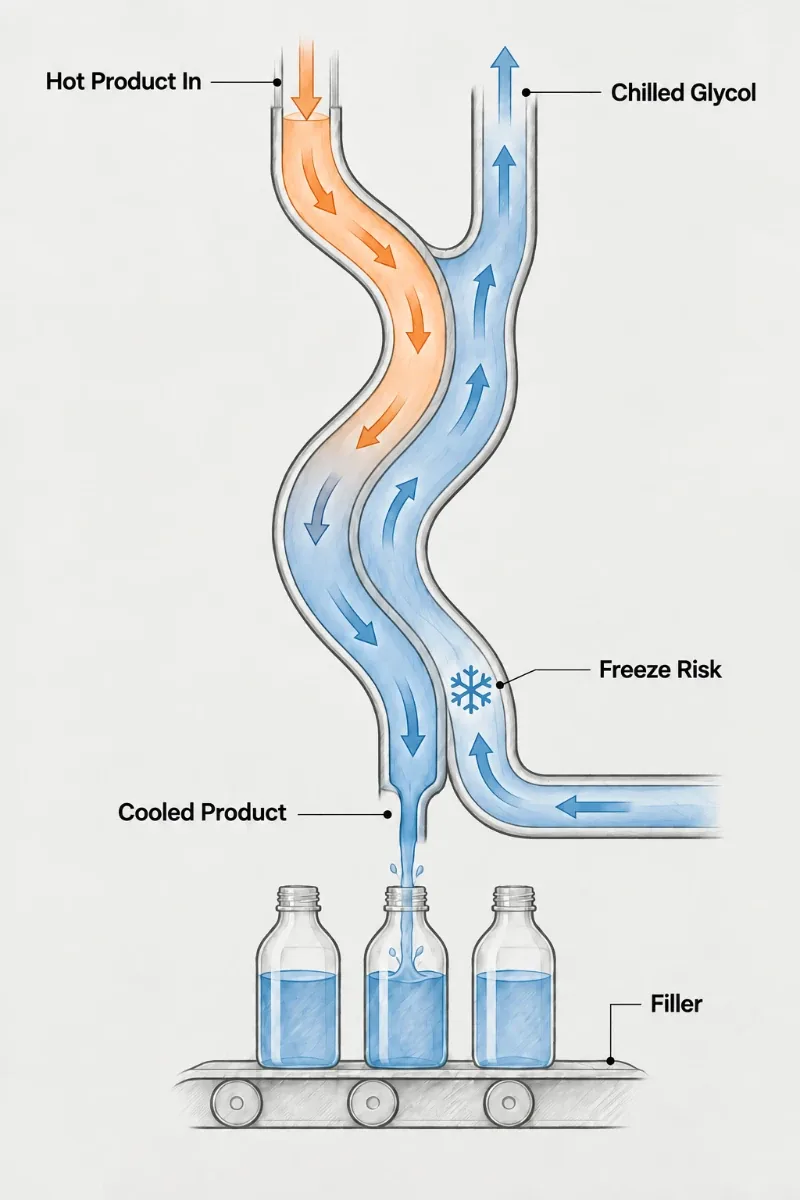
Viscosity rises as product cools, so the cold end works hardest for the least return. Size against the property profile rather than an average value.
Request a QuoteSanitary Product Cooling


Design Notes
Viscosity is a range, not a number. Send the property profile across the whole cooling range. Product entering thin and leaving thick changes flow regime through the exchanger, and a design based on an average will misjudge the coefficient, the pressure drop and often the required surface by a meaningful margin.
Drainability matters at the cold end too. Residue left in a cold exchanger between runs is still residue, and cold viscous product drains more slowly than hot. Vertical orientation or a properly sloped horizontal shell with a low-point drain is what makes the cleaning claim demonstrable rather than argued.
Which side for the product. Viscous and particulate-bearing products usually favor the shell side, where velocities are gentler and the surface can be reached once the bundle is out. Thin, clean products can run tube side, where drainage is straightforward and CIP solution follows exactly the same path the product took.
Related pages: sanitary product heating, pasteurization and HTST, process cooling and sanitary U-tube construction.
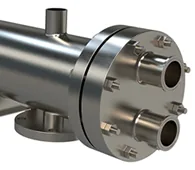
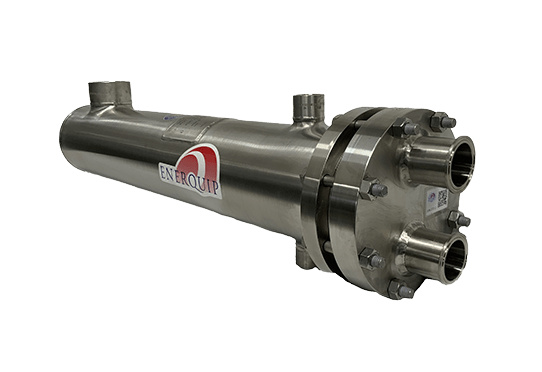
Cold-End Cooling Answers
Divide the product heat load in BTU/hr by 500 times the chilled water temperature rise you allow, and the result is gallons per minute. A load of 500,000 BTU/hr with a 10 F rise on the water needs 100 gpm; allow a 5 F rise and the flow doubles to 200 gpm, but the mean temperature diffrence across the exchanger improves and the surface shrinks. That trade between pumping and surface is the sizing decision on the water side. Glycol changes the constant: its heat capacity sits below 1 BTU/lb-F, so the same load needs noticeably more flow of glycol solution than of water.
Often, yes: a first stage against tower or ambient water takes the bulk of the heat where the temperature difference is large, and a second stage against chilled water or glycol finishes the job. The chiller then carries only the cold-end load instead of the whole duty. Two shells also let the cold stage run product on the side that drains best while the warm stage takes the higher velocity. The cost is a second set of connections and CIP paths.
Closer than most people expect on a thin product, and not very close at all on a viscous one. The approach between product outlet and coolant inlet is bought with surface area at the cold end, where the film coefficient on a thickening product collapses. Every degree of approach you give back buys surface, so state the outlet you actually need for fill or storage and the tolerance on it. Call for rating on a specific product and coolant pairing rather than carrying a rule of thumb from a water duty into a product that leaves the cooler as a paste.