
1-805-484-2992
Quotes - Engineering - SalesPasteurization & HTST U-Tube Exchangers
Regeneration, Heating, Holding and Cooling
Pasteurization is one of very few heat transfer duties where the temperature is set by regulation rather than by process economics. Hitting it reliably, and being able to prove you did, is the entire job.
An HTST system heats product to a defined temperature, holds it for a defined time in the hold tube, and cools it back down, recovering much of the heat through regeneration on the way. Each section is a separate thermal problem and the regulation governs the middle one.
Regeneration is where the economics live. Incoming cold product is heated by outgoing hot product, which cuts utility consumption dramatically. It also creates the condition that governs the entire system: two product streams at different microbiological status separated by a single wall.
The pressure differential rule. Pressure on the pasteurized side must exceed pressure on the raw side at all times, so that any leak in the regeneration section flows from safe to unsafe rather than the reverse. This is a regulatory requirement, not a design preference, and it constrains pump placement, valve arrangement and the entire system layout. It also stresses gasketed equipment, which is one reason tubular units earn their place here.
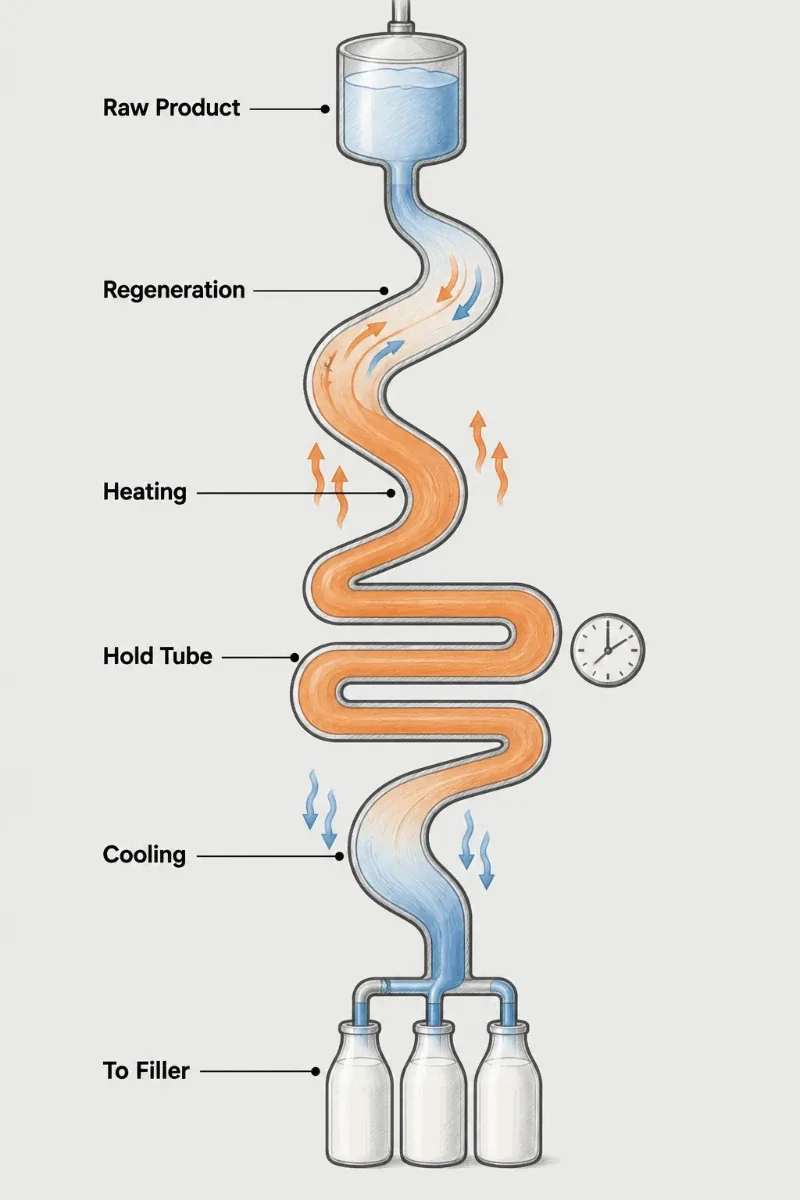
Pasteurized product must sit at higher pressure than raw product at all times, so any leak in the regeneration section flows the safe direction.
Request a QuotePasteurization & HTST




Design Notes
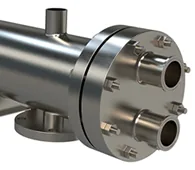
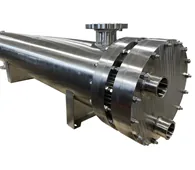
Where tubular beats plate. Plate exchangers dominate HTST regeneration because their close temperature approach makes regeneration efficient, and on clean low-viscosity products they are the right choice. Where they struggle is with particulates, fibers and viscous products, all of which block narrow plate channels, and with the pressure differentials the safety case demands. On juices with pulp, soups, sauces and products carrying inclusions, tubular is frequently the more reliable answer.
Fouling is protein burn-on. Denaturation at the heating surface depends on surface temperature rather than bulk temperature, so a hotter medium with less surface produces shorter run times between cleans. Reducing the heating medium temperature and adding surface area usually lengthens run length significantly, and on dairy duty that is the difference between cleaning once a shift and cleaning once a day.
The hold tube belongs to the design. Residence time at temperature is what actually achieves pasteurization, and it depends on the slowest particle rather than the average. Hold tube sizing, slope and the velocity profile through it are part of the same conversation as the exchanger, not a separate piping question.
Related pages: sanitary product cooling, product heating, 3-A sanitary construction and double tubesheet exchangers.
HTST System Answers
Regeneration efficiency is the temperature rise the raw product takes from the pasteurized stream divided by the total rise to pasteurization temperature, and a tubular section is sized to whatever figure the economics justify. Every point of regeneration cuts both the heating and the cooling utility, so the section pays twice. Tubular regenerators run a wider approach than plate units because shell-side velocity is gentler, so a high figure means more surface and often a second shell in series. The trade is run time: a plate section blocks on pulp, a tubular one keeps regenerating. Send the target efficiency and the product and the section is rated against it.
On the raw side, between the balance tank and the raw regenerator inlet, interlocked so it cannot run unless the timing pump is running and product is at pasteurization temperature. The Pasteurized Milk Ordinance requires pasteurized product in the regenerator to stay at least 1 psi above raw product, and the booster pump is the pump that pressurizes the raw side, so the differential pressure controller stops it the moment that margin is lost. On a tubular regenerator the pressure drop through each section is part of that calculation, so pump head and exchanger are specified together.
It sends under-temperature product back to the balance tank, so the heating section sees the same product again, warmer, and the regenerator briefly sees mismatched flow on its two sides. The exchanger has to recover temperature fast after a divert so the line is not cycling between forward and diverted flow, which argues for margin in the heating section rather than a design that just reaches setpoint. Every divert is also a thermal cycle on the bundle.
With a salt conductivity test: a slug of salt solution is injected at the hold tube inlet and timed to a conductivity probe at the outlet, at the maximum flow the timing pump can deliver. The regulation counts the fastest particle, so the test runs at full pump speed and the result has to exceed the legal hold time with no credit taken for the exchanger. The hold tube is pitched upward so no part of it drains forward, and the exchanger pressure drop is part of the same hydraulic loop the pump works against.