
1-805-484-2992
Quotes - Engineering - SalesSanitary Heating
U-Tube Exchangers
Heating the Product Stream Without Damaging It
Heating the product itself is a different problem from heating a utility. The stream is valuable, often viscous, frequently shear sensitive, and it will burn onto any surface that is hotter than it should be.
Product heating covers sauces, purees, syrups, protein solutions, dairy streams, plant-based beverages and anything else that has to reach a target temperature without being altered on the way there. The thermal duty is usually straightforward; everything around it is not.
Burn-on is the dominant fouling mechanism. Product in contact with a surface well above its bulk temperature denatures, caramelises or scorches and adheres. That deposit insulates, so the wall runs hotter, so the deposit grows faster. Run length between cleans collapses, and the cleaning itself becomes more aggressive, which shortens equipment life in turn.
Surface temperature, not medium temperature. This is the single most useful thing to get right. Using 100 psi steam to heat a delicate stream produces a wall temperature far above the product target, and the product touching that wall pays for it. Hot water or low-pressure steam with a larger exchanger costs more in surface and far less in cleaning downtime and product loss. On most sanitary heating duty that trade is strongly favorable.
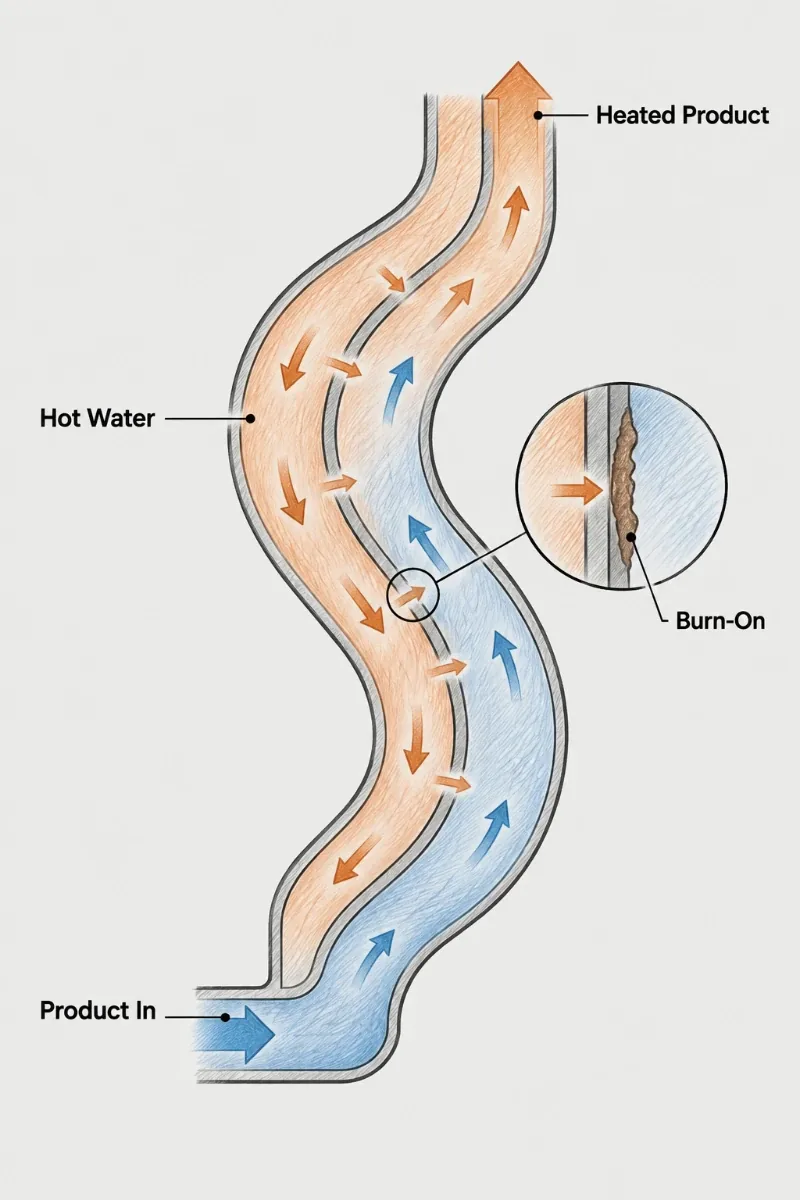
What damages product is the temperature of the metal it touches, not the temperature of the medium. A gentle approach with more surface beats hot steam with less.
Request a QuoteSanitary Product Heating




Design Notes
Which side should the product be on? Shell side gives gentler velocities for shear-sensitive fluids and a surface you can physically reach once the bundle is out, at the cost of having to engineer drainage rather than assume it. Tube side gives a smooth passage that CIP solution follows exactly, with the U-bend as the honest limitation. Viscous products and anything carrying particulates usually favor the shell.
Viscosity is a range, not a number. Send the viscosity across the whole temperature range rather than at one point. Product entering cold and leaving hot changes its flow regime through the exchanger, and a design based on the average will misjudge both the coefficient and the pressure drop.
Particulates favor tubular. Plate exchangers block on fibers, pulp and inclusions. A tubular unit sized with passage dimensions chosen against the largest expected particle handles those streams comfortably, and the bundle can be pulled and the shell side cleaned. This is one of the clearer cases where shell and tube beats plate on sanitary duty.
Related pages: sanitary U-tube exchangers, pasteurization and HTST, sanitary product cooling and surface finish and passivation.
Product Stream Answers
As close to the product outlet temperature as the surface budget allows, usually hot water or steam at the lowest pressure that still delivers the duty. The figure to request from your quality team is the product's burn-on threshold; with it, the tube wall temperature is rated directly and the medium is backed off until the wall sits below it. A larger stainless U-tube bundle on hot water often costs less over a year then a small one on 100 psi steam, once cleaning downtime and lost product are counted.
Every product-contact surface must be reached by CIP solution at cleaning velocity, drain fully, and tolerate caustic and acid cycles. On a U-tube bundle that means tube-side product runs in a smooth bore with the bend as the only non-straight path, while shell-side product requires a drainable shell with no dead pockets behind baffles. Specify the CIP flow rate and temperature, because the CIP cycle often sets a higher velocity and a hotter wall than production does, and the exchanger has to survive both. Tri-clamp connections let the heads come off for inspection.
Send viscosity at the inlet, outlet and at least one midpoint temperature; a single value is the most common cause of an undersized product heater. Viscous product on the shell side stays laminar, so the rating uses laminar correlations and the surface grows. Tube-side viscous flow in two passes may be turbulent at the hot end and laminar at the cold end of the same pass, which is why the rating is done in zones. Where pressure drop allows, a four-pass bundle often cuts surface more than any alloy change would.
Yes, with low-pressure steam in the tubes and the product on the shell, where the condensing coefficient is high and the wall temperature is set by the steam saturation temperature. The limit is burn-on: steam condenses at a fixed temperature, so the wall cannot be backed off the way a hot-water loop can. Steam works for robust streams such as syrups and brines and is generally avoided for proteins and dairy. Culinary steam is required wherever the steam side could reach product through a leak.