
1-805-484-2992
Quotes - Engineering - SalesHorizontal U-Tube Heat Exchangers
Supports, Growth and Access
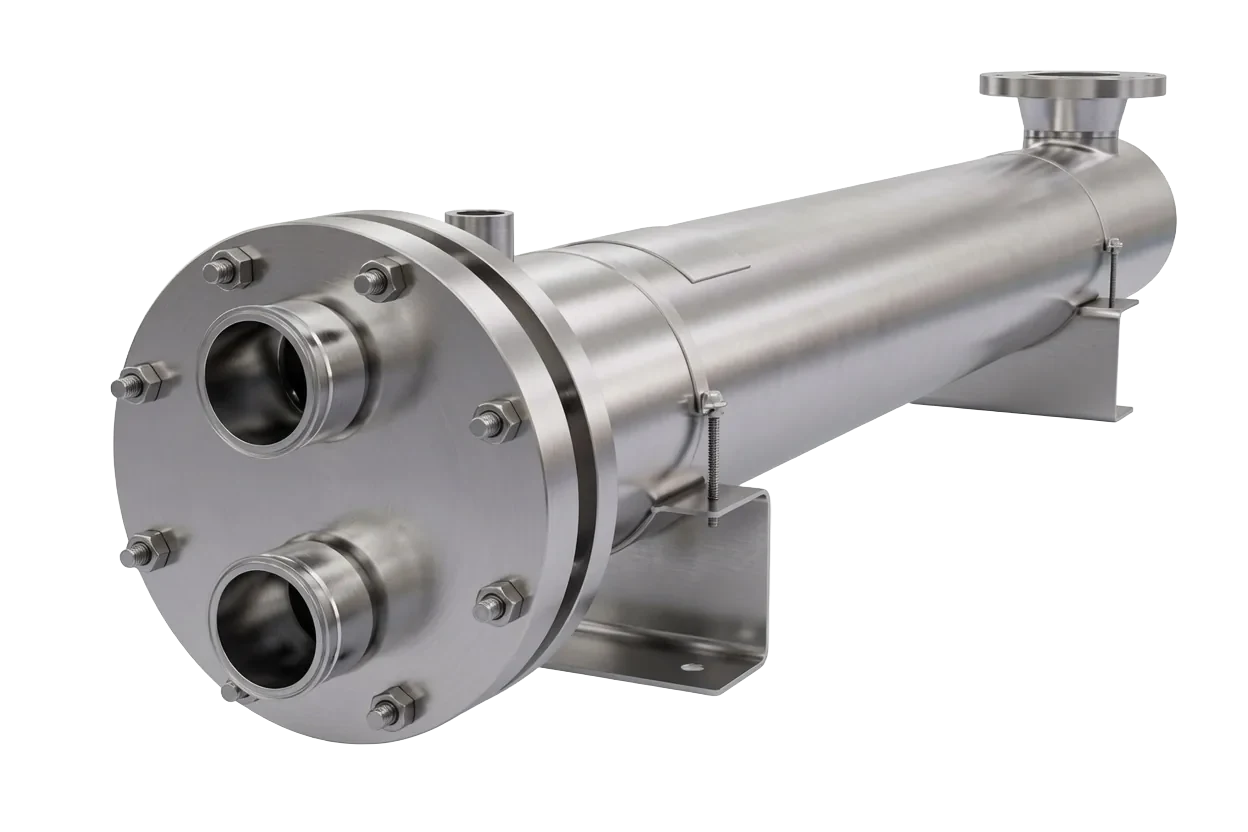
Most exchangers are horizontal because most plants have floor space and not much headroom. The arrangement is straightforward, provided the supports allow the shell to grow and the layout allows the bundle to come out.
A horizontal shell rests on two saddles. Under temperature it grows lengthwise, and that growth has to be accommodated somewhere. Standard practice is one saddle fixed and one with slotted holes so the shell can slide.
Getting the slots right. Slot length is calculated from the shell material, the temperature range and the distance between saddles. Slots that are too short bind, and a bound shell transmits load straight into the nozzles.
Typical Construction
- Orientation: Horizontal on saddle supports
- Support arrangement: One fixed saddle, one sliding with slotted holes
- Slot sizing: Calculated from material, temperature range and saddle spacing
- Vent: High point of the shell in the installed position
- Drain: True low point, allowing for installed slope
- Bundle clearance: At least bundle length in line with the shell
- Davit arm: Recommended where the bundle will be removed periodically
- Lifting lugs: Sized for the assembled unit and for the bundle separately
- Insulation: Allow for jacket thickness at supports and nozzles
- Codes: ASME Section VIII, TEMA R, B or C
The second of the two saddles under a horizontal shell, with slotted bolt holes so the shell can grow lengthwise under temperature while the fixed saddle holds its position.
Horizontal U-Tube Heat Exchangers
Vent and drain against the real slope. Nozzle placement should reflect how the unit will actually sit, including any deliberate slope for drainage. A drain that is not at the true low point leaves liquid in the shell.
Bundle removal. Leave clear space in line with the shell at least equal to the bundle length. A davit arm mounted on the front head turns bundle removal into a routine operation instead of a crane lift, and it is far cheaper specified with the unit than added later.
The Clearance Conversation
It is worth having at layout stage with the piping designer in the room. The clearance envelope has to be free of pipe racks, cable trays, adjacent equipment and structural steel, and it has to stay free.
Where the plot genuinely will not allow it, say so early. Options exist: a shorter, larger-diameter shell; two smaller units; or a different exchanger type where bundle removal is not the maintenance route.
Saddles, Slope and Pull Space
Long enough for the saddle to slide the full calculated growth plus a margin, which for carbon steel is about 0.08 inch per 10 feet of saddle spacing for every 100°F above the installation temperature. Austenitic stainless shells grow about half again as much. The bolt in the slot is snugged rather than torqued, and often sits on a slip plate or lubricant so it moves on the first warm-up. A slot cut to the bolt diameter plus a little clearance, which is common on general fabrications, is the usual mistake; it binds, and the shell then pushes on the nozzles.
The saddle nearest the piping that cannot flex, which is usually the one at the front head where the tube-side nozzles connect. Fixing that end keeps the heaviest and stiffest connections stationary and lets the bonnet end of the shell grow away from them. On a U-tube exchanger both tube-side nozzles are on the front head, so the choice is simpler than on a two-head design. If the shell-side piping is the rigid one instead, fix the saddle nearest the shell nozzles and tell the piping designer which end moves.
Yes, a slight slope toward the condensate outlet so condensate drains instead of pooling along the bottom and submerging the lower tubes. Flooded tubes do no condensing, so the exchanger loses surface, and on a steam-to-water U-tube that shows as a hunting temperature control valve and water hammer at startup. The slope is small, but the drain nozzle must be at the true low point of the installed unit rather than the drawing. Note the slope on your Request a Quote so nozzle and saddle heights suit it.
Enough for the insulation jacket to pass between the saddle web and the shell without being crushed, and for the nozzle flanges to clear the jacket thickness on the piping side. Saddles usually carry a wear plate so the insulation stops at the plate edge. Where insulation is wrapped over the saddle, the sliding saddle cannot move and the slots do nothing. Give the insulation thickness with the inquiry and the saddle height and nozzle projections will be set to suit, which is far cheaper than shimming the unit in the field.
On the shell for the assembled unit and on the tubesheet for the bundle alone, because the two are lifted at different times and have different centers of gravity. The assembled lift must clear the nozzles and saddles; the bundle lift has to balance a cantilevered assembly whose center of gravity sits well toward the tubesheet end. A lug sized for the complete exchanger is not automatically safe for a bundle pull, since the load path is different. Lug positions appear on the outline drawing, and a davit can take over the bundle lift on units pulled routinely.
Yes, provided the bundle pull path runs out from under the rack rather than along it, and no rack column sits in that path. The front head should face the open side. Headroom under a rack is usually enough for a shell on low saddles, but a davit arm on the front head swings through an arc and needs that arc free. Check that the condensate drain still reaches the trap by gravity from a low mounting height. Settle these on the plot plan before the shell diameter is final.
Related
CONFIGURATION • TEMA
Tank-Mounted & Immersion
Bundles that enter the tank through a manway flange.
+ Learn More
CONFIGURATION • TEMA
TEMA U-Tube Types
BEU, AEU, BKU and DEU, and what the front head decides.
+ Learn More