
1-805-484-2992
Quotes - Engineering - SalesHigh-Pressure U-Tube Heat Exchangers
Fewer Joints at Higher Pressure
As tube-side pressure climbs, joints become the problem. A U-tube bundle has one fewer pressure-boundary joint at the rear than any floating head design, and that single omission is why it dominates high-pressure service.
Every pressure-boundary joint is a place that has to seal and a place that can leak. A floating head design needs a seal at the rear tubesheet that moves during operation. A U-tube design does not have a rear tubesheet at all; the bend end floats freely inside the shell with no seal, no gasket and no bolting.
That absence scales well. At moderate pressure the difference is a cost item. At high pressure it becomes a design advantage, because sealing a moving joint against several thousand psi is expensive, and every such joint is a maintenance liability for the life of the unit.
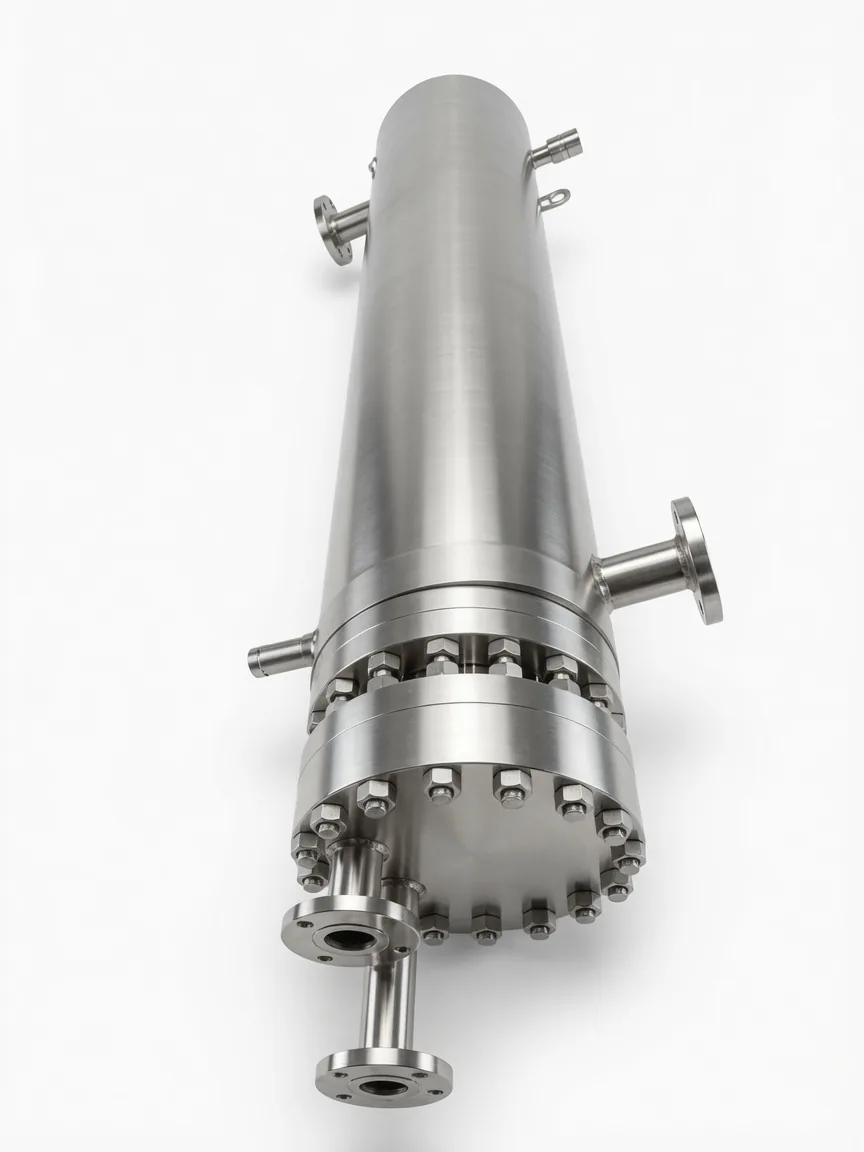
| PRODUCT | STYLE | TEMA TYPE | BUNDLE |
| U-Tube Heat Exchanger | U-Tube, single tubesheet | BEU / AEU / BKU | Removable |
Typical Construction
- Pressure capability: Design pressures to several thousand psi, service dependent
- Front head: Bonnet or channel at moderate pressure; D-type closure above
- TEMA designation: BEU, AEU or DEU depending on front head
- Rear head: U-tube; no rear pressure-boundary joint
- Tubesheet: Thickness set by differential pressure and diameter
- Tube joints: Rolled, roll-plus-seal-weld, or strength welded
- Materials: Carbon steel, low alloy, stainless, duplex and higher alloys
- Testing: Hydrostatic test with documented records
- Codes: ASME Section VIII Division 1; API 660 where required
- Sour service: NACE MR0175 hardness control with post-bend stress relief
High-Pressure U-Tube Heat Exchangers
Front head selection. Standard A and B heads cover a wide pressure range. Above that, a D-type front head with a special high-pressure closure is the usual answer, which is where the TEMA DEU designation comes from. Feedwater heaters and high-pressure gas coolers are the classic homes for it.
Tubesheet and testing. The single tubesheet carries the full differential and grows thick quickly with pressure. Hydrostatic testing, examination coverage and joint detail all step up accordingly, and on the highest-pressure work the tube-to-tubesheet joint moves from rolled to strength welded.
Choosing Between U-Tube and Floating Head at Pressure
Both designs give you a removable bundle and both absorb thermal expansion, so the decision comes down to two questions. Does the tube side need mechanical cleaning? If yes, floating head, because you cannot rod a U-bend. If no, U-tube, because it is cheaper, simpler and has fewer things to seal.
High-pressure duty tends to answer the first question with a no, because the high-pressure stream is usually the clean one. That is why the combination shows up so consistently.
What Rises With Pressure
Tubesheet thickness climbs faster than most people expect, because it scales with both differential pressure and shell diameter. That has knock-on effects: a thicker tubesheet means longer tubes for the same effective length, and it can change the economics enough to favor two smaller shells over one large one.
Examination and documentation also step up. Higher pressure classes bring more radiography or ultrasonic coverage, tighter material requirements and more third-party involvement, all of which affect schedule as much as cost.
Pressure-Class Details
The tube side, nearly always, because a small-bore tube carries pressure far more cheaply than a large-diameter shell. Required wall thickness for a given pressure scales with diameter, so a tube at several thousand psi is still a thin section, while a shell of the same rating becomes a heavy forging. Keeping the high pressure inside the tubes also means the shell can be carbon steel at a modest rating while the tubes, tubesheet and front head take the alloy and the thickness. The exception is a kettle or a condensing duty where the high-pressure stream has to be on the shell side; then the shell rating drives the cost and the tubesheet carries the differential in the other direction.
When the tubesheet forging, not the surface area, is setting the price. Tubesheet thickness grows with shell diameter at a given differential pressure, and the forging cost grows faster still, because the volume of metal rises with the square of the diameter times the thickness. Two shells in series at a smaller diameter each need a thinner tubesheet, a thinner shell and lighter flanges, and the forging material saved can pay for the second set of heads and nozzles. Series flow also gives two tube passes per shell for four effective passes, which helps when tube-side velocity is otherwise low. Ask for both arrangements priced at inquiry when the diameter is heading past what standard plate thickness covers.
Either a relief device sized for the tube rupture case or a low-pressure side designed to withstand it. ASME Section VIII requires protection against internal failure, and the practice described in API 521 treats a low-pressure side designed to at least two-thirds of the high-pressure side design pressure as covered without a dedicated rupture relief. Where the ratio is wider than that, the shell gets a relief valve or rupture disk sized for flow through both open ends of a broken tube, and the discharge has to go somewhere safe. On a U-tube unit the shell is normally the low-pressure side, so this is a shell-rating decision made at design.
Each side separately, at 1.3 times it's design pressure corrected for the material stress ratio at test temperature, per ASME Section VIII Division 1. The shell side is tested first with the bonnet or channel removed, so every tube joint on the tubesheet face is exposed; shell pressure pushes any joint weep out the tube end where it can be seen. The tube side is tested afterward with the head bolted up, which checks the head gasket and the pass partition as well as the tubes. Expect both tests to be witnessed by the Authorized Inspector on a stamped unit and recorded on the U-1 form.
Yes. TEMA sets the expanded length at the smaller of 2 inches or the tubesheet thickness minus 1/8 inch, so on a tubesheet several inches thick most of the hole depth is not gripped by the roll. The unexpanded hole length is a crevice where chloride or sour attack starts, so those services ask for full-depth expansion; strength welds take over as pressure climbs for load, not for the crevice. With a welded joint the weld at the front face carries the load and seals; the expansion behind it only keeps the tube from vibrating in the hole. Ask for the joint detail on the drawing: expanded length, seal or strength weld, and whether the holes are grooved.
Related
U-TUBE • CONSTRUCTION
High-Temperature U-Tube
Hot oil and thermal fluid, with no expansion joint.
+ Learn More
U-TUBE • CONSTRUCTION
Corrosion-Resistant U-Tube
Alloy selection by the attacking species.
+ Learn More