
1-805-484-2992
Quotes - Engineering - SalesCIP Heat Exchangers
Heating Clean-in-Place Solutions to Setpoint
A CIP exchanger has to heat aggressive chemistry quickly and then be cleaned itself. It is one of the few duties where the exchanger is simultaneously the tool and the thing being cleaned.
A CIP circuit brings caustic, acid, sanitizer and rinse water to setpoint and holds them there while solution recirculates through the process equipment being cleaned. The exchanger doing that heating is in the circuit, which means it sees every chemical the plant uses, hot, over and over again.
Ramp rate is the commercial driver, not energy. Once solution is at setpoint the standing heat load is small. What matters is how quickly the tank reaches temperature, because that time is production time lost. CIP heaters are therefore sized for heat-up rate rather than for hold duty, and undersizing one to save capital cost is usually a poor trade against the changeover time it adds every single day.
Chlorinated sanitizers are the alloy problem. Caustic at temperature is straightforward in 316L. Acid cycles are manageable. What catches austenitic stainless is chlorinated sanitizer, because chlorides plus temperature plus the residual tensile stress at a U-bend is precisely the recipe for stress-corrosion cracking. Where a chlorinated sanitizer is part of the cycle, that frequently moves the recommendation to duplex, and it is far cheaper to make that decision once than to replace a cracked bundle twice.
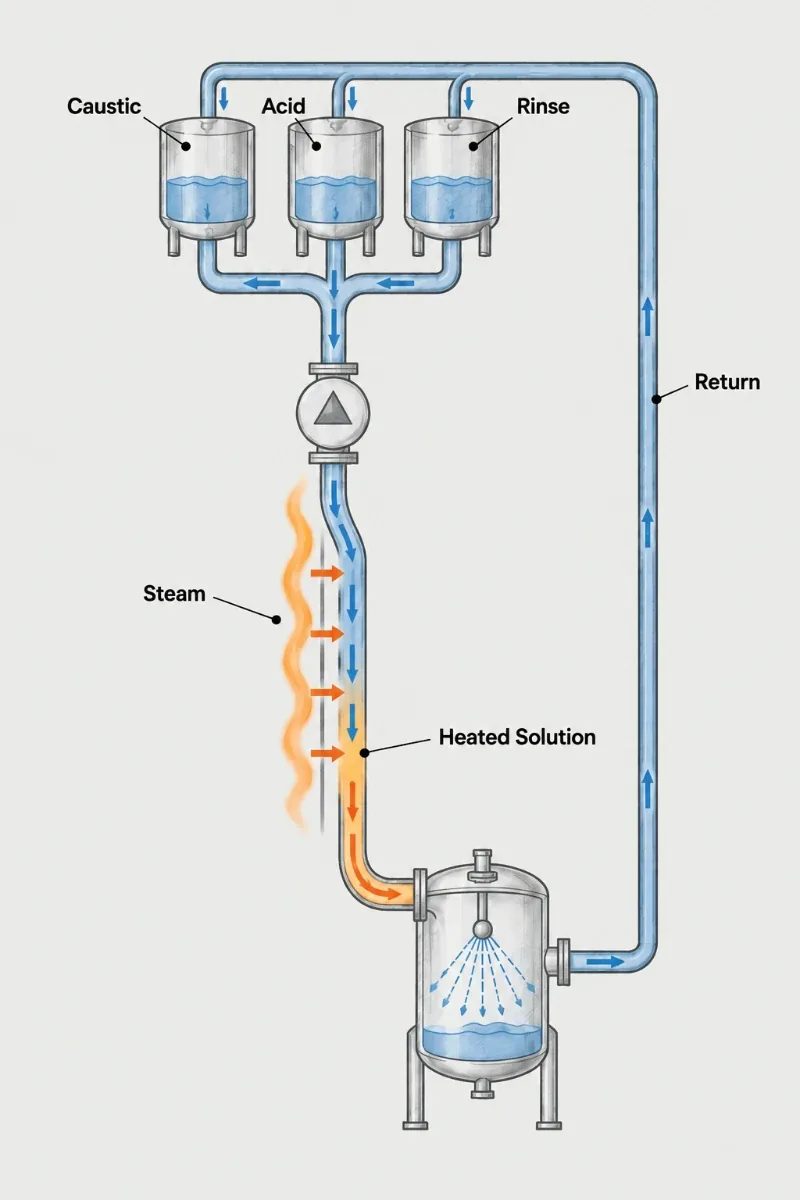
The exchanger sits in the circuit, so it receives the same solutions as the equipment it cleans. It has to be as drainable and cleanable as everything downstream of it.
Request a QuoteCIP Solution Heating


Design Notes
Tell us the full cycle, not the product. The most useful information for a CIP heater is the complete sequence: which solutions, at what concentration, at what temperature, for how long, and in what order. That sequence is a more aggressive service than most of the product the circuit cleans up after, and it is what the alloy has to survive.
The exchanger has to clean itself. Because it sits in the circuit it needs the same drainability, the same crevice-free construction and the same absence of dead legs as any product-contact equipment. Seal-welded tube joints, sloped shells, low-point drains and sanitary connections are all specified for the exchanger's own cleanability rather than only for the product it eventually helps make.
Single tank or multi-tank. Single-tank sets reuse solution and are simpler; multi-tank sets hold caustic, acid and rinse seperately and change over faster. The exchanger sizing follows the arrangement, and on multi-tank sets it also has to handle the transition between chemistries without carryover.
Related pages: sanitary U-tube exchangers, culinary and clean steam, duplex and high alloys and tri-clamp connections.
CIP Heater Specifics
Steam, in almost every plant that has it, because steam at 970 BTU/lb delivers the ramp rate a changeover demands from a far smaller bundle than a hot water loop. A hot water loop caps the heater at the loop supply temperature, so the approach shrinks as the tank nears setpoint and the last ten degrees take longest, which is exactly where the production clock is running. Steam in the tubes with solution on the shell side keeps the condensing surface steady across the whole ramp. The trade is control: a steam valve and trap sized for the ramp rather than the hold, plus a vacuum breaker so the bundle does not stall when demand drops to the standing load.
The rinse between them has to pass through the heater too, or the next solution carries over the last one and neutralizes itself inside the bundle. On a multi-tank set the exchanger sees caustic, a water rinse, then acid in sequence, and anything held in a low spot or a dead nozzle goes straight into the next tank. The heater therefore drains to the same low point as the rest of the circuit, and the shell is sloped so the rinse displaces the previous solution instead of layering over it.
Because rinse water carries hardness, and hot caustic drops that hardness onto the hottest surface in the circuit, which is the heater. Calcium carbonate precipitates faster as temperature rises, so the tube wall nearest the steam inlet scales first even though the bulk solution is well below boiling. On single-tank sets that reuse solution, soil carried back from the equipment being cleaned adds a second layer. The acid cycle strips some of it each time, which is why heaters on circuits without an acid step foul noticeably faster. Softened rinse water and a periodic acid pass through the heater alone keep the ramp rate where it was commissioned.
Yes, provided the alloy and the gaskets are chosen for the worst solution in the sequence rather than the average. Gaskets are the item most often overlooked: a material that handles hot caustic comfortably may swell in the acid cycle or harden under a chlorinated sanitizer, and a tri-clamp gasket that has taken a set is a leak on the next heat-up. Specify the gasket against the full chemistry list and the maximum temperature it will see, and keep spares at the plant.