
1-805-484-2992
Quotes - Engineering - SalesCustom U-Tube Heat Exchangers
Engineered to the Duty
A custom exchanger is not a stock unit with a different nozzle. It is a unit rated against your operating envelope, built in the material the chemistry requires, and documented to whatever standard the site enforces.
The value of a custom build is that nothing has to be compromised to fit a catalog. Shell diameter, tube length, pass arrangement, baffle spacing, alloy, connection style and code package are all selected rather than accepted.
Thermal rating comes first. The unit is modeled against the full envelope, not a single design point: startup, normal, turndown and upset. Fouling factors are chosen from what the streams actually do rather than from a default table where we can help it.
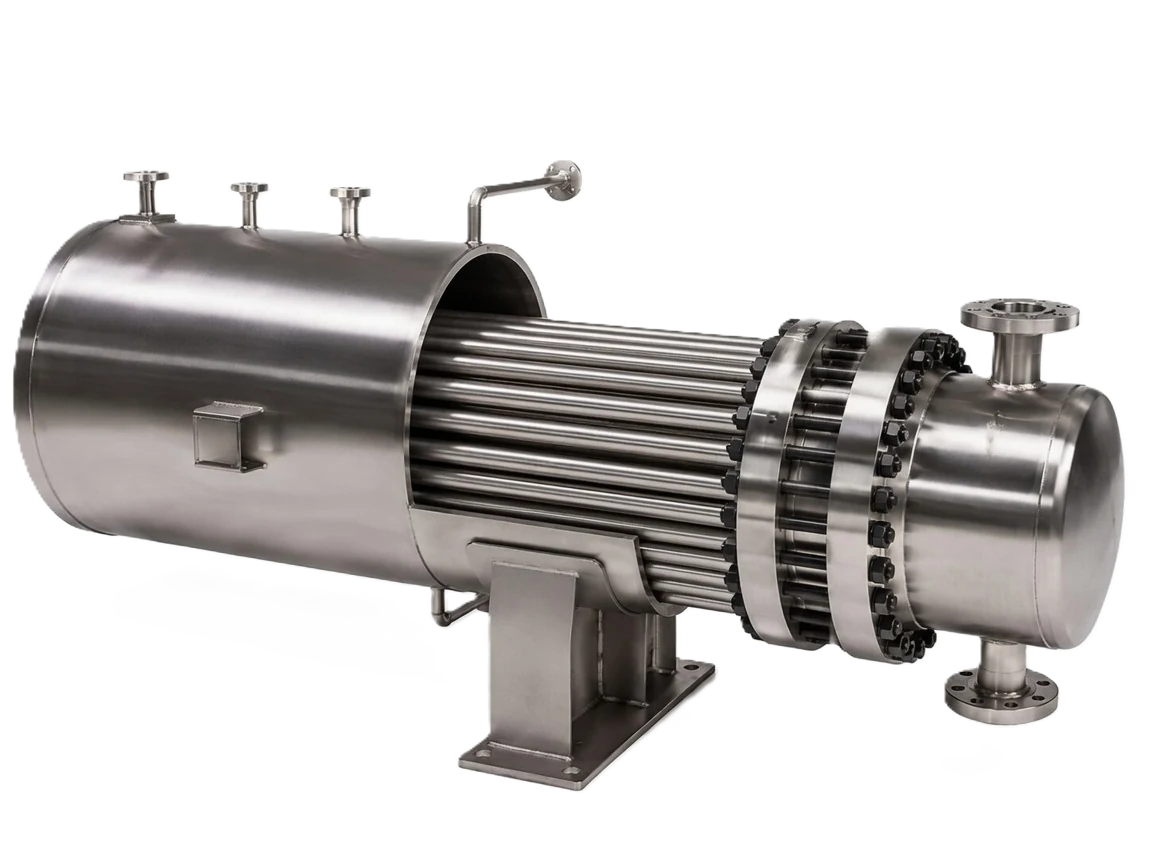
| PRODUCT | STYLE | TEMA TYPE | BUNDLE |
| U-Tube Heat Exchanger | U-Tube, single tubesheet | BEU / AEU / BKU | Removable |
Typical Construction
- Shell diameter: To approximately 48 inches, weight dependent
- Materials: Carbon steel, 304L/316L, duplex, Alloy 20, Monel, Hastelloy, AL-6XN, titanium
- Design pressure: To several thousand psi depending on service
- Tube joints: Rolled, roll-plus-seal-weld or strength welded
- Tubesheets: Single or double with vented interspace
- Connections: Sanitary clamp, ASME flanged, NPT or lap-joint
- Finishes: Mill, passivated, polished or electropolished
- Codes: ASME Section VIII, TEMA R/B/C, 3-A, ASME BPE, API 660, PED, CRN
- Site conditions: Client nozzle loadings, seismic and wind cases applied
- Accessories: Sight glasses, vacuum breakers, jackets, distributors, davit arms, supports
Custom U-Tube Heat Exchangers
Mechanical design follows. Code calculations, tubesheet thickness, nozzle reinforcement, support design and, where the site requires them, applied nozzle loadings, seismic and wind cases. Third-party inspection is arranged where the jurisdiction or the specification calls for it.
Accessories are designed in. Sight glasses, vacuum breakers, insulation jackets, annular distributors, spray balls, davit arms, lifting lugs and saddle supports work far better when they are part of the drawing than when they are added afterward.
What We Need to Start
Both fluids identified with flow rates, inlet temperatures and required outlet temperatures. Operating and design pressures on each side. Allowable pressure drop. Any code, alloy, hygienic or documentation requirement. Available space and the orientation you have room for.
Then the practical detail that changes designs: expected turndown, known fouling history, how the unit will be cleaned, and how much clearance exists to pull the bundle. If part of that is unknown, tell us which part. We would rather size against a stated assumption than a silent one.
Reverse Engineering an Existing Unit
A large share of custom work is replacing something that already exists, sometimes from a manufacturer who no longer does. Old drawings are ideal, the U-1 data report is nearly as good, and a clear nameplate photograph with measured dimensions is often enough.
Replacement is also the natural moment to fix what the original got wrong: upgrade the alloy, change the pass arrangement, add a vent that should always have been there. The fit stays the same; the exchanger gets better.
Specifying a Custom Build
Yes, to the nozzle positions, support centers, bolt circles and overall length, provided a drawing, U-1 data report or a nameplate with field measurements exists. What we deliberately do not copy is a mistake: a vent the original lacked, a pass arrangement that never suited the flow, or a rolled joint that should have been welded. Those are flagged and offered as options, so the drop-in fit is preserved and you choose. One measurement decides most of it: the distance between nozzle centerlines, because piping is the thing that cannot move. Measure that to the sixteenth of an inch.
Yes; the Authorized Inspector for the ASME stamp is standard, and an owner's or insurer's inspector can attend material receipt, tube rolling, welding, the hydrostatic test or any other hold point your specification names. State the hold points at inquiry, because each one pauses fabrication until the inspector has been and gone, and a late request can add weeks when a witness must travel. Send the inspection and test plan and the visit dates are set before plate is cut.
Yes, and on a plant installation you should, because the default is that nozzles carry only the pressure load and the supports carry only the vessel weight. Send the piping loads as forces and moments on each nozzle, the seismic design category or site accelerations, and the wind case if the unit sits outdoors. They are applied in the mechanical design and change saddle plate thickness, anchor bolt size and nozzle reinforcement, not the thermal rating. The common failure is a saddle sized for weight alone, bolted to a pad that cracks under the first thermal push from the piping.
Give the design pressure, which is the relief valve set pressure or the maximum the system can deliver with the pump dead-headed, not the normal operating pressure. The code stamp is to the design value, and it sets shell thickness, tubesheet thickness and flange rating on each side. A steam side is rated to the boiler relief setting rather than the reduced pressure the control valve usually holds, because a failed-open valve puts full header pressure on the shell. State both sides separately; a modest clamp rating on the tube side beside an industrial steam shell is normal.
Say so, and the rating will use a stated fouling resistance drawn from the fluid type and service history rather than a silent default, with the value printed on the datasheet. A fouling factor is a resistance added to each side that reserves surface for the deposit expected between cleanings; to small and the unit falls short within a year, too large and you pay for surface that mostly adds pressure drop. Tell us what the stream is, how it has fouled elsewhere in the plant and how often cleaning is acceptable, and the number becomes a decision rather than a guess.
Related
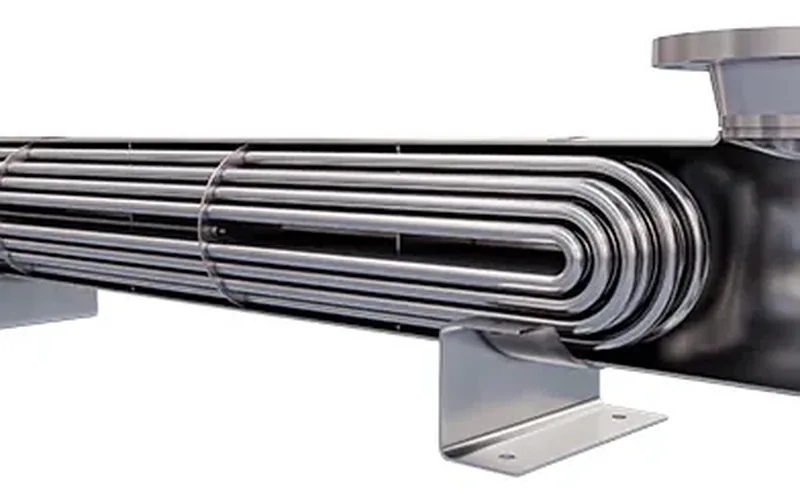
U-TUBE • CONSTRUCTION
Stock Steam-to-Liquid
Two-pass 304L and 316L units, code stamped.
+ Learn More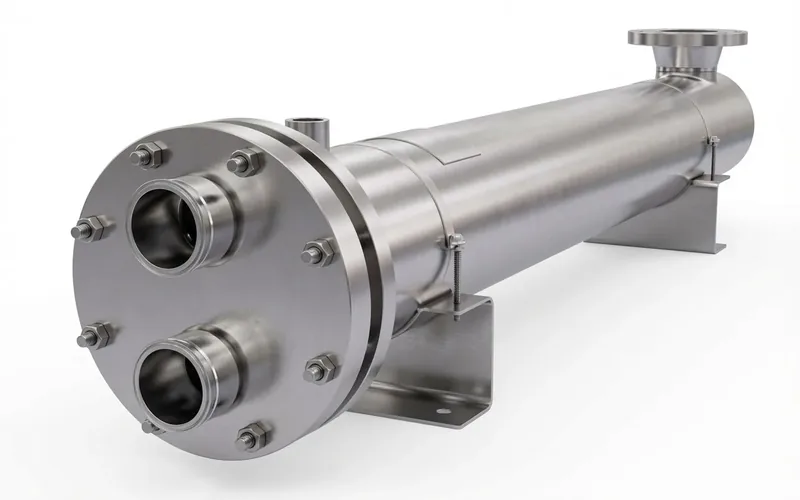
U-TUBE • CONSTRUCTION
Two-Pass U-Tube Exchangers
Why a U-bundle is even-pass, and the temperature cross.
+ Learn More