
1-805-484-2992
Quotes - Engineering - SalesU-Tube Heat Exchangers For
U-Bend Radius and Tube Bending
U-Tube Duty
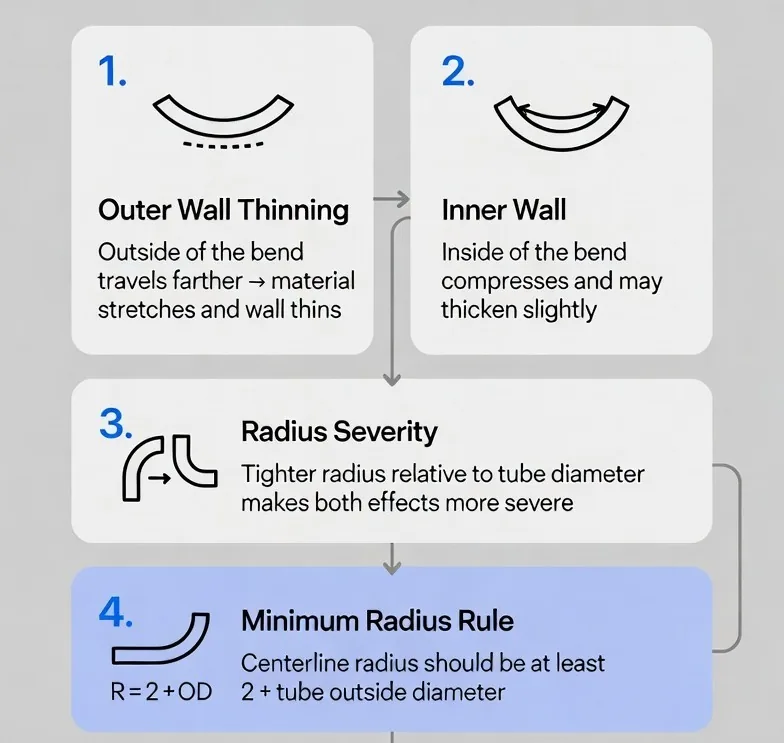
Bending a tube through 180 degrees stretches the outside and compresses the inside. Both effects are permanent, both are predictable, and both have to be designed for rather than discovered.
The outside of a bend travels further than the inside, so material there stretches and the wall thins. The inside compresses and may thicken slightly. The tighter the radius relative to tube diameter, the more pronounced both effects become.
Minimum radius. A centerline radius of at least twice the tube outside diameter is the general working rule. Below that, thinning becomes significant enough that the tube gauge has to increase, which costs money and reduces the inside diameter available for flow.
Why the Bend Is Where Failures Start. Three things coincide there. The wall is thinnest, the residual stress is highest, and the material is hardest. Any corrosion mechanism that needs tensile stress finds ideal conditions.
In chloride service on 300-series stainless, and in sour service on carbon and low alloy steels, the bend is the location worth inspecting first. Eddy current testing covers it, and it is worth including the bend region specifically in an inspection scope rather than sampling straight lengths.
Radius and Alloy Are One Decision. Duplex grades work-harden noticeably during bending and need a more generous radius than austenitic stainless. High-strength and high-nickel alloys have their own formability limits. Titanium bends well but springs back differently.
Choosing the alloy first and the bend radius second produces designs that have to be revisited. Send the service conditions and let both be decided together.
Stress relief. In sour service NACE MR0175 limits hardness, which normally means a post-bend stress relief of the bend zone with documented procedure and hardness testing. It is routine work and it adds cost and lead time, so flag the service at inquiry rather then at order.
Request a Quote


What Happens at the Bend
Bending a tube through 180 degrees stretches the outside and compresses the inside, thinning the outer wall and hardening the material. Both effects are permanent and predictable. The bend is where the wall is thinnest, the residual stress is highest and the material is hardest, which is why any corrosion mechanism that needs tensile stress starts there.
Radius
Alloy Behavior
Stress Relief & Inspection
Related
TUBE BUNDLE DESIGN • DESIGN
Tube Passes & Flow
The even-pass constraint and velocity targets.
+ Learn More
TUBE BUNDLE DESIGN • DESIGN
Baffles & Tube Supports
Baffle cut and spacing, and flow-induced vibration.
+ Learn More
DESIGN • CONSTRUCTION
Tube Bundle Design
Bend radius, layout, passes, baffles and span.
+ Learn More