
1-805-484-2992
Quotes - Engineering - SalesTank-Mounted and Immersion U-Tube Bundles
Heating Inside the Vessel
Sometimes the exchanger goes inside the tank. A U-bundle mounted through a manway flange heats the contents directly, with no circulation pump, no external piping and nothing to freeze up outside.
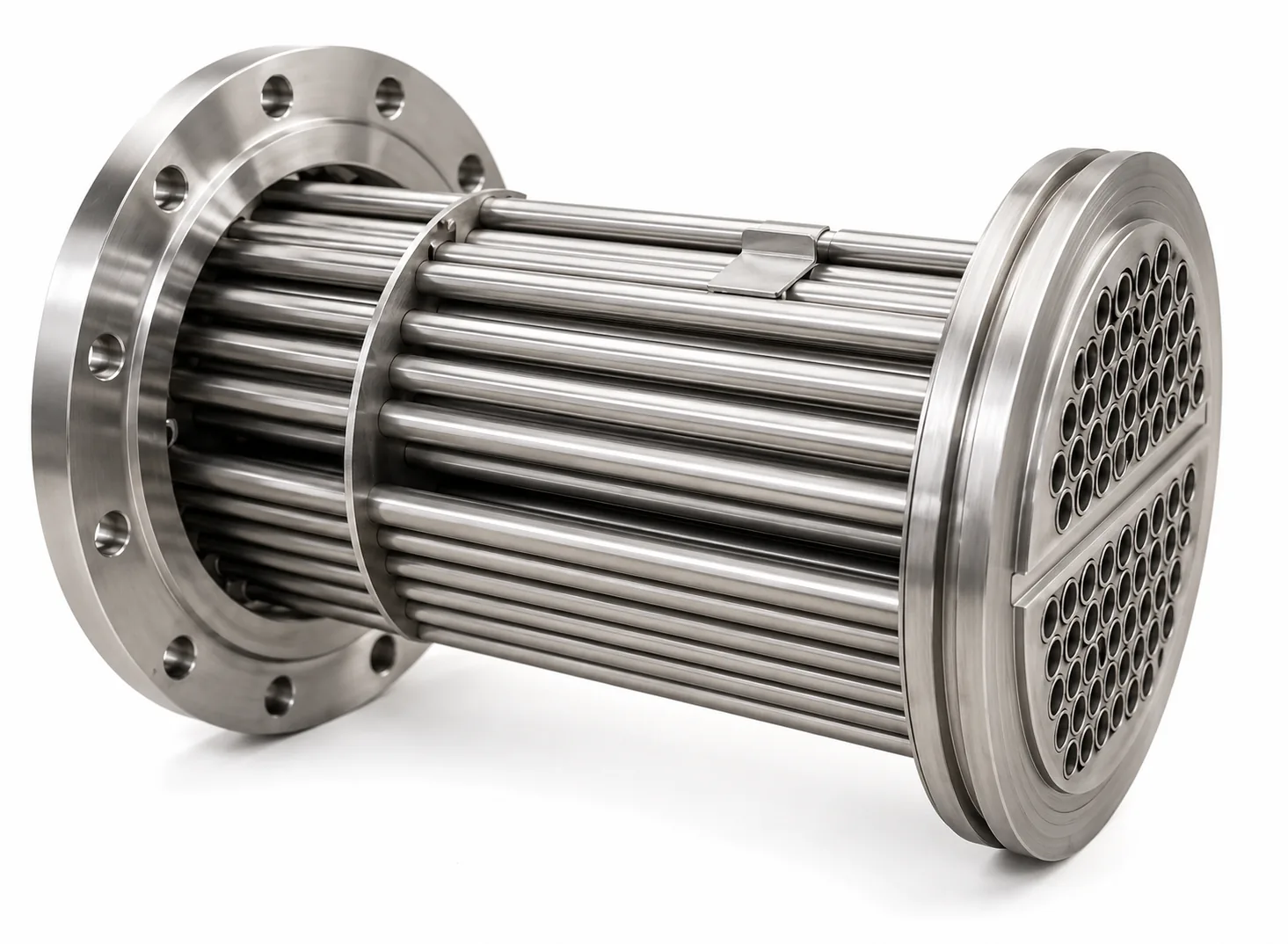
An immersion bundle is a U-tube assembly on a mounting flange that bolts to a tank nozzle or manway. Steam or hot oil runs through the tubes; the tank contents are the shell side. There is no shell, because the tank is the shell.
Whole-tank heating. A bundle sized to raise the entire contents, used where the whole inventory needs to be at temperature. Slow, simple and effective, and the usual approach on asphalt, heavy fuel oil and tallow storage.
Typical Construction
- Construction: U-tube bundle on a mounting flange
- Mounting: ANSI flange, tank nozzle or manway
- Shell side: The tank contents
- Heating medium: Steam, hot oil or hot water in the tubes
- Whole-tank duty: Bundle sized to raise total contents
- Suction duty: Bundle sized for the pumped volume only
- Finned option: Available where the tank-side coefficient is poor
- Support: Cantilevered from the flange; internal support where required
- Removal clearance: Bundle length clear outside the tank opening
- Codes: ASME Section VIII for the tube side
A U-tube assembly on a mounting flange that bolts to a tank nozzle or manway. The heating medium runs inside the tubes and the tank contents are the shell side, because the tank is the shell.
Tank-Mounted and Immersion U-Tube Bundles
Suction heating. A smaller bundle located at the pump suction, conditioning only the volume about to leave the tank. Far less energy than heating everything, and the right answer when the product only needs to be pumpable rather than uniformly hot.
Practical detail. The bundle is cantilevered from its flange, so support and vibration matter. Removal means pulling it back out through the same opening, which sets a clearance requirement outside the tank equal to the bundle length.
Suction Heating Is Usually the Better Economics
Heating an entire tank of heavy product so that a fraction of it can be pumped is expensive and slow. A suction heater conditions only the material entering the pump, which cuts energy use sharply and shortens the time between deciding to pump and being able to.
The trade is that the bulk stays cold, so anything requiring uniform temperature throughout still needs whole-tank heating. Tell us which problem you are solving and the sizing follows.
Inside the Tank
Short bundles hang from the mounting flange alone; longer ones get a support leg or bracket at the bend end that rests on the tank floor or a clip on the tank wall. The unsupported length is limited by deflection of the bundle under its own weight plus the product that fills it, and by the vibration that steam flashing in the tubes can set up. A sagging bundle loads the tube joints at the tubesheet. Tell us the tank depth and whether an internal support is acceptable, since some asphalt and tallow tanks cannot take welded attachments.
Yes, because the tube wall runs close to the steam saturation temperture, and a product that chars or degrades at the wall will coat the tubes. Heavy fuel oil, asphalt and tallow each have a film temperature above which they lay down a hard carbon layer. Lower steam pressure keeps the wall temperature down and the bundle gets more surface to compensate. Hot water or thermal oil is used where even low-pressure steam runs too hot. The mistake is choosing the plant's main steam pressure for convenience and finding the bundle coked after one season.
The coldest product temperature the bundle has to work against, which is usually the tank after a winter weekend with no heat, not the normal operating temperature. Natural convection on the tank side is weakest when the product is cold and most viscous, so that condition sets the surface. Sizing for the running temperature gives a bundle that keeps a warm tank warm but cannot recover a cold one. Give the lowest expected ambient, the tank insulation, the volume and the time allowed for heat-up, and the bundle will be sized for recovery rather than just holding.
Related
CONFIGURATION • TEMA
Horizontal U-Tube
Saddles, thermal growth and bundle pull clearance.
+ Learn More
CONFIGURATION • TEMA
TEMA U-Tube Types
BEU, AEU, BKU and DEU, and what the front head decides.
+ Learn More