
1-805-484-2992
Quotes - Engineering - SalesTri-Clamp U-Tube Exchangers
Choosing the Process Connection
A clamp connection breaks apart in seconds without tools, leaves no thread to harbor soil, and seals on a gasket you can inspect. It is also the connection most often specified past its pressure and temperature limits.
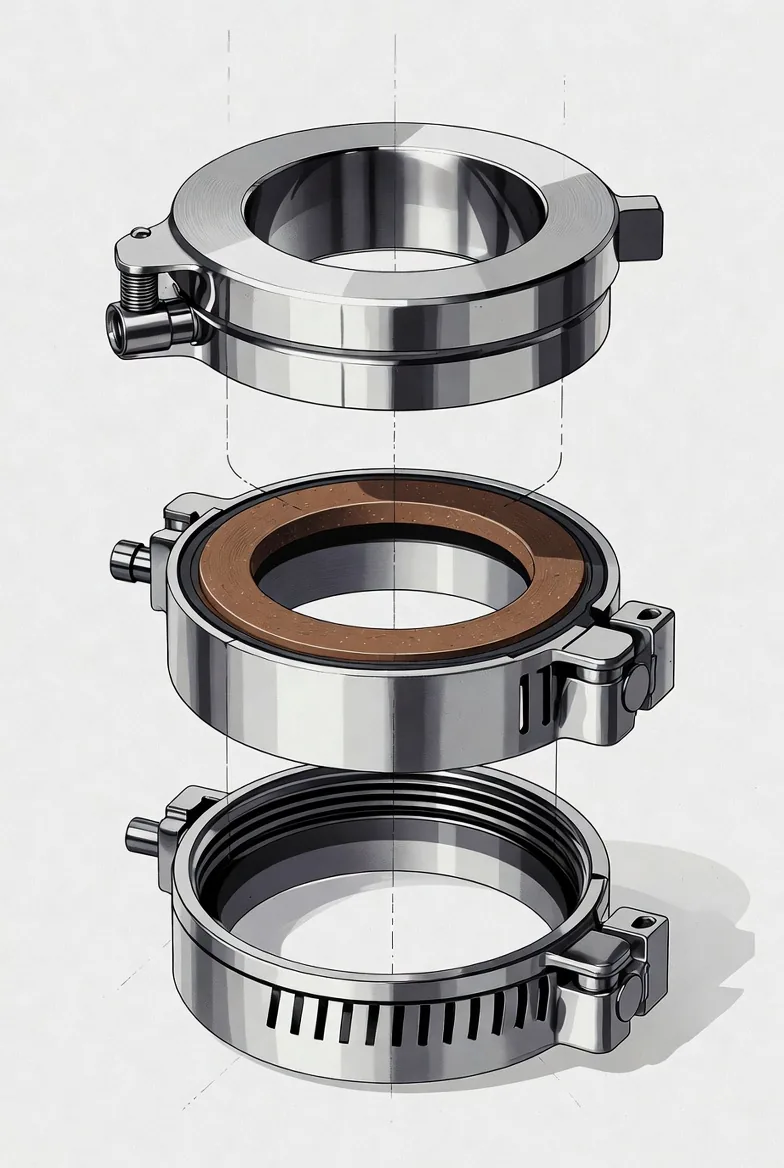
The tri-clamp fitting — a pair of ferrules, a gasket in a controlled groove and a clamp ring — became the sanitary standard because it does something no threaded or standard flanged joint does: it comes apart cleanly, exposes the whole joint face for inspection, and reassembles without disturbing the surrounding pipework.
Sizing. Clamp sizes are chosen to match the process line rather than the exchanger shell, and on smaller exchangers this can mean a clamp connection larger than the nozzle would otherwise need. That is normal and usually correct; matching the line avoids a reducer and the dead leg that comes with it.
| CONNECTION | TYPICAL USE | PRESSURE | TOOL-FREE |
| Sanitary tri-clamp | Product and clean utility | Moderate, gasket dependent | Yes |
| Extended tube weld end | Permanent hygienic joints | Full tube rating | No |
| ASME flanged | High pressure or large bore | Full flange rating | No |
Sanitary Connection Options
- Tri-clamp ferrules: Sized to the process line, 316L
- Gasket: EPDM: Steam, caustic, hot water; good resilience
- Gasket: PTFE: Broad chemical resistance, higher temperature, low creep resistance
- Gasket: Viton: Hydrocarbons and some acids; poor in steam
- Gasket: Gylon / filled PTFE: Chemical resistance with improved recovery
- Clamp rings: Single pin, double pin or high pressure styles
- Extended tube weld ends: Permanent joint at full tube rating
- ASME flanged: For high pressure and large bore utility connections
- Utility side: Typically flanged or NPT where not product contact
- Dead leg control: Nozzle projection kept within specified ratio
Getting the Connection Right
Gasket selection is the real specification. EPDM handles steam and caustic well and is a common default. PTFE handles almost any chemistry and higher temperature but has less resilience, so it is less forgiving of flange face irregularity and clamp torque. Viton suits hydrocarbons and some acids but is poor in steam. Gylon and filled PTFE variants sit between.
Know the limits. A clamp joint's pressure and temperature rating is set by the gasket and clamp ring, not by the tube wall, and it falls as temperature rises. On duty above roughly 150 psig, or where the exchanger is regularly SIP'd at elevated temperature, an extended tube weld end or a flanged connection is often the more honest choice.
Match the Line, Not the Nozzle
It is tempting to size a clamp connection to whatever the exchanger nozzle naturally wants. Resist it. A reducer between the exchanger and the process line adds a joint, adds a potential dead leg, and adds a component that has to be cleaned and inspected alongside everything else.
Where the exchanger genuinely needs a smaller nozzle for velocity reasons, the reduction is better made inside the exchanger design than bolted on afterward, and a concentric reducing ferrule is better than an eccentric one on a line that has to drain.
Temperature Is the Constraint People Miss
Clamp joint ratings are quoted at ambient and fall as temperature climbs. A joint that comfortably holds process pressure at 70 degrees Fahrenheit may be marginal during a steam-in-place cycle. Because SIP is precisely the condition where a leak is least welcome, this is worth checking rather than assuming.
It also drives gasket choice. EPDM is the usual answer for steam service among the common elastomers. PTFE handles the temperature but creeps under sustained load, which shows up as a joint that needs retorquing after thermal cycling.
Where a Weld End Beats a Clamp
On a permanent connection that will never be broken for cleaning — and on many exchanger nozzles that is the honest description — an extended tube weld end gives you a joint at full tube rating with no gasket to select, replace or fail. The trade-off is that servicing means cutting and rewelding.
The practical middle ground on many sanitary exchangers is weld ends where the connection is effectively permanent and clamps where the unit genuinely gets broken down. Deciding that at design stage rather than defaulting everything to clamps usually produces a better exchanger.
Clamp Joint Practice
Snug by hand on a wing-nut clamp, and no more; the gasket seals on compression into its groove, not on clamp load. Overtightening squeezes the gasket into the bore, where the intruded bead becomes a crevice that holds soil and a ridge that catches drainage, and on a PTFE gasket it leaves a permanent set that will not recover. The symptom is a joint that seals when first made up and weeps after the first hot cycle, because the extruded material relaxed. Bolted and double-pin clamps have a published torque from the clamp maker; use it. If a joint needs more than that to stop a leak, the gasket or a ferrule face is wrong.
A double-pin or bolted clamp ring, rather than a single-hinge wing-nut style, on any joint that cycles to steam temperature regularly. The single-hinge ring is quick to open and fine at moderate pressure and temperature, but it applies load unevenly around the ferrules and loses some of it as the joint heats and the gasket relaxes. A two-segment ring with two bolts, or a high-pressure ring with a heavy band, holds load more evenly through the cycle and tolerates the small retorque that PTFE gaskets ask for. Match the ring to the gasket: EPDM with a double-pin ring is the usual pairing for steam-sanitized product connections on a U-tube exchanger.
Tube outside diameter. A sanitary clamp size names the tube OD the ferrule is welded to, so a 2 inch clamp ferrule fits 2 inch OD sanitary tubing, which is a smaller bore than 2 inch pipe. The mismatch bites when a process line is pipe-sized and the exchanger nozzles are tube-sized, or when a flanged utility nozzle is compared with a clamp product nozzle of the same nominal size. Specify the process connections by sanitary tube OD and the utility connections by pipe size, and say which standard each follows. On an inquiry, send the line size as tubing OD and wall, because a nominal pipe size will be read as pipe and the ferrule will not fit.
Yes, and on a sanitary exchanger they usually are, in the smallest clamp size that still clears the nozzle neck. The constraint is the dead-leg ratio. A vent or drain is a dead-ended branch, so its projection from the shell or head wall has to stay within the length-to-diameter limit the standard allows, which argues for short nozzles with the valve mounted close. A drain that stands off on a long nipple to clear insulation is the classic violation. Put the drain at the true low point of the installed orientation, the vent at the true high point, and keep both to a clamp size the plant already stocks gaskets for, which simplifies maintenance.
Related Sanitary Detail
SEALING • JOINTS
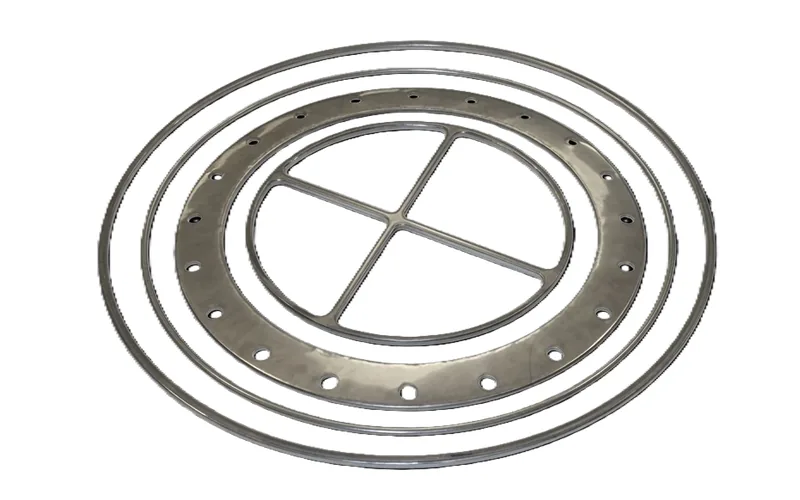
Gaskets & Sealing
Bonnet and tubesheet gaskets, o-ring grooves on removable bundles and torque sequence at reassembly.
+ Learn More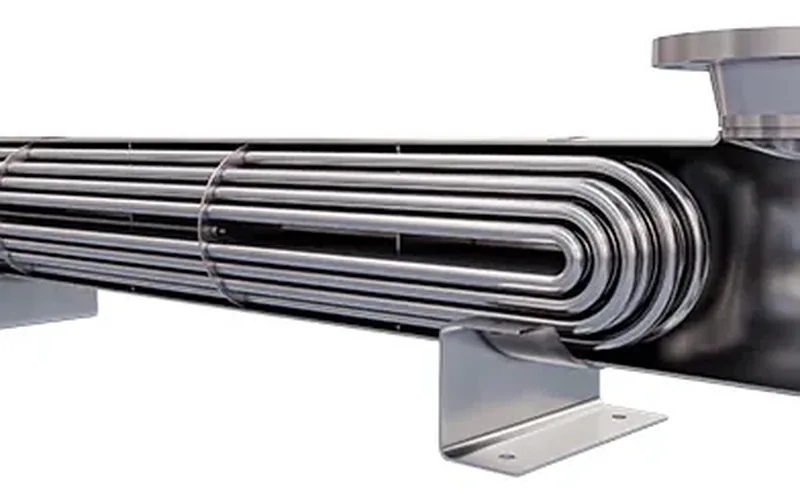
STOCK • FAST SHIP
Stock Steam-to-Liquid
Shelf units already built with tri-clamp process connections, for shutdowns and urgent replacements.
+ Learn More
STANDARD • 3-A
3-A Sanitary
Symbol authorized construction where the connection style is part of what is being certified.
+ Learn More