1-805-484-2992
Quotes - Engineering - SalesAEU U-Tube Heat Exchangers
Access Without Disassembly
The difference between AEU and BEU is one component: a removable cover on the front head. It costs more and it buys you the ability to open the tube side without touching the piping.
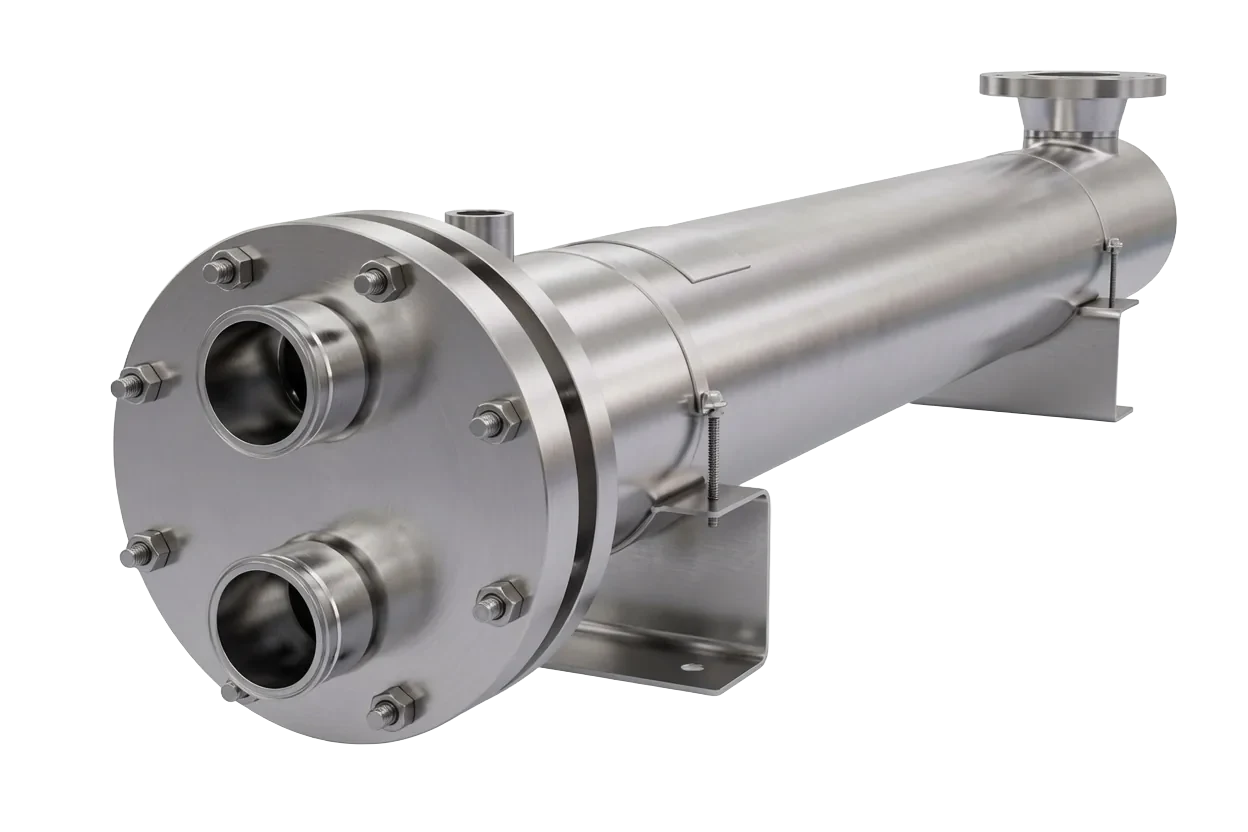
A channel head is a cylindrical section bolted to the shell with a separate flat cover bolted to its face. Remove the cover and the tubesheet face and every tube end are exposed, with the tube-side nozzles still connected to their piping.
What that is worth. On a unit that gets inspected annually, or where the tube side fouls enough to need periodic attention, the labor saving over the life of the exchanger comfortably exceeds the price premium. On a unit that never gets opened, it does not.
Typical Construction
- Front head: A - channel with removable cover
- Shell: E - single pass
- Rear head: U - U-tube bundle
- Tube-side access: Cover removal only; piping stays connected
- Pass partitions: Plates in the channel with a ribbed cover gasket
- Tube passes: Two minimum, even numbers only
- Bundle: Removable
- Joints: More gasketed surface than a bonnet head
- Typical duty: Tube side needing periodic inspection or access
- Codes: ASME Section VIII, TEMA R, B or C
Channel front head with removable cover, single-pass E shell, U-tube rear. Remove the cover and every tube end is exposed with the tube-side piping still connected.
AEU U-Tube Heat Exchangers
Pass partitions. Multi-pass arrangements are built with partition plates inside the channel and a matching rib on the cover gasket. Getting that gasket right at reassembly is important; a partition leak short-circuits flow and quietly destroys performance.
The trade-off. More joints, more gasket surface and a larger flange than a bonnet of the same size. At high pressure that becomes expensive, which is part of why BEU and DEU dominate the upper pressure range.
Is the Premium Worth It?
Ask how often someone will need to see the tubesheet face. Annual inspection on a regulated duty, a tube side that scales, or a unit where plugging a failed tube must be possible during a short outage all justify a channel head.
A closed loop of treated water on the tube side of a utility heater does not. Specifying AEU by habit is a common way to add cost that nothing in the duty will ever recover.
Channel Cover Considerations
Yes. The cover gasket on a channel head is a crush type, compressed sheet or spiral wound, and it takes its seal from one compression. Reuse it and the first place it leaks is the pass partition rib, which has already taken a set to the old plate position. A rib leak never shows on a hydrotest, since both sides of the partition are at the same test pressure; it shows later as a short outlet temperature. Keep a spare gasket on the shelf for every unit with a channel head, and record the bolt torque used at commissioning so the next reassembly repeats it.
Only the cover thickness plus the stud length, which on most sizes is well under a foot. Inspection, plugging and chemical cleaning all happen in that space without the bundle-pull length being clear. The bundle-pull length is still required for the day the bundle actually comes out, so a channel head is not a license to box in the front end. Allow for the cover weight as well; on larger diameters a flat cover is a lift rather then a two-person carry.
Because a flat cover carries pressure in bending, and ASME Section VIII UG-34 makes the required thickness grow in proportion to diameter and to the square root of pressure. Double the diameter and the cover doubles in thickness; double the pressure and it grows about 41 percent. A dished bonnet carries the same pressure in membrane tension and stays thin. That is the mechanics behind the AEU premium growing with size and pressure class, and why on a large high-pressure unit the cover alone can weigh more than the bonnet it replaces. Below a certain size the difference is a few bolts and a gasket; above it, the cover is the cost.
Related
CONFIGURATION • TEMA
BEU Heat Exchangers
The least expensive removable-bundle exchanger.
+ Learn More
CONFIGURATION • TEMA
BKU Kettle Reboilers
Kettle reboilers and vaporizers on a U-bundle.
+ Learn More