
1-805-484-2992
Quotes - Engineering - SalesHigh-Temperature U-Tube Heat Exchangers
Unlimited Differential Expansion
This is the duty the U-tube was made for. Large differential temperature, abrupt startup transients and constant cycling would all need an expansion joint in a fixed tubesheet unit. Here they need nothing at all.
When shell and tubes run at very different temperatures they try to change length by different amounts. In a fixed tubesheet exchanger that difference has nowhere to go, so it becomes stress in the shell, the tubesheet and the tube joints. The standard remedy is a bellows expansion joint in the shell, which works and which introduces the most fatigue-sensitive component in the whole assembly.
A U-tube bundle removes the problem rather than accommodating it. Each tube is fixed at one end and free at the bend. It grows, the bend radius shifts slightly, and no load is transmitted anywhere. Tubes can even run at different temperatures from one another without consequence.
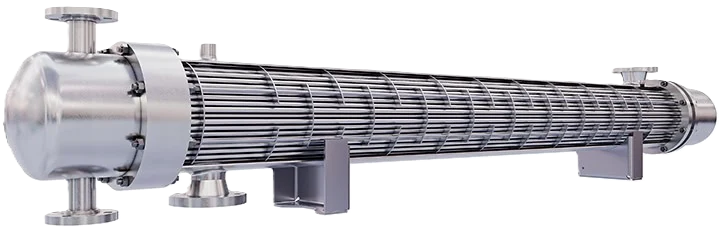
| PRODUCT | STYLE | TEMA TYPE | BUNDLE |
| U-Tube Heat Exchanger | U-Tube, single tubesheet | BEU / AEU / BKU | Removable |
Typical Construction
- Expansion accommodation: Unlimited; no expansion joint required
- Typical fluids: Thermal oil, hot water, steam, process gas, molten media
- Film temperature control: Velocity and flux selected to the fluid supplier's limit
- Thermal cycling: Tolerated by design; each tube expands independently
- Materials: Carbon steel, low alloy, 304L/316L, higher alloys as required
- Insulation: Jacketed or lagged; personnel protection where specified
- Supports: Sliding and fixed saddles sized for shell growth
- Gaskets: Selected for sustained temperature, not just design point
- Codes: ASME Section VIII Division 1, TEMA R, B or C
- Bundle: Removable for shell-side cleaning and inspection
High-Temperature U-Tube Heat Exchangers
Cycling is the real test. Steady high temperature is manageable in several designs. What separates them is repeated heating and cooling: startup, trip, blowdown, batch operation. Those cycles fatigue an expansion joint and they fatigue a fixed tube joint. A U-bundle simply moves.
Thermal fluid systems have their own rules. Film temperature, not bulk temperature, degrades hot oil, so tube-side velocity and heat flux are selected to keep the film within the fluid supplier's limit. Get that wrong and the fluid cokes on the tube wall, which shows up as fouling that cleaning will not fix.
Startup Is Usually the Governing Case
The worst thermal condition an exchanger sees is rarely steady operation. It is the moment hot fluid meets a cold bundle, or cold fluid hits a hot one after a trip. Those transients produce differential expansion far beyond anything in the process datasheet.
Tell us how the unit is started, how fast, and what happens on a trip. A U-tube bundle tolerates all of it, but the shell supports, the nozzle loads and the gasket selection still have to be designed for it.
Support Design at Temperature
A hot shell grows, and if both saddles are fixed the shell will find another way to relieve the load, usually through the nozzles and into the piping. Standard practice is one fixed saddle and one sliding, with slotted holes sized for the calculated growth.
This is a detail that gets lost between the exchanger supplier and the installing contractor more often than any other. We will state the expected growth and the required support arrangement on the drawing so it does not have to be inferred.
Running Hot
Spiral-wound gaskets with a flexible graphite filler on the bonnet and tubesheet joints, or solid flexible graphite sheet where a flat gasket is unavoidable. Elastomer and compressed-fiber sheet gaskets lose their binder at sustained temperature and the joint relaxes, which shows up as a bonnet that seeps after every cooldown rather than during steady running. On a hot oil unit the first evidence is usually a dark stain below the flange and a smell, not a visible drip. Specify the gasket for the sustained operating temperature plus the trip and startup excursions, confirm the flange faces have the right finish for a spiral-wound ring, and plan to retorque the bolts after the first full thermal cycle.
Tube side, when it is the hot fluid being controlled for film temperature. Tube-side velocity is set directly by the pass arrangement, so the wall temperature can be held where the fluid supplier wants it; shell-side velocity varies across baffle windows and leaves low-flow pockets where oil overheats and cokes. Tube-side placement also keeps the oil inventory small, puts fewer gasketed joints in contact with it, and leaves the shell for the fluid being heated. The exception is a heavily fouling process stream that needs the bundle pulled for cleaning; then the process goes shell side and the oil runs in the tubes anyway. Oil on the shell side is the arrangement to question, not the default.
Slowly enough that the tubesheet and the bolted joints heat through before full flow, which on most units means a warm-through at reduced flow rather than a ramp rate. The bundle itself does not care. The parts that do are the thick tubesheet, which develops a through-thickness gradient, and the bonnet flange, whose bolts heat more slowly than the flange and lose preload as the flange grows. Introduce the hot fluid at low flow with the cold side already circulating, let the shell come up, then open to full flow. On a trip, keep the cold side moving so the bundle is not quenched. Retorque the bonnet bolting hot after the first cycle.
Related
U-TUBE • CONSTRUCTION
High-Pressure U-Tube
D-type heads, heavy tubesheets, fewer joints.
+ Learn More
U-TUBE • CONSTRUCTION
Corrosion-Resistant U-Tube
Alloy selection by the attacking species.
+ Learn More