1-805-484-2992
Quotes - Engineering - SalesWFI and Pure Steam U-Tube Exchangers
Where the Condensate Is the Product
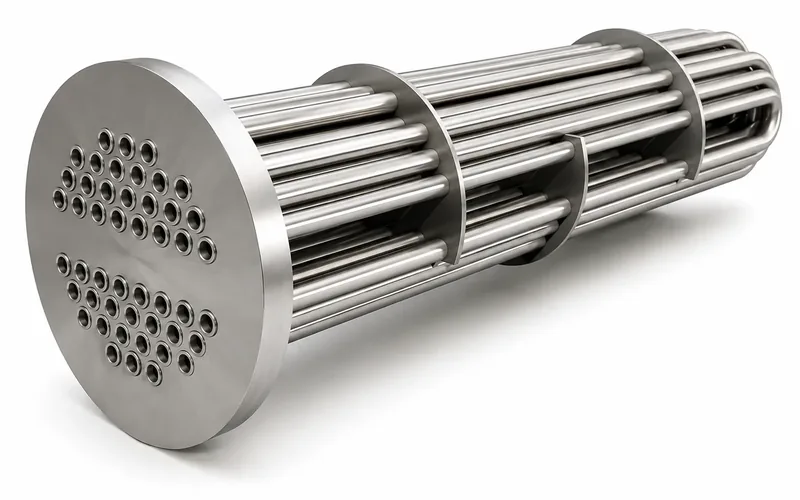
On a WFI loop the condensate is the product. That single fact drives everything: double tubesheets, electropolished surfaces, and a design that tolerates being sanitized at temperature over and over again.
Water for injection and pure steam systems invert the usual hierarchy. In most exchangers the process fluid is valuable and the utility is not. Here the high-purity stream is the product, the utility is ordinary plant water or glycol, and the entire design question is how to guarantee the two never meet.
Double tubesheets are effectively standard. A vented interspace gives a tube joint leak somewhere visible to go instead of allowing plant water into injectable-grade water. Given the consequence, this is rarely argued about.
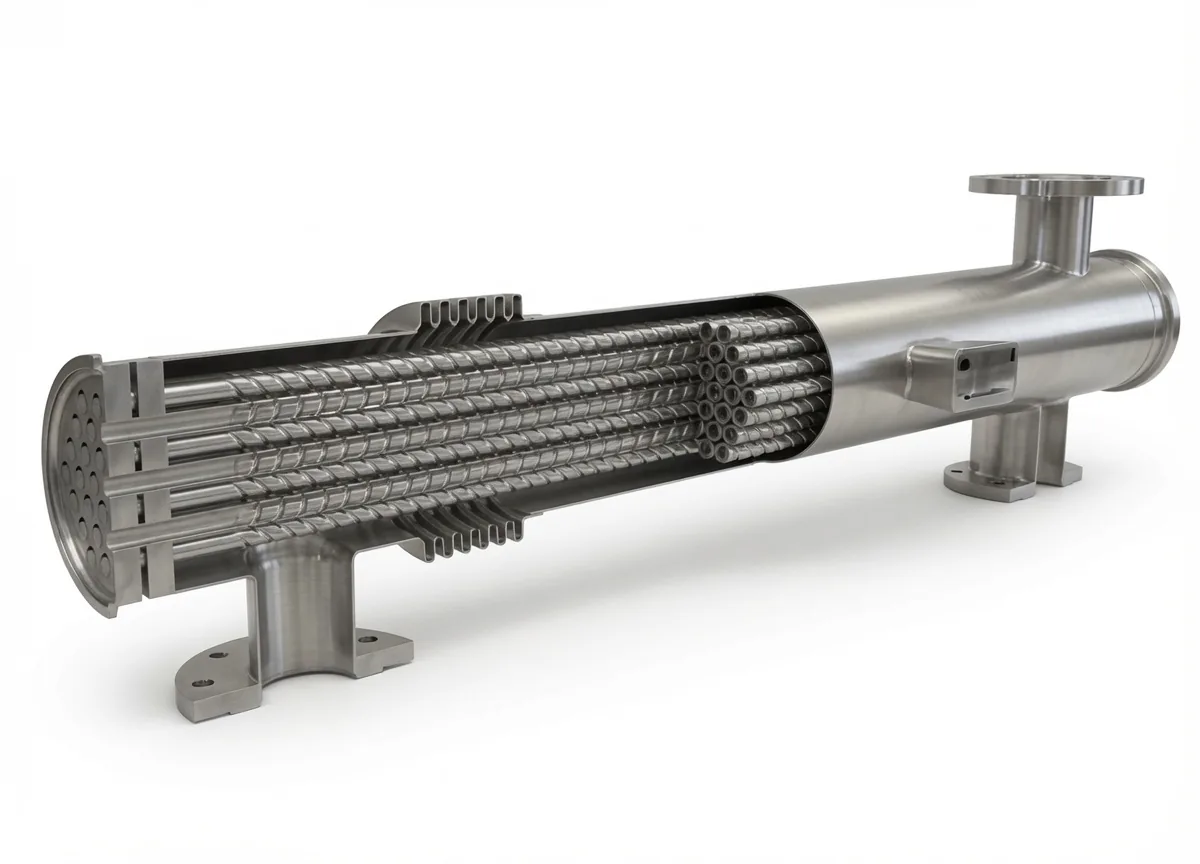
| PRODUCT | STYLE | TEMA TYPE | BUNDLE |
| U-Tube Heat Exchanger | U-Tube, single tubesheet | BEU / AEU / BKU | Removable |
Typical Construction
- Typical duty: WFI cooling, pure steam generation and condensing
- Tubesheet: Double, vented interspace with telltale
- Wetted material: 316L, dual certified, controlled sulfur
- Surface finish: Electropolished, BPE SF designation
- Sanitization: Designed for repeated hot cycles
- Connections: Sanitary clamp or extended tube weld ends
- Drainability: Sloped, low-point drain, no dead legs
- Codes: ASME Section VIII Division 1 and ASME BPE
- Leak detection: Open telltale or instrumented interspace
- Documentation: Full BPE turnover package
WFI and Pure Steam U-Tube Exchangers
Thermal cycling is the fatigue driver. Hot WFI loops are held at elevated temperature and periodically sanitized higher still. The exchanger sees that cycle for its whole life. A U-tube bundle handles it without an expansion joint because each tube grows independently, which is a large part of why the geometry dominates this duty.
Material detail matters. 316L with controlled sulfur welds predictably and produces a surface that electropolishes well. Heat tint and weld ferrite are controlled because both create sites where the passive layer is weaker, and a hot high-purity loop is an efficient way to find them.
Design for the Sanitization Cycle, Not Just the Duty Point
A WFI cooler spends most of its life doing a modest thermal job and a small fraction of its life being sanitized. The sanitization condition frequently sets the design temperature, the gasket selection and the fatigue case even though it contributes nothing to the process duty.
Tell us the sanitization temperature, how long it is held and how often it runs. It changes the answer on gasket material, on whether clamp connections are appropriate, and on how the interspace of a double tubesheet is expected to behave.
Which Side Should the WFI Be On?
Running WFI through the tubes gives a smooth passage that drains under gravity in a vertical unit and is straightforward to sanitize. The limitation is the bend interior, which cannot be electropolished or verified.
Running WFI on the shell side makes every product-contact surface accessible for finishing and inspection, at the cost of engineering the shell for positive drainage. Where the specification demands an electropolished designation on all wetted surfaces, this is normally the resolution.
Inside a WFI Loop
Rouge is a thin iron-oxide film that forms on stainless surfaces in hot high-purity water. The exchanger is often where it is found first because it has the hottest wall and the most weld in the loop, but it is not a tube failure and it does not come from the utility side. Class I rouge is migratory and deposits on everything downstream; the usual source is a surface whose passive layer is weak: heat-tinted welds, mechanically polished areas with embedded iron, or a bend interior that could not be electropolished. The defense is controlled-sulfur 316L, clean welds and electropolished surfaces where they can be verified. Expect a derouging and repassivation step in the loop's maintenence plan regardless.
Yes, and it is a common duty, but it is sized for the draw rate and the response time, not an average load. A point-of-use cooler takes water from the hot loop on demand and delivers it at use temperature within seconds of the valve opening, which means a small unit with low hold-up and a fast-responding utility side. Between draws the cooler sits idle and must be returned to loop temperature so it does not become a cold, stagnant pocket; the usual arrangement is a return line that keeps hot WFI moving through it or a sanitization step on a timer. Give us the draw rate, the outlet temperature and how often the point is used.
Yes, with a double tubesheet and with propylene rather than ethylene glycol anywhere a leak could reach product. Ethylene glycol is toxic and its presence in injectable water is a recall; propylene glycol is the food-grade choice and is the one specified against a product-contact interspace. Note what the interspace detection will see. An inhibited glycol mix carries a conductive inhibitor package and a probe finds it, but plain propylene glycol is a poor conductor, so an instrumented interspace on a glycol unit usually adds a level switch or a sight glass as well. State the glycol type and concentration at inquiry; it changes the rating and the tube-side velocity as well.
Related
U-TUBE • CONSTRUCTION
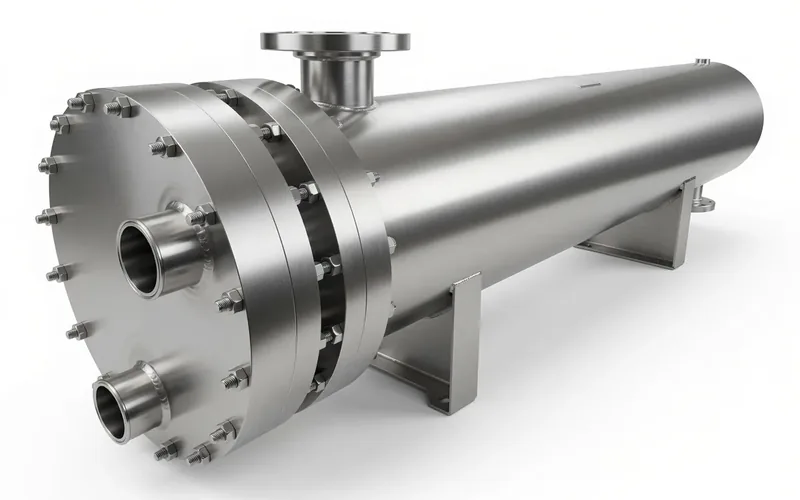
ASME BPE U-Tube
Surface designations and a qualification package.
+ Learn More