
1-805-484-2992
Quotes - Engineering - SalesU-Tube Heat Exchangers For
Single Tubesheet Design
U-Tube Duty
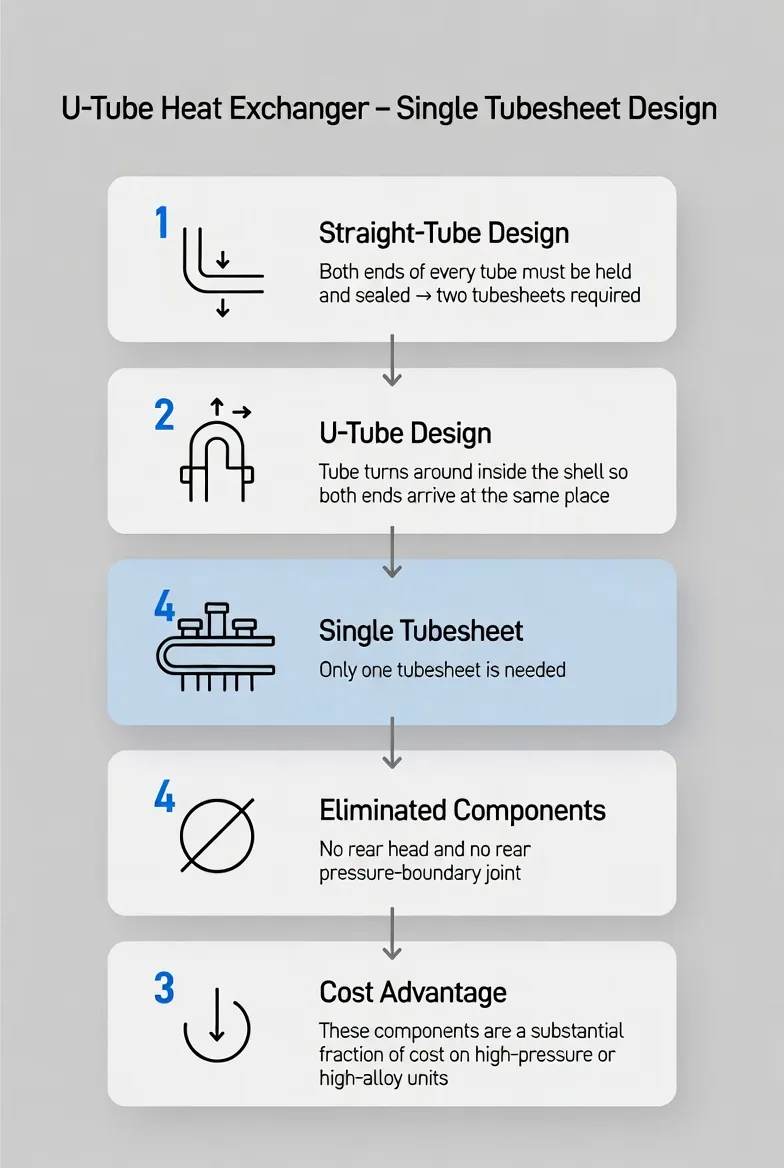
One tubesheet instead of two is the U-tube's structural economy. It is also why the design tolerates unlimited thermal expansion, because nothing anchors the far end of the bundle.
In a straight-tube exchanger both ends of every tube must be held and sealed, which needs a tubesheet at each end. In a U-tube exchanger the tube turns around inside the shell, so both ends arrive at the same place.
The structural consequence. Half the tubesheets, no rear head, no rear pressure-boundary joint. On any exchanger those are significant components, and on a high-pressure or high-alloy unit they are a substantial fraction of the cost.
Where the Saving Actually Lands. On a small carbon steel exchanger the second tubesheet is a modest line item. On a large unit in Hastelloy or titanium it is enormous, and removing it changes the economics of the whole selection.
This is why U-tube construction dominates high-alloy service. The material cost of a thick alloy tubesheet is high enough that halving the count often outweighs the loss of tube-side cleaning access.
Cladding and overlay. Where the wetted face needs an alloy the whole tubesheet does not, a corrosion-resistant layer is clad or weld-overlaid onto a carbon steel base. That gets alloy performance at the surface that matters without alloy cost through the full thickness, which on a thick high-pressure tubesheet is a large saving.
Request a Quote



What One Tubesheet Buys
In a U-tube exchanger the tube turns around inside the shell, so both ends arrive at the same tubesheet. That removes the second tubesheet, the rear head and the rear pressure-boundary joint, and it leaves the far end of the bundle free to expand. On a large high-alloy or high-pressure unit those components are a substantial fraction of the cost.
Structure
Economics
Cladding & Overlay
Related
TUBESHEETS & JOINTS • DESIGN
Double Tubesheet Design
Interspace, venting, drainage and leak detection.
+ Learn More
TUBESHEETS & JOINTS • DESIGN
Rolled vs Seal-Welded
Crevices, retubing, pressure and cycling compared.
+ Learn More
TUBESHEETS & JOINTS • DESIGN
Gaskets & Sealing
Gasket material and bolt torque sequence.
+ Learn More