
1-805-484-2992
Quotes - Engineering - SalesU-Tube Heat Exchangers For
Duplex and High Alloy Construction
U-Tube Duty
Beyond 316L the choices stop being general purpose and start being specific. Each alloy was developed for a particular problem, and choosing well means naming the problem precisely.
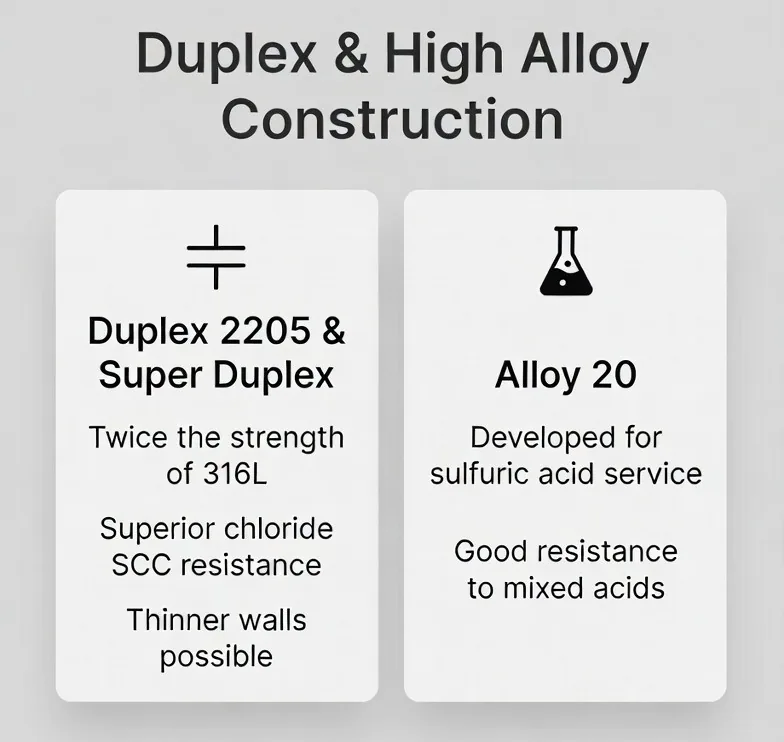
Duplex 2205 and super duplex. A mixed austenitic-ferritic structure giving roughly twice the strength of 316L and far better chloride stress-corrosion cracking resistance. The higher strength allows thinner walls. The caution is that duplex work-hardens noticeably during bending, so minimum bend radius is more generous and forming is less forgiving.
Alloy 20. Developed for sulfuric acid service and still the default there, with good resistance to a range of mixed acids.
Duplex and the U-Bend. Duplex is the alloy where bending most affects the design. It work-hardens significantly, which raises forming loads and springback, and the ferrite-austenite balance in the cold-worked region needs attention.
In practice this means a more generous minimum bend radius, a fabricator experienced with the material, and in some services a post-bend solution anneal. None of it is exotic, and all of it needs to be decided before the tubes are ordered.
AL-6XN and Monel. AL-6XN is a super-austenitic alloy sitting between duplex and the nickel alloys, strong in high-chloride and seawater duty. Monel suits hydrofluoric acid and certain reducing conditions where stainless fails quickly.
Request a Quote



Naming the Problem Before the Alloy
Beyond 316L the choices stop being general purpose and start being specific. Each alloy was developed for a particular problem, and choosing well means naming the problem precisely: chlorides at temperture, sulfuric acid, seawater, hydrofluoric acid or reducing conditions. Bending behavior differs as much as corrosion resistance, and both have to be decided before the tubes are ordered.
Duplex 2205 & Super Duplex
Alloy 20 & AL-6XN
Monel & Nickel Alloys
Related
MATERIALS & FINISHES • DESIGN
304L & 316L Stainless
Where each fits, and the chloride cracking limit.
+ Learn More
MATERIALS & FINISHES • DESIGN
Carbon Steel
Shells, tubes, corrosion allowance and coatings.
+ Learn More
MATERIALS & FINISHES • DESIGN
Titanium & Copper-Nickel
Alloys for seawater and brine service.
+ Learn More