
1-805-484-2992
Quotes - Engineering - SalesDouble Tubesheet U-Tube Exchangers
Turning an Invisible Failure Into a Visible One
A single tubesheet has one barrier between utility and product. If a tube joint leaks, the first evidence is often a failed batch test. A double tubesheet puts an open, vented gap in that path so the leak has somewhere visible to go.
In a conventional exchanger the tube-to-tubesheet joint is the only thing separating the two fluids. It is a good joint and it rarely fails, but when it does the failure is silent: utility water enters product, or product enters utility, and nothing about the exchanger's behavior announces it. On a pharmaceutical or dairy duty that silence is the whole problem.
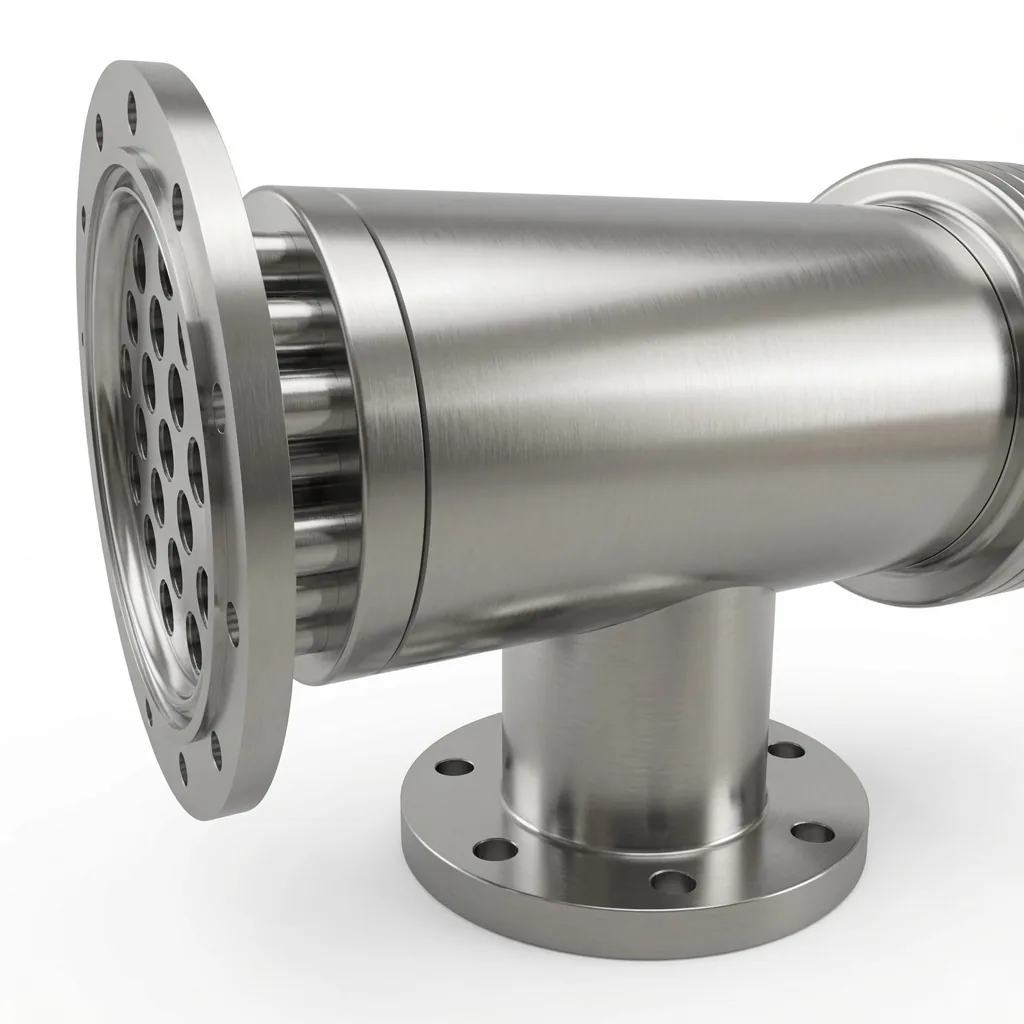
How the construction works. Two tubesheets are set a short distance apart at the same end of the shell. The tubes pass through both. The space between them — the interspace — is open to atmosphere and drained. If either tube joint leaks, fluid enters the interspace and appears at the telltale drain rather than crossing into the other stream.
| FEATURE | SINGLE TUBESHEET | DOUBLE TUBESHEET | BENEFIT |
| Leak path | Direct utility to product | Vented to atmosphere | Visible detection |
| Detection | Batch testing | Visual or instrumented | Immediate |
| Cost impact | Baseline | Added tube length and machining | Contamination risk removed |
Double Tubesheet Design Considerations
- Interspace width: Sized for visibility, drainage and tube support
- Interspace venting: Open to atmosphere, drained at the low point
- Leak detection: Open telltale, sight glass, conductivity or level switch
- Tube length penalty: Additional length spanning both tubesheets
- Effective surface: Interspace length contributes no heat transfer
- Tube joints: Seal welded at both tubesheets on sanitary duty
- Thermal consideration: Interspace tube section runs at an intermediate temperature
- Typical duty: WFI, clean steam, product contact, toxic utility
- Materials: 316L standard, higher alloys available
- Codes: ASME Section VIII, ASME BPE where specified
When to Specify a Double Tubesheet
Detection options. The simplest arrangement is an open drain observed on rounds. Where the duty justifies it, the interspace can be fitted with a sight glass, a conductivity probe, a level switch or a pressure sensor tied into the plant control system, so the leak raises an alarm rather than waiting for someone to walk past.
What it costs. The tubes have to be longer to span both tubesheets, the machining is more involved, and the exposed tube length in the interspace does no heat transfer at all. Expect a real increase in both surface area and price. Where a cross-contamination event means destroying a batch and explaining it to a regulator, that increase is rarely the expensive part of the decision.
The Test Is Consequence, Not Probability
Tube joints do not fail often. The question is not how likely a leak is but what happens if one occurs and nobody notices for a shift. If the answer is a rejected batch, a recall, a contaminated water loop or a regulatory conversation, the arithmetic favors a double tubesheet regardless of how reliable the joint is.
The classic cases are water for injection cooling, clean and pure steam, product-contact duty where the utility side is plant water or glycol, and any service where the utility fluid is toxic and the process fluid is not. The reverse also applies: where a valuable or hazardous process fluid must not reach a utility loop that discharges to drain.
What You Give Up
Surface area, first. The tube section spanning the interspace is exposed to air and transfers essentially nothing, so the exchanger has to be longer to reach the same duty. On a compact skid that lenght can be the binding constraint.
There is also a thermal detail worth understanding. The tube section in the interspace runs at an intermediate temperature and is not restrained the way it is inside the shell. On duty with large thermal cycling this is a design consideration rather than a problem, but it is one reason the interspace dimension is engineered rather than picked from a table.
Detection Is Part of the Specification
A double tubesheet that drains into a bucket nobody checks provides documentation, not protection. Decide at quotation how the interspace will be monitored and design for it: an open telltale on a unit that is inspected every shift, or an instrumented interspace tied to the control system where the consequence of a slow leak is severe.
Where the interspace is instrumented, think about what the sensor actually detects. A conductivity probe finds aqueous leaks quickly and clean condensate slowly. A level switch needs a leak large enough to accumulate. A pressure transmitter on a sealed interspace responds fastest but requires the interspace to be closed rather than open, which changes the design.
Interspace Engineering
Yes. A closed interspace filled with a clean barrier fluid held above both process and utility pressure reverses the leak direction: a failed joint lets barrier fluid into the leaking side, and a falling barrier pressure is the alarm. It is used where the utility is toxic or the product must never see air, and where an open telltale would itself be a contamination path. The trade is that the barrier fluid becomes a third fluid to select, qualify and maintain, and the interspace becomes a small pressure chamber that is designed, tested and stamped as one. On hygienic duty the open vented interspace remains the default; what leaks into it is visible and nothing in it can reach product.
Each side separately, with the interspace open and dry, so that a weep at either tubesheet shows up in the gap during the hold. The shell-side test loads the joints at the shell-side tubesheet and any leak appears at the interspace drain; the tube-side test loads the joints at the head-side tubesheet and shows the same way. That is a better test than a single-tubesheet unit gets, because the tube-side joints are watched directly as well; on a single sheet only the shell-side test exposes the tube ends. The interspace drain stays open through both tests and is never plugged for either. Ask for both holds to be witnessed and for the interspace to be inspected dry afterward.
Outside the shell, between the shell flange and the channel or bonnet, as part of the bundle. Both tubesheets are bundle components: the one nearest the shell seals against the shell flange and the one nearest the head seals against the head flange, with the open gap between them exposed to the room. Pulling the bundle brings both tubesheets and the interspace out together, so there is no hidden cavity inside the shell to clean or inspect. The practical consequence is a longer flange-to-flange dimension than a single-tubesheet unit of the same shell size, which matters when the unit is replacing an existing one in a fixed piping layout; check the face-to-face length early.
Yes, and often they should be. The tubesheet on the product side matches the product-contact alloy, normally 316L with a polished face, while the tubesheet on the utility side only has to match the utility and can be 304L or a less costly grade. The tubes run through both, so they stay in the product alloy. Where the utility is seawater or an aggressive coolant the roles reverse and the utility-side sheet carries the higher alloy. Keep the two sheets at compatible expansion rates; a large mismatch in growth between them loads the tube section in the interspace, which is the one place on the bundle with no shell to restrain it.
Related Construction

PHARMA • HIGH PURITY
WFI & Pure Steam
Water for injection cooling and pure steam duty, where double tubesheets are effectively standard.
+ Learn More
DESIGN • JOINTS
Tubesheet Design
The engineering behind gap dimension, thermal behavior in the interspace and joint selection.
+ Learn More
STANDARD • 3-A
3-A Sanitary
Symbol authorized sanitary construction, frequently specified together with a double tubesheet.
+ Learn More