1-805-484-2992
Quotes - Engineering - SalesASME BPE U-Tube Heat Exchangers
What the Standard Governs
ASME BPE is the standard that turns a stainless exchanger into a qualifiable one. It governs the things an inspector can check and a validation engineer has to prove.
The Bioprocessing Equipment standard exists because pressure vessel codes say nothing about whether a vessel can be cleaned, drained or documented. BPE fills that gap with requirements that are specific enough to be verified.
Surface designations. BPE replaces a bare Ra number with designations that state both the finish and how it was achieved, distinguishing mechanically polished from electropolished surfaces. Specify the designation rather than a number, because two surfaces at the same Ra can behave differently in service.
| PRODUCT | STYLE | TEMA TYPE | BUNDLE |
| U-Tube Heat Exchanger | U-Tube, single tubesheet | BEU / AEU / BKU | Removable |
Typical Construction
- Standard: ASME BPE, current edition
- Pressure code: ASME Section VIII Division 1, U-stamp
- Wetted material: 316L, dual certified, controlled sulfur for weldability
- Surface finish: BPE SF designation, mechanically polished or electropolished
- Weld examination: Per BPE, with weld map and procedure records
- Dead leg ratio: Within BPE limits at all connections
- Drainability: Sloped in installed orientation, low-point drains
- Tubesheet options: Single or double with vented interspace
- Connections: Sanitary clamp or extended tube weld ends
- Documentation: Turnover package including MTRs, weld records, finish and passivation certification
ASME BPE U-Tube Heat Exchangers
Welds. Procedures, welder qualification, examination method and coverage, ferrite control and heat tint limits are all addressed, and weld maps tie each joint back to its record. On tube-to-tubesheet joints this is what turns a seal weld into a documented seal weld.
Dead legs and drainability. Nozzle projections, instrument connections and vents are limited by length-to-diameter ratio, and the assembly must drain in its installed orientation. Slope is specified, not assumed.
Specify the Designation, Not Just a Number
A specification that reads 20 Ra is ambiguous: it does not say whether that finish is mechanically produced or electropolished, and those surfaces do not corrode the same way. BPE surface designations remove the ambiguity by naming both the roughness limit and the method.
This matters most on hot, continuously circulating high-purity water, where the chromium-enriched surface left by electropolishing is doing real corrosion-resistance work rather than just looking clean.
Where BPE and a U-Tube Bundle Interact
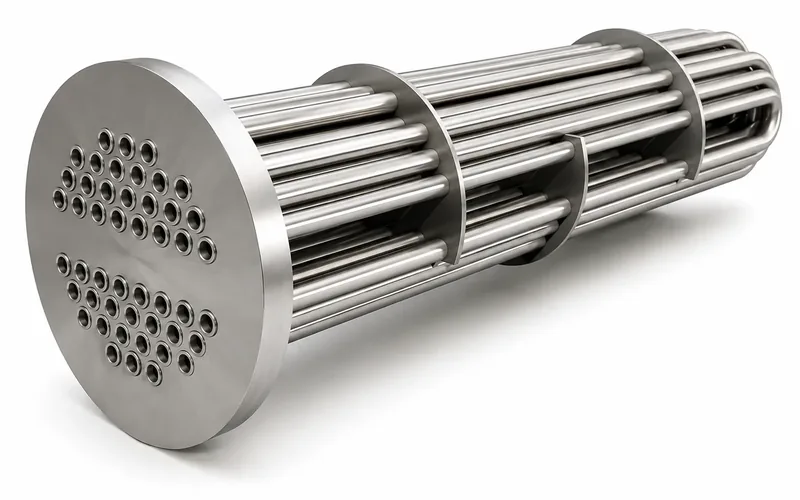
Two points come up on every project. The first is the bend interior, which can not be reliably electropolished or verified; where every product-contact surface must carry an electropolished designation, run the high-purity fluid shell-side. The second is drainability, which on a horizontal U-tube unit depends on shell slope and nozzle placement rather than on the bundle itself.
Both are straightforward to resolve at design stage and awkward to resolve afterward, which is the argument for settling them before fabrication rather than during qualification.
BPE Compliance Specifics
SF1 for most pharmaceutical process duty, SF4 where the loop is hot, continuously circulating high-purity water. SF1 is a mechanically polished product-contact surface at 20 microinch Ra maximum; SF4 is electropolished at 15 microinch Ra maximum, and the two are not interchangeable even though the numbers sit close together. The common specification error is writing SF4 on every wetted surface of a unit with product in the tubes, which the bend interiors can not meet. On such a unit, specify SF4 for the surfaces that can be processed and verified and SF1 for the tube bores, and say so on the data sheet so the certification can be checked line by line.
No. BPE governs product-contact surfaces, and a utility side carrying plant steam, chilled water or glycol falls under ASME Section VIII alone. On a tube-side product unit the shell interior, baffles and tube exteriors can be mill-finish 304L with ordinary weld examination, which cuts the fabrication cost of the shell considerably. Write the specification so it names which surfaces are product contact and which are not, rather than applying BPE to the whole exchanger. Where the utility is clean steam feeding a sterilization step, it is itself a product-contact service and both sides carry the designation; that is the case people miss in the other direction.
Only the light straw discoloration at the low end of the BPE color acceptance criteria; the darker blue and gray bands are rejected on product-contact welds. Heat tint is chromium pulled out of the parent metal into a surface oxide during welding, and the band beneath it is chromium depleted, so it is the first place a hot water loop rouges and the first place a passivation audit fails. The fix is a controlled purge with the oxygen level verified before each weld, not pickling afterward, which strips the color but cuts into the metal. Ask for the purge records with the weld map; a weld pickled clean and a weld made clean are different things on the certificate.
A welded joint on the product-contact face, finished and examined as a product-contact weld, with no crevice left between tube and hole. A rolled-only joint leaves an annular gap behind the roll where product sits unswept, which is exactly the condition the standard exists to remove. In practice the tube is expanded for contact, seal welded at the face, and the weld is blended so the tubesheet face can be cleaned and its finish verified. On a double tubesheet unit only the tubesheet facing product carries the BPE finish; the one facing the interspace is treated as non-product-contact. Expect those welds to appear on the weld map individually, each tied to a procedure and a welder qualification.
Related
U-TUBE • CONSTRUCTION
WFI & Pure Steam U-Tube
Double tubesheets and electropolished 316L.
+ Learn More