
1-805-484-2992
Quotes - Engineering - SalesU-Tube Heat Exchangers For
Rolled vs Seal-Welded Tube Joints
U-Tube Duty
The tube-to-tubesheet joint is where most exchanger leaks start. Choosing how to make it is a decision about pressure, cycling, cleanability and whether you ever intend to retube.
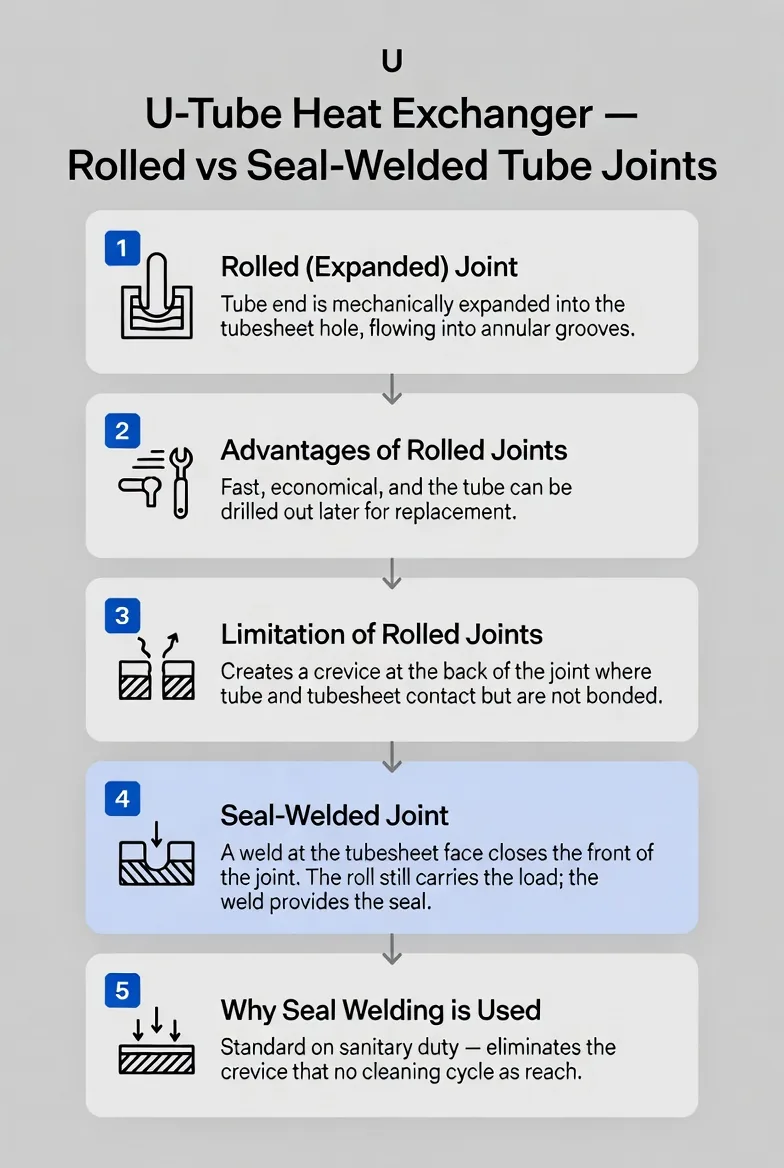
Rolled (expanded). The tube end is expanded mechanically into the tubesheet hole, which usually carries annular grooves that the tube material flows into. It is fast, economical, and it can be drilled out later so the tube is replaceable. The limitation is the crevice at the back of the joint where tube and tubesheet are in contact but not bonded.
Seal welded. A weld at the tubesheet face closes the front of the joint. The roll still carries the mechanical load; the weld provides the seal and eliminates the crevice at the wetted face. This is the standard arrangement on sanitary duty, where a crevice no cleaning cycle reaches is unacceptable.
The Crevice Problem. Behind a rolled-only joint, tube and tubesheet touch without being bonded. That gap is microscopic and it is enough. Process fluid enters, sits stagnant, concentrates and attacks. On sanitary duty it is a place cleaning agents never reach.
A seal weld at the face closes it from the wetted side. That is why sanitary and pharmaceutical specifications require seal welding regardless of the pressure, where an industrial specification at the same pressure might accept a rolled joint quite happily.
Roll plus seal weld. The common middle ground on industrial duty: a full roll for mechanical strength and a seal weld for tightness and crevice elimination.
Request a Quote



Three Ways to Make the Joint
The tube-to-tubesheet joint is where most exchanger leaks start. A rolled joint carries the mechanical load and can be drilled out for retubing, but leaves a crevice at the back where tube and tubesheet touch without bonding. A seal weld at the face closes that crevice from the wetted side, which is why sanitary specifications require it irregardless of pressure.
Rolled (Expanded)
Seal Welded
Roll Plus Seal Weld
Related
TUBESHEETS & JOINTS • DESIGN
Single Tubesheet Design
Why one is enough, and what sets its thickness.
+ Learn More
TUBESHEETS & JOINTS • DESIGN
Double Tubesheet Design
Interspace, venting, drainage and leak detection.
+ Learn More
TUBESHEETS & JOINTS • DESIGN
Gaskets & Sealing
Gasket material and bolt torque sequence.
+ Learn More