
1-805-484-2992
Quotes - Engineering - SalesU-Tube Heat Exchangers For
Gaskets and Sealing
U-Tube Duty
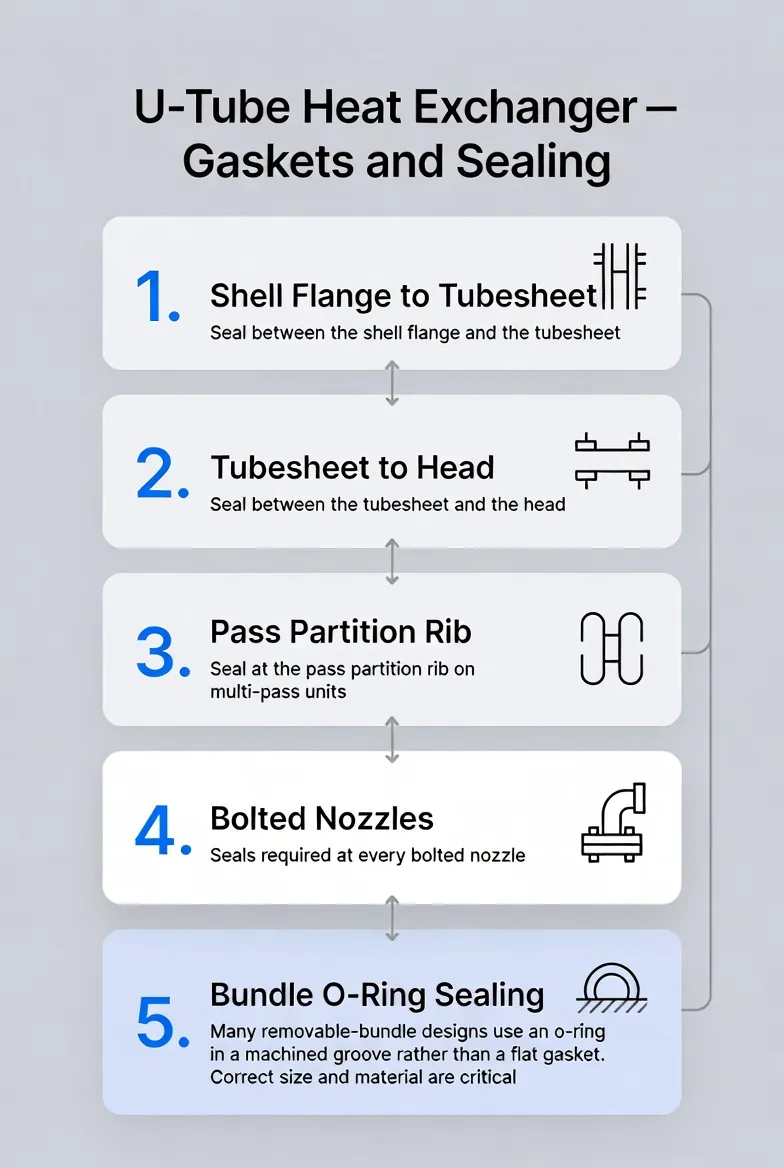
Sealing a removable bundle means gaskets, and gaskets are the components most often got wrong during maintenance. Material, thickness and torque all matter, and all three are easy to get casually wrong.
A U-tube exchanger seals in several places: between the shell flange and the tubesheet, between the tubesheet and the head, at the pass partition rib on multi-pass units, and at every bolted nozzle.
Bundle sealing. On many removable-bundle designs the tubesheet is sealed with an o-ring in a machined groove rather than a flat gasket. That arrangement seals well and is sensitive to o-ring size and material, which is why the correct part should come with the bundle.
Thickness Changes More Than You Expect. A gasket of correct material but different thickness alters the compressed stack height. That changes bolt load, and on a bundle it can change the axial position of the tubesheet relative to the shell.
Small position changes matter when nozzle-to-baffle alignment is tight. It is a genuine cause of performance loss and of leaks that no one can explain, and it is entirely avoidable by using the specified part.
Torque sequence. Bolted joints are tightened in a crossing pattern in stages, not around the circle in one pass. Doing it wrong cocks the flange and loads the gasket unevenly, and it is the most common installation error on serviced exchangers.
Request a Quote



Where a U-Tube Exchanger Seals
A U-tube exchanger seals between the shell flange and the tubesheet, between the tubesheet and the head, at the pass partition rib on multi-pass units and at every bolted nozzle. Gaskets are the components most often got wrong during maintenance: material, thickness and torque all matter, and the correct part should come with the bundle.
Sealing Points
Material & Thickness
Installation
Related
TUBESHEETS & JOINTS • DESIGN
Single Tubesheet Design
Why one is enough, and what sets its thickness.
+ Learn More
TUBESHEETS & JOINTS • DESIGN
Double Tubesheet Design
Interspace, venting, drainage and leak detection.
+ Learn More
TUBESHEETS & JOINTS • DESIGN
Rolled vs Seal-Welded
Crevices, retubing, pressure and cycling compared.
+ Learn More