
1-805-484-2992
Quotes - Engineering - SalesU-Tube Heat Exchangers For
Double Tubesheet Design
U-Tube Duty
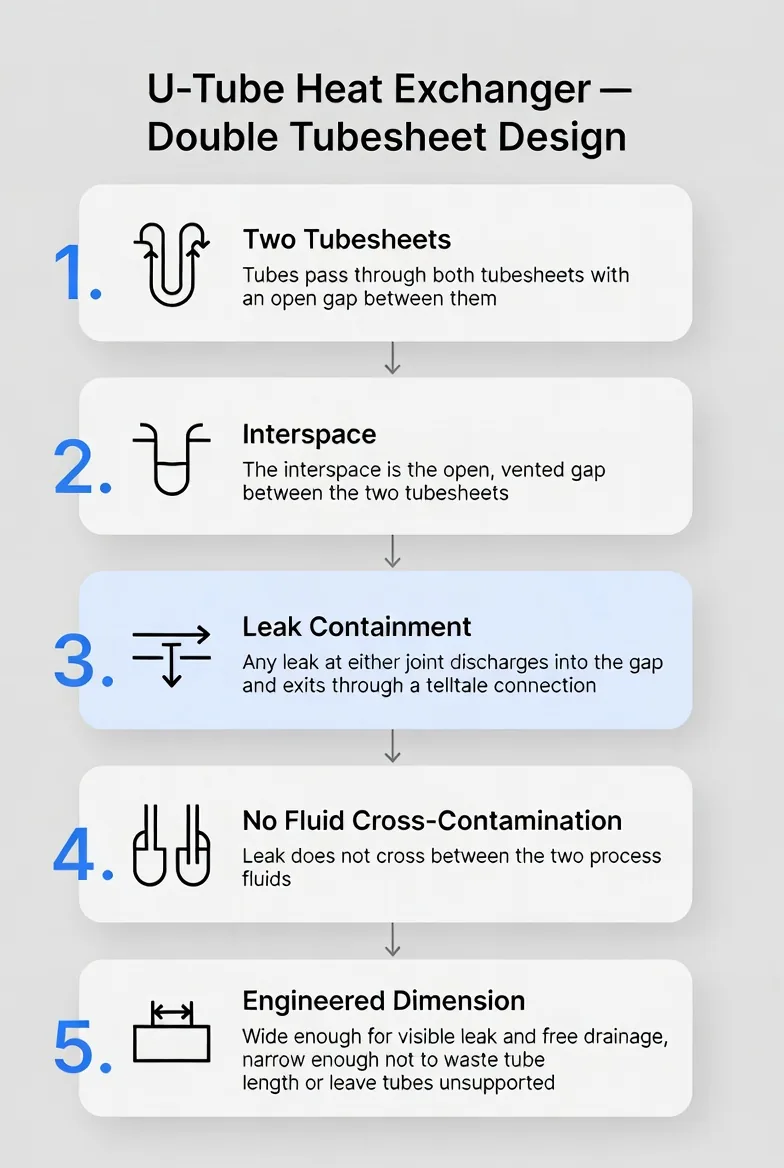
Two tubesheets with an open gap between them. Simple in concept, and the detail that decides whether it works is the interspace: how wide, how vented, how drained and how monitored.
The interspace is the open, vented gap between the two tubesheets. Tubes pass through both. Any leak at either joint discharges into that gap and leaves through a telltale connection rather than crossing between the two fluids.
Dimension. Wide enough for a leak to be visible and to drain freely, narrow enough not to waste tube length or leave the tubes inadequately supported. It is an engineered dimension rather than a standard one.
Choosing a Detection Method. An open telltale checked on rounds suits duty where a slow leak found within a shift is acceptable. Where it is not, the interspace can be instrumented, and the sensor should match the leak you are actually worried about.
A conductivity probe responds quickly to an aqueous leak and slowly to clean condensate. A level switch needs enough accumulation to trip. A pressure transmitter on a closed interspace responds fastest but requires a sealed design rather than an open one, which is a different exchanger.
Thermal behavior. The tube section in the interspace is exposed to ambient air rather than to either process fluid, so it sits at an intermediate temperature and is unrestrained. On duty with heavy thermal cycling this affects the design of the gap and the joint detail.
Request a Quote


How the Interspace Works
Two tubesheets with an open, vented gap between them; the tubes pass through both. A leak at either joint discharges into the interspace and leaves through a telltale rather than crossing between the two fluids. The gap is an engineered dimension, and the detection method should match the leak you are actually worried about.
The Interspace
Detection
Thermal Behavior
Related
TUBESHEETS & JOINTS • DESIGN
Single Tubesheet Design
Why one is enough, and what sets its thickness.
+ Learn More
TUBESHEETS & JOINTS • DESIGN
Rolled vs Seal-Welded
Crevices, retubing, pressure and cycling compared.
+ Learn More
TUBESHEETS & JOINTS • DESIGN
Gaskets & Sealing
Gasket material and bolt torque sequence.
+ Learn More