
1-805-484-2992
Quotes - Engineering - SalesU-Tube Vapor Condensers
Noncondensable Gas, Drainage and the Condensing Curve
A condenser is not a cooler that happens to handle vapor. Latent heat, a moving condensate film and any gas that refuses to condense make it a distinctly different design problem, with more ways to disappoint.
Condensation releases latent heat at a high rate, so condensers achieve large duties in modest volumes. That is the good news. The complications are all about what happens at the surface, and a condenser that meets its calculated duty and fails in service almost always fails for one of three reasons.
Noncondensable gas blankets the surface. Whatever will not condense is swept toward the condensing surface and stays there, forming a barrier the vapor has to diffuse through. Even a few percent by volume can cost a large share of the coefficient. Venting is not an accessory on a condenser; it is part of the design, and the vent has to be sized for the gas load the process actually produces rather than for the load the datasheet assumed.
Vent from the cold end. Noncondensable gas concentrates where the vapor has largely condensed away, which is the coldest part of the path. That is where the vent belongs. A vent placed where the piping was convenient removes useful vapor and leaves the blanket exactly where it was, and it is among the most common condenser design errors we see.
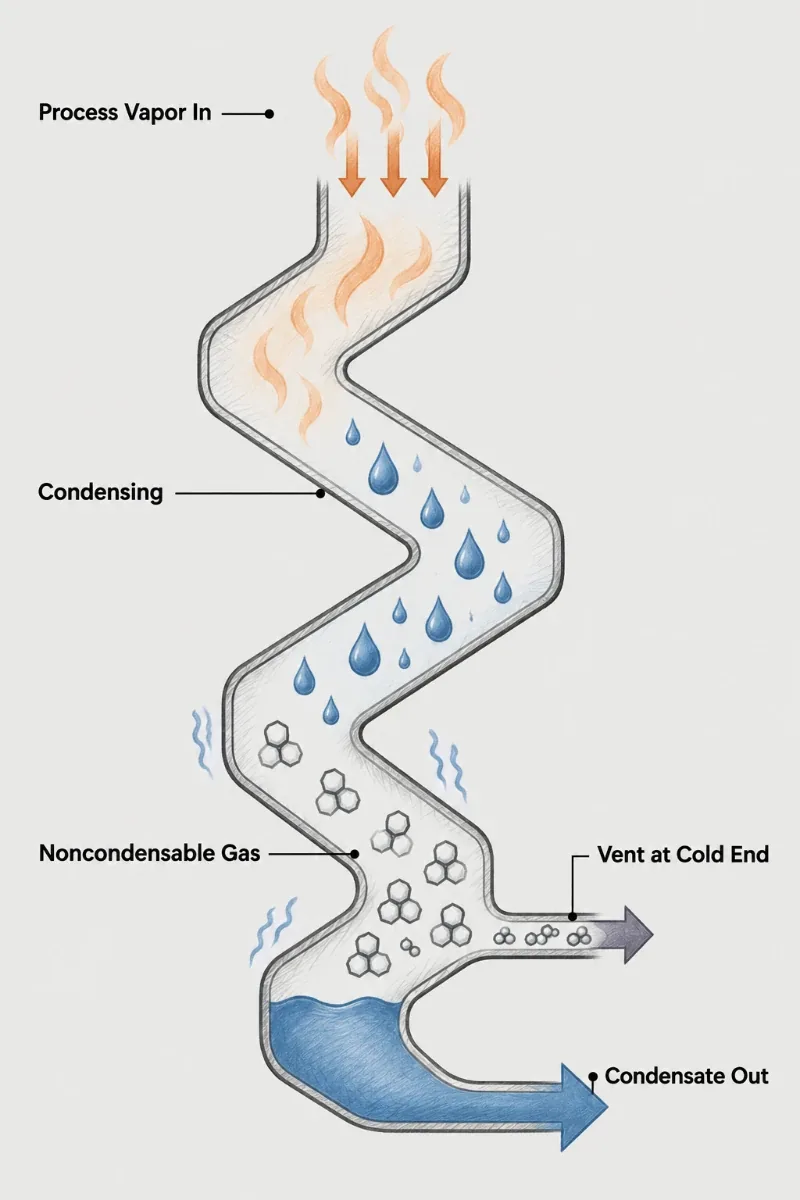
Vent from the coldest point in the condensing path, where noncondensables concentrate. A vent placed for piping convenience removes vapor and leaves the gas blanket behind.
Request a QuoteVapor Condensing

Design Notes
Flooding looks exactly like fouling. When condensate cannot drain freely it backs up into the bundle and covers surface. Performance falls gradually, the approach widens, and everything points to a fouled exchanger. Before pulling a bundle on a condenser that has lost performance, check the seal leg or trap, the back pressure and whether the unit can vent. On clean condensing duty, flooding is far more likely than genuine fouling.
The condensing curve is not a temperature. A multicomponent vapor condenses across a range rather than at a single point. Treating it as one temperature overstates the driving force and undersizes the exchanger, sometimes badly. The rating needs the curve, and where subcooling of the condensate is required, that duty is specified and rated separately rather than assumed to come free.
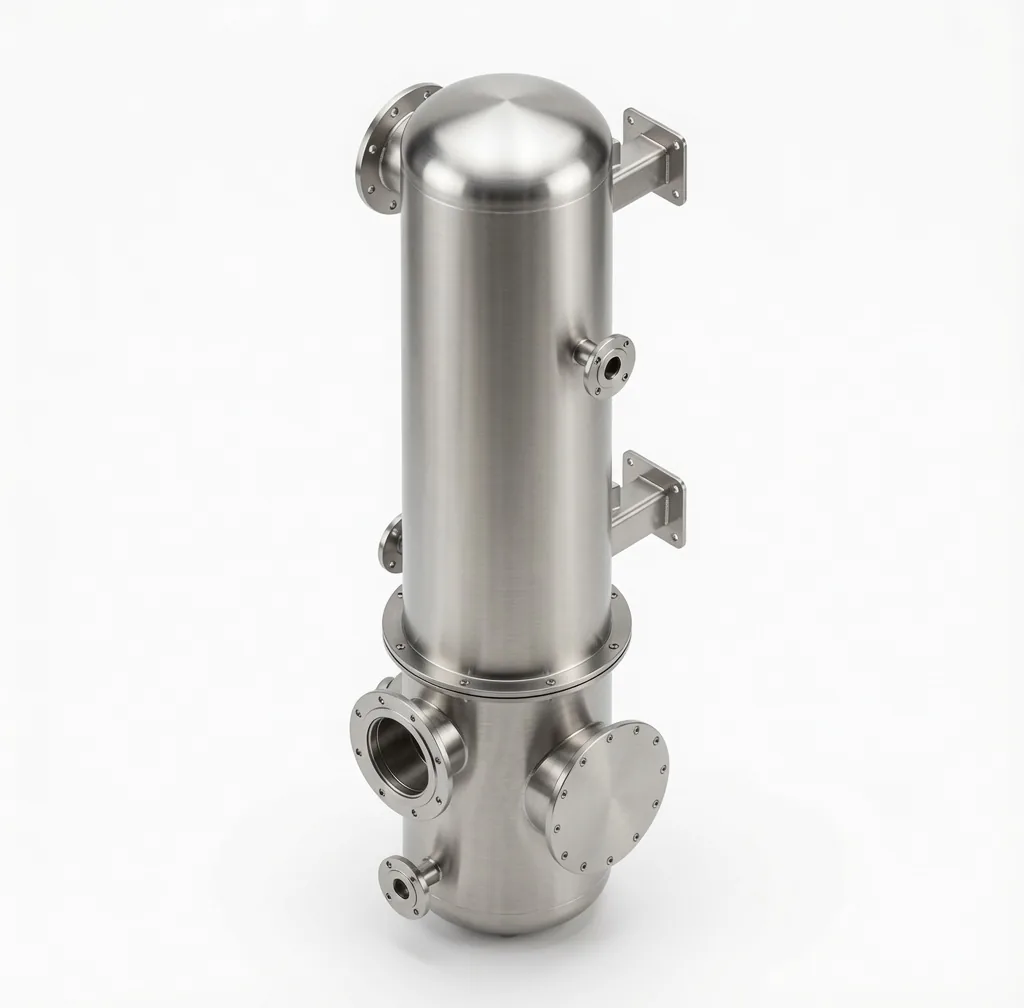
Orientation is fixed before rating, not after. Gravity governs how the condensate film behaves, so a condenser rated horizontally and installed vertically will not perform as calculated. Vertical mounting drains by gravity and self-vents at the top, which is why it dominates hygienic and reflux duty; horizontal suits large shell-side condensing where vapor volume is high.
Related pages: reflux and column overhead duty, vertical mounting, shell selection and gas cooling. Condensing duty is covered in considerably more depth on our sister site VaporCondensers.com.
Condensing Duty Answers
Yes, on any condenser that drains by gravity: a loop seal or a trap holds a liquid level that stops vapor blowing through the drain. The seal height has to exceed the shell-side pressure drop plus whatever back pressure the condensate line adds, and a seal sized for the design rate blows at startup when the pressure drop is highest. Give the leg a generous margin over the calculated height, and vent the top of the leg so it cannot siphon the shell dry. On a vertical U-tube unit the seal starts at the bottom head drain, so note the drain nozzle elevation on the inquiry.
At the absolute pressure in the shell, not the gauge reading, because saturation temperature and vapor density both fall sharply under vacuum. At low absolute pressure the vapor volume is enormous, so inlet nozzles and shell-side flow areas are sized for velocity first and surface second. Any pressure drop through the bundle lowers saturation temperature further and cuts the driving force, which is why vacuum condensers use wide baffle spacing or none. The vent connects to the ejector or vacuum pump at the cold end, with the air leakage rate stated on the inquiry rather then guessed.
Steam carries a latent heat near 970 BTU/lb and condenses with a high coefficient, so a steam condenser is compact and the cooling-water side controls. Organic vapors carry far less latent heat per pound, so a condenser handling them moves more mass through the bundle for the same duty and the condensate film resistance starts to matter. Multicomponent organics also condense across a range, so the rating uses a curve. Material changes too: steam service tolerates copper and carbon steel, where organic overheads often call for stainless or better.