
1-805-484-2992
Quotes - Engineering - SalesU-Tube Heat Exchangers For
Titanium and Copper-Nickel Construction
U-Tube Duty
Seawater defeats most alloys eventually. Titanium ignores it entirely. Copper-nickel handles it well within a velocity band that has to be respected in both directions.
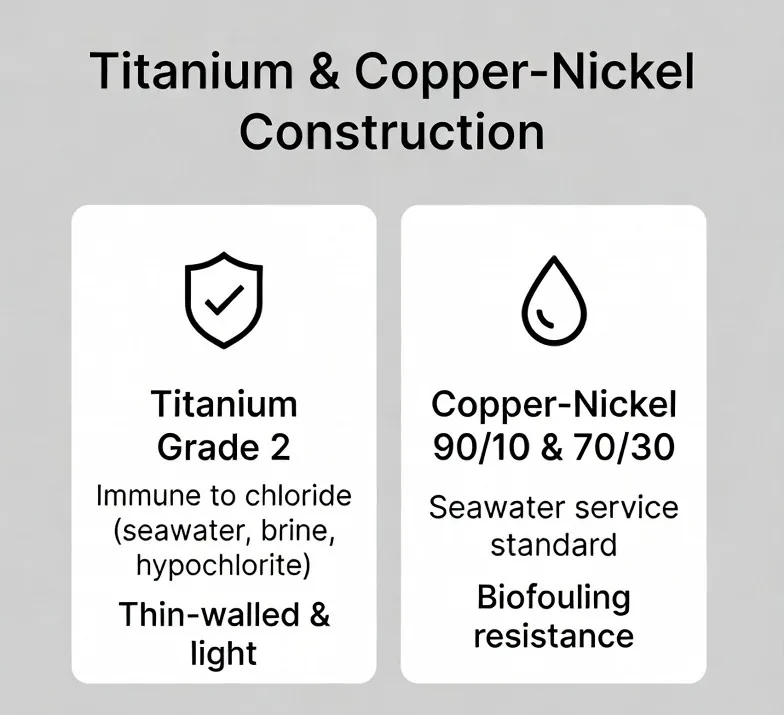
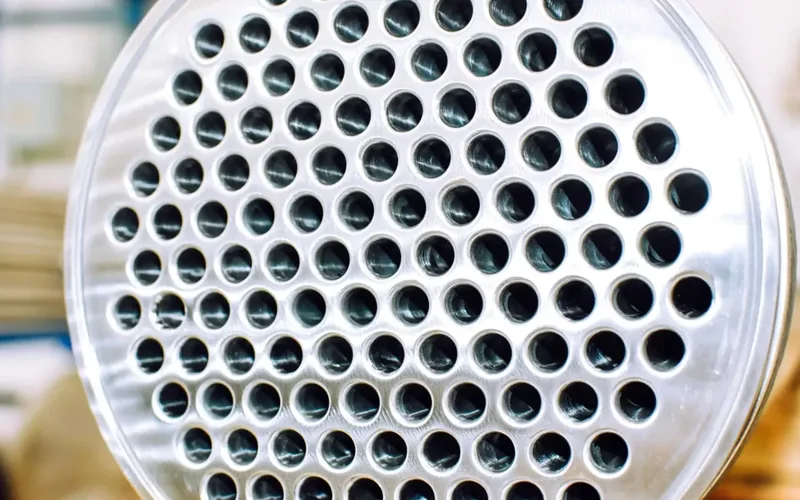
Titanium Grade 2. Effectively immune to chloride attack including seawater, brine and hypochlorite, at any concentration and across the temperature range these exchangers see. It is thin-walled and light, so the cost per square foot is considerably less punishing than the price per pound implies.
Copper-nickel. 90/10 and 70/30 alloys have long been standard in seawater service, and they carry a genuine advantage in biofouling resistance because copper ions discourage marine growth. The constraint is velocity: too high and the protective film erodes away, too low and deposits form and cause under-deposit attack.
Velocity Is the Copper-Nickel Constraint. Copper-nickel relies on a protective surface film. Exceed the alloy's velocity limit and that film erodes faster than it reforms, producing erosion-corrosion that concentrates at tube inlets and at any local turbulence.
Run too slow and the opposite problem appears: deposits settle, and corrosion proceeds underneath them where the film cannot maintain itself. The result is a design window rather than a maximum, and it has to be checked against turndown as well as design flow.
Galvanic care. Titanium is noble relative to almost everything, so pairing it with carbon steel or copper alloys in a wetted joint accelerates attack on the less noble metal. Tubesheet material and any sacrificial protection have to be considered together with the tube choice.
Request a Quote



Two Answers to Seawater
Seawater defeats most alloys eventually. Titanium ignores it entirely; copper-nickel handles it well within a velocity band that has to be respected in both directions. Titanium is noble relative to almost everything, so the tubesheet material and any sacrificial protection have to be considered together with the tube choice.
Titanium Grade 2
Copper-Nickel 90/10 & 70/30
Galvanic Care
Related
MATERIALS & FINISHES • DESIGN
304L & 316L Stainless
Where each fits, and the chloride cracking limit.
+ Learn More
MATERIALS & FINISHES • DESIGN
Carbon Steel
Shells, tubes, corrosion allowance and coatings.
+ Learn More
MATERIALS & FINISHES • DESIGN
Duplex & High Alloys
2205, Alloy 20, Hastelloy and how each bends.
+ Learn More